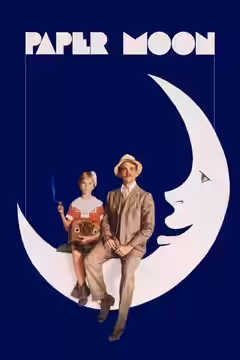
Madeline Kahn played women putting on a voice, and let us hear the strain under it. For Bogdanovich and Brooks in the 1970s that was the funniest and saddest thing on screen; few films gave her more than a stretch to do it in.
Fi1m perspective
Trixie Delight gets out of a car at a carnival in Paper Moon (1973) with a maid, a plan and an accent from somewhere grander. That is the Madeline Kahn performance in one entrance. The voice is all breath and pretended refinement, pitched a shade higher than she can hold, and the comedy is in watching her hold it anyway. Then Bogdanovich puts her on a hillside and gives her a speech, the refinement goes, and what is left is a tired woman who knows how long her luck lasts. It is sad without the film pointing at it, and it stung more than we expected after an hour of laughing at her.
She came from the stage, with a trained voice, and the films used both. Bogdanovich cast her first, as Eunice Burns in What's Up, Doc? (1972), then Mel Brooks took her for a run of spoofs: Lili Von Shtupp, the saloon singer in the Dietrich manner, in Blazing Saddles (1974); Elizabeth, the doctor's prim fiancée, in Young Frankenstein the same year; then High Anxiety (1977) and History of the World: Part I (1981). Four films with Brooks, three with Bogdanovich, with Gene Wilder and Eileen Brennan recurring beside her. The Brooks films were broad enough that she could sing, parody and fall over in a single number without it looking like work.
What she did that nobody around her did was put two or three feelings into the same line. Seduction, exhaustion and absurdity arrive together, and she never tells us which one is the joke. The brassiness was always a front, and she let the fright or the calculation behind it show for a second before the next gag covered it. That is why Trixie's hillside works and Lili's number is the one people remember: the woman doing the act is more interesting than the act.
The limits were the parts, not the actor. She was cast as flighty for three decades, and her filmography has more than one picture, At Long Last Love (1975) among them, that critics disliked while noting she was the best thing in it. Even Paper Moon, which we rate highly, slackens during her stretch while the picture waits in a hotel for two women to settle who owns the man. She said herself "I find being funny very hard work," and some of that strain is what she showed us.
Later came Mrs White in Clue (1985), with an improvised monologue about flames still singled out, and Gorgeous Teitelbaum on Broadway in The Sisters Rosensweig (1993), a quieter part. Her last film, Judy Berlin (1999), used her in a subdued key she was rarely offered. Start with Paper Moon, for the entrance and the hillside, then the two Brooks films of 1974; after that, she is usually the reason to look a film up.
Biography
Madeline Kahn (née Wolfson) was an American actress, comedian and singer. She was born on 29 September 1942 in Boston, Massachusetts, and died on 3 December 1999 in New York City. She appeared as Trixie Delight in Paper Moon (1973), Elizabeth in Young Frankenstein (1974) and Lili Von Shtupp in Blazing Saddles (1974).
Kahn trained at Hofstra University, graduating in 1964 with a degree in speech therapy. She made her Broadway debut in Leonard Sillman's New Faces of 1968. She received Tony Award nominations for In the Boom Boom Room (1974), On the Twentieth Century (1978) and a revival of Born Yesterday (1989), and won the Tony Award for Best Actress in a Play for The Sisters Rosensweig (1993). She also won a Daytime Emmy Award in 1987.
Her other film roles include What's Up, Doc? (1972), High Anxiety (1977), History of the World: Part I (1981), Clue (1985) and voice work in An American Tail (1986) and A Bug's Life (1998).