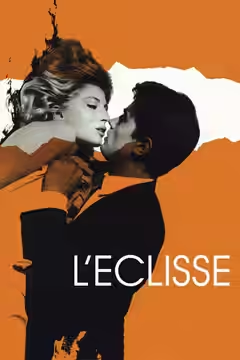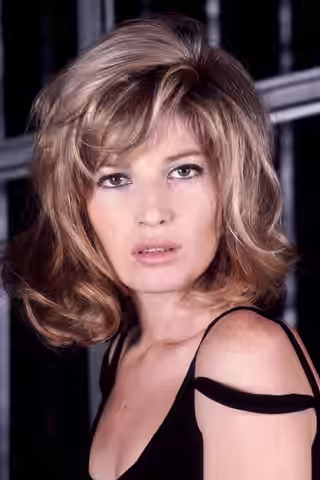
Vitti spent four films with Antonioni standing still in empty rooms, and from 1968 she was funny in Italian comedies for years. Both were the same actor. Start with Antonioni; the comedies are where the rest of her is.
Fi1m perspective
The scene to start with is one in L'Eclisse (1962) in which nothing happens. Vittoria has left one man and not yet found another, and on her way home at night she follows a dog, and Vitti lets us see that she is enjoying it. Antonioni's films are known for long silences and people standing a long way apart, and she supplied both, but what she added was this: a woman who is bored and unhappy and also, plainly, amused by herself. Without that the films would be architecture.
She made four with him between 1960 and 1964, L'Avventura (1960), La Notte (1961), L'Eclisse and Red Desert (1964), and they made her known far beyond Italy. In them she plays modern women who say little and are placed with great care against white walls, factories and half-built suburbs. Gianni Di Venanzo shot her in L'Eclisse in flat hard daylight so that her black dress is often the only dark thing in the frame; Carlo Di Palma photographed her four times. Her own account of the working method was unsentimental: "Michelangelo treats his actors as objects, and it is useless to ask him the meaning of a scene or a line of dialogue." Whatever he was doing, it worked. On screen she looks like the only person in the film who is thinking.
Then, from 1968, she did what actors who have been called the face of alienation do not usually do. She was funny on purpose. The Girl with a Pistol (1968), for Mario Monicelli, changed what Italian audiences thought she was, and Dramma della gelosia (1970), for Ettore Scola, opposite Mastroianni and Giannini, was a success at home. She worked again and again with Monicelli, Scola and Alberto Sordi, and the male comics she was paired with did not push her to the edge of the frame. The deep, hoarse voice and the face she had once been told was too irregular for films turned out to be comic equipment. Not all of it travelled. Modesty Blaise (1966) tried to sell her abroad as something she was not and did not take, and the comedies are still little seen outside Italy, so her reputation there stops in 1964, which is the wrong place to stop.
We have reviewed only L'Eclisse, so it must carry the weight, and it can. What moved us was small: she and Delon agree to meet again, and both look, for a second, as though they already know they will not. Nothing is said and everything is visible, and that is the whole of her work with Antonioni in one look.
After the comedies came Buñuel's The Phantom of Liberty (1974), one film as director, Scandalo segreto (1990), which was received quietly, and then she withdrew in the 1990s. Watch L'Eclisse first and give it the patience it asks for. Then find The Girl with a Pistol and watch the same woman, in the same decade, refuse to stand still.
Biography
Monica Vitti was an Italian actress. Born Maria Luisa Ceciarelli in Rome in 1931, she trained at the city's National Academy of Dramatic Art and graduated in 1953. She began her career on the stage before making her film debut in the mid-1950s.
She is best known for her leading roles in four films directed by Michelangelo Antonioni: Claudia in L'Avventura (1960), Valentina Gherardini in La Notte (1961), Vittoria in L'Eclisse (1962) and Giuliana in Red Desert (1964). After these collaborations she appeared in comedies and other films, including The Girl with a Pistol (1968) and The Phantom of Liberty (1974). Vitti died in Rome in 2022.