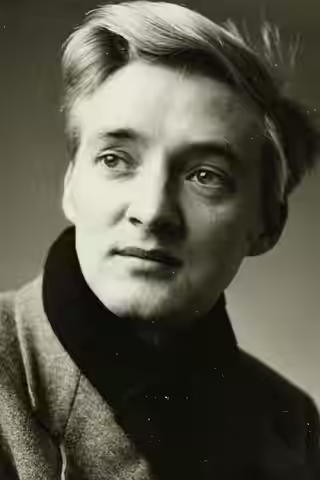
Oskar Werner had a clear, quiet voice and let his face do the thinking, and he spent both on men who were never sure of anything. His best decade was the 1960s, but start with Decision Before Dawn, where the performance happens before he speaks.
Fi1m perspective
In Decision Before Dawn (1951) Oskar Werner plays a German medic who has agreed to go back behind his own lines and report on his own army, and almost nothing he does is in the dialogue. It is in the half-second before he answers a question, when a false name has to be found and put on, and in the way he thanks people who could have him shot. Then the voice arrives, light and clear and in no hurry, and it is the thing everyone who writes about him ends up writing about. The face and the voice together let him play men who are thinking while everyone around them is acting.
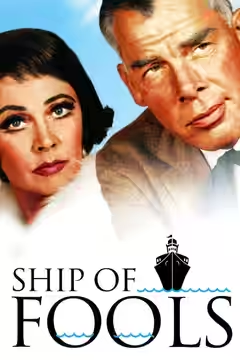
He came from the Burgtheater in Vienna, which he joined at eighteen as its youngest member, and he never quite left the stage behind. Fox brought him over for Decision Before Dawn and he went home when the contract ended. A decade passed. Then François Truffaut cast him as Jules in Jules and Jim (1962) and for a few years he was the European actor everybody wanted: Dr Schumann, the ship's doctor in Ship of Fools (1965), Fiedler the East German interrogator in The Spy Who Came In from the Cold (1965), Montag the fireman in Truffaut's Fahrenheit 451 (1966). Four films in five years. After that he took fewer parts, and the ones he did not take became part of his reputation.
He specialised in the sensitive and the bookish, the man with a conscience he cannot switch off, and nobody cast him to hit anyone. It is a narrow strip of ground and he farmed it well. The complaint, made mostly about his stage work in the seventies and eighties, is that the acting turned mannered, a recital for one. We cannot judge those evenings. What we can say is that on screen, in the film of his we have reviewed, he is still listening to the other actors, and that is where the performance lives.
Franz Planer puts him in medium shot before a wrecked station and lets the rubble behind him do the work, and the film is at its best when it trusts that. Hildegard Knef, as Hilde, gives him one scene of tired kindness, and he receives it like a man who had forgotten kindness was still available. We found that harder to watch than any checkpoint in the picture, because Werner does not play gratitude; he plays someone trying to remember how it is done.
He was, by most accounts, difficult, and selective to the point of vanishing. Start with Decision Before Dawn. If the voice has got you by the end of it, and it will, go on to the two Truffauts. He made fewer films than he might have, and he did not waste the ones he made.
Biography
Oskar Werner was an Austrian stage and film actor. Born Oskar Josef Bschließmayer in Vienna in 1922, he joined the Burgtheater at the age of 18, becoming one of its youngest members, and made his stage debut in 1941. He adopted the stage name Werner and appeared in early Austrian and German films before his first English-language role.
He gained international recognition in the 1960s with leading parts in Jules and Jim (1962), The Spy Who Came In from the Cold (1965), Ship of Fools (1965) and Fahrenheit 451 (1966). His film work also included Decision Before Dawn (1951), Lola Montès (1955), The Shoes of the Fisherman (1968) and Voyage of the Damned (1976). Werner maintained a parallel stage career, notably in productions of Hamlet.
He received an Academy Award nomination for Ship of Fools and other honours including a Golden Globe. Werner died in 1984.