Richard Brooks took big American novels and made them into loud, decent, well-built films that never trust the audience to notice a point without being told. At his best, with Burt Lancaster in Elmer Gantry, the telling hardly matters.
Fi1m perspective
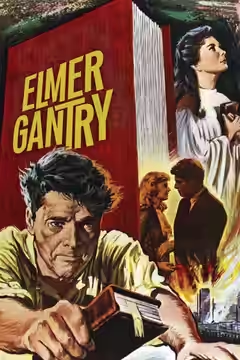
Watch the first sermon in Elmer Gantry (1960). Burt Lancaster gives it uninvited, from the floor of Sister Sharon Falconer's tent, arms out and teeth bared, leaning in as if he means to climb over the rail. Richard Brooks lets us see the wheels turning, and we laughed, and then noticed we had leaned forward. A scene or two later, somebody tells us what we have just watched. That is Brooks in one film: a gift for a big room and a crowd turning, and a habit of underlining it afterwards.
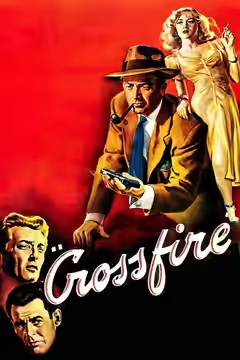
He came to films through journalism and radio, and through a novel. The Brick Foxhole, written while he was in the Marines, was about the murder of a homosexual man; when Edward Dmytryk filmed it as Crossfire (1947) the victim became a Jew, because one prejudice could be named on screen and the other could not. What survived was the mood, soldiers with nothing to do drinking through the evenings, and a taste for hard subjects that Brooks kept for the rest of his career. He wrote noirs for Mark Hellinger, Brute Force (1947) and Key Largo (1948), directed his first film, Crisis, at MGM in 1950, and broke through with Blackboard Jungle (1955). After that he mostly took on other people's books: Tennessee Williams in Cat on a Hot Tin Roof (1958), Sinclair Lewis in Elmer Gantry, Truman Capote in In Cold Blood (1967).
He was good with actors who could fill a room. Lancaster made three films with him, and Elmer Gantry gives him the part of his life, a fraud having a wonderful time whose pleasure is catching. The trouble is that Brooks the screenwriter did not trust Brooks the director. Lefferts is handed speeches that explain what we have just seen; the converts are played for laughs and then offered up for our sympathy; the second half turns to melodrama and the satire thins. The Brothers Karamazov (1958) has the same reputation, a large book made literal, and Lord Jim (1965) is generally counted a misfire. Brooks wanted control of script, cutting and direction, and got it, which meant nobody was left to tell him that a point made once does not need making again.
And yet the most tender thing in any film with his name on it is a speech in Crossfire, given by Sam Levene's Samuels in a single flashback, to a stranger, about men who have fought for years and do not know what to do with a quiet night. It moved us more than we expected, because Levene says it kindly and we already know what is going to happen to him. Brooks did not direct that one; it is his book in someone else's hands, and it does not stop to explain itself. Start with Elmer Gantry for Lancaster and Crossfire for that scene, and forgive the second half of the first, which will not stop explaining.
Biography
Richard Brooks (born Reuben Sax, 18 May 1912 – 11 March 1992) was an American screenwriter, film director and novelist. Born in Philadelphia, Pennsylvania, he attended Temple University before working as a journalist and radio commentator. He served in the US Marine Corps during the Second World War and wrote the novel The Brick Foxhole (1945), which was adapted as the film Crossfire (1947).
Brooks began directing feature films in 1950. His notable credits as writer and director include Blackboard Jungle (1955), Cat on a Hot Tin Roof (1958), Elmer Gantry (1960), for which he won the Academy Award for Best Adapted Screenplay, The Professionals (1966) and In Cold Blood (1967). He received eight Academy Award nominations in total and has a star on the Hollywood Walk of Fame.