Film review

Crossfire

1947 · Directed by Edward Dmytryk · 1h 26m · MPA NR

In a sentenceThree Roberts, one dead man, and not a single room with the lights on

CrimeMysteryThriller

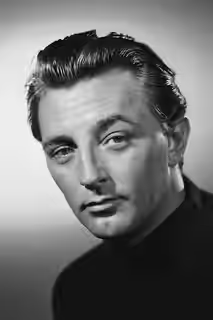
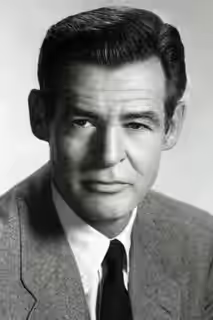
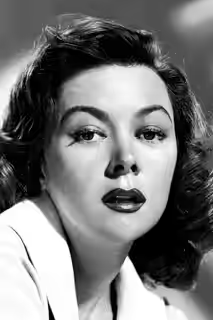
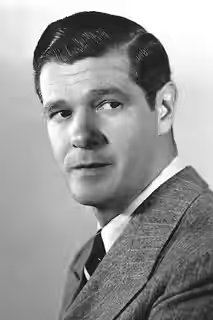
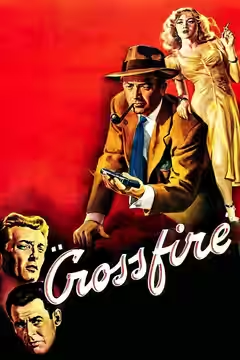
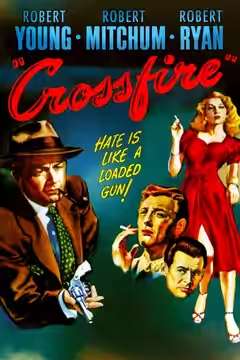
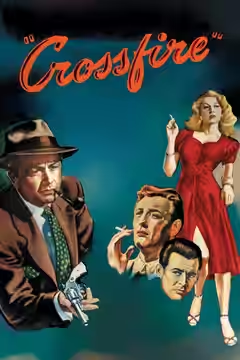
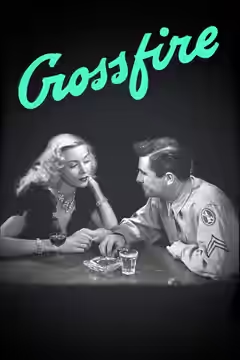
A man is beaten to death in a rented room, and we see it only as two shadows fighting on the wall. The dead man is Samuels (Sam Levene), a civilian who spent the evening drinking with a group of soldiers waiting to be demobilised. Police Captain Finlay (Robert Young) works the case through one hot night. The soldiers who were with him include Montgomery (Robert Ryan), who does most of the talking, Floyd (Steve Brodie), who has gone quiet, and Mitchell (George Cooper), who has disappeared. Sergeant Peter Keeley (Robert Mitchum) does not believe Mitchell is a killer and goes looking for him before the police find him. Mitchell’s wife Mary (Jacqueline White) arrives in town, and a dance-hall girl called Ginny (Gloria Grahame) turns out to have given the missing man a key to her flat.

Fi1m review

Edward Dmytryk’s cheap, fast thriller says out loud what American films in 1947 would not, and Robert Ryan makes the saying frightening. It stops to lecture more than it should, but at 86 minutes it does not have time to waste much of yours.

Edward Dmytryk’s Crossfire opens with a murder we do not quite see. Two shadows fight across the wall of a rented room, a lamp goes over, and a man is left dead on the carpet. What follows is a police investigation, but the film cares little about the mystery. It cares why the man was killed, and the answer is that he was Jewish. In 1947 that was a subject American studios did not touch, and Dmytryk, producer Adrian Scott and screenwriter John Paxton made a film about it in 86 minutes on sets that cost almost nothing. It is blunt, it moves, and it is still good.

Richard Brooks’s novel, The Brick Foxhole, was about the murder of a homosexual man; the film changed the victim to a Jew, because one prejudice could be named on screen and the other could not. What it keeps is the mood: a city full of soldiers with nothing to do, drinking through the evenings. Sam Levene plays Samuels, the dead man, in a single flashback, and he gets one speech, about men who have fought for years and do not know what to do with a quiet night. It is the best-written thing in it. It moved us more than we expected, because Levene delivers it kindly, to a stranger, and we already know what is going to happen to him.

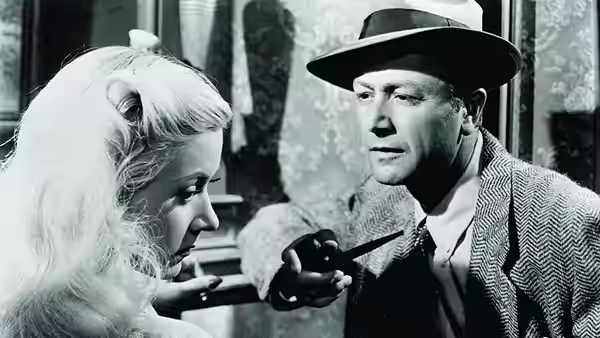
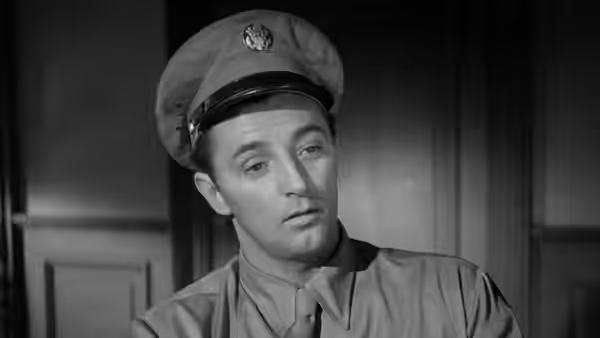
Robert Ryan plays Montgomery, the loudest of the soldiers, who says what he thinks and smiles while he does it. Ryan does not play a villain. He plays a man who believes he is being reasonable and cannot understand why people go quiet when he talks. We wanted him off the screen, and then realised that was the point: this is what it is like to share a bar with him. Robert Young’s Captain Finlay is the film’s conscience, and he is fine until the script gives him a lecture about hatred that runs long enough for us to start looking at the furniture. Robert Mitchum, as Sergeant Keeley, has the least to do of the three, and does it with the sleepy watchfulness that would keep him in work for decades.

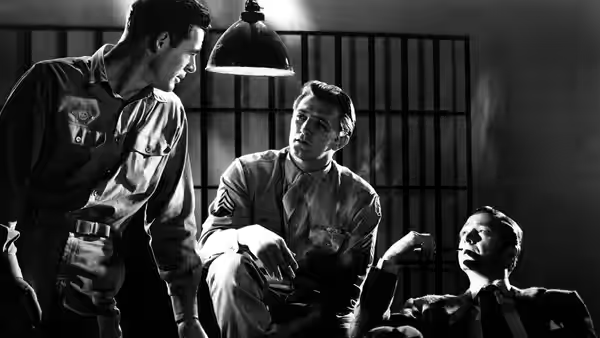
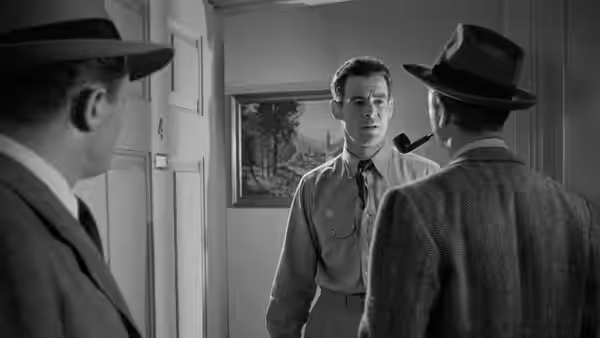
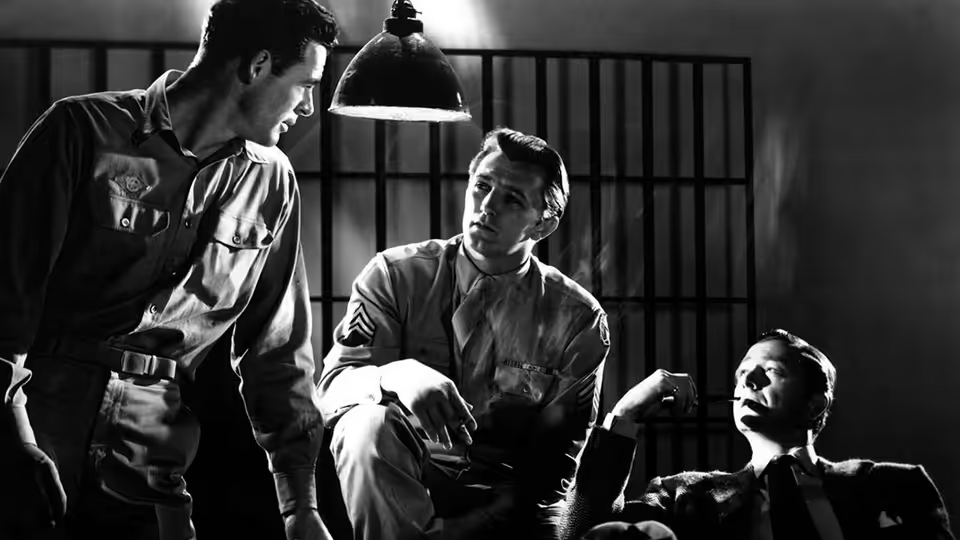
J. Roy Hunt shoots almost everything in the dark. Faces are lit from one side by a single lamp and everything else is allowed to vanish, which hides how small the sets were. When Finlay switches on a light, it is a plot point. Roy Webb’s score stays out of the way, rightly. Harry Gerstad’s editing handles the flashbacks so that we always know whose account we are watching, and the same evening is told from more than one angle without confusion.

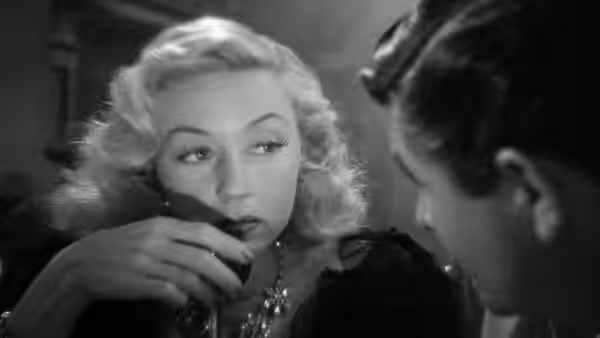
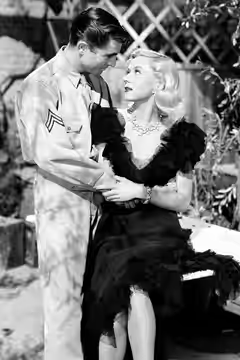
The strangest and best scene has almost nothing to do with the case. Gloria Grahame plays Ginny, the dance-hall girl, tired, in a dressing gown, with no interest in helping anyone. Then Paul Kelly walks in as a man who says he is her husband, then says he is not, then says he might be, and the film lets him talk for three minutes and never explains him. It is the one place where Paxton’s script stops making its argument and simply watches two damaged people. We would have taken another reel of it.

The mystery is not much of one. The film gives away who did it earlier than a whodunit would, and Dmytryk plainly does not care; neither did we. What we did mind was the talking. The point about hatred is made in speeches more than once, and the film gets a little worse each time. The women are thin: Jacqueline White’s Mary Mitchell gets one scene and wants only to be told her husband is a good man. Set beside Gentleman’s Agreement, the glossier film on the same subject, this one is uglier, quicker and more honest about the men saying these things, who wear the same uniform as everyone else.

The reviews so far are warm and we are with them. Watch it after dark, in one sitting, with the lamp off. Nobody in it ever turns on more than one light, and by the end you will understand why.
Critical consensus AI synthesised

74
Positive
6
Mixed
0
Negative
0

The reviews are uniformly favourable, and nearly all approach Crossfire the same way: as a thriller whose real business is anti-Semitism, said more bluntly than a studio picture of its period was expected to say it. Robert Ryan’s killer is the performance most critics single out, with Sam Levene and Robert Mitchum also praised. Edward Dmytryk’s use of a small budget is the other recurring point: several reviews note how cramped sets, low-key lighting and tilted angles turn poverty into tension.

The reservations are few and mild. The New York Times finds the exposition confusing in places and the dialogue heavy, and The New Yorker thinks the plot simple, with Variety agreeing that the murder mystery is incidental to the argument. The spread is otherwise narrow, with the 1947 notices and the recent reappraisals landing in much the same place; only Collider gives it top marks.

Film Comment
20 June 2026 · Michael Koresky
70*

The critic presents Crossfire as a potent postwar noir that confronts anti-Semitism through a murder investigation among GIs, delivering a bitter view of embedded national hate. It singles out the film's flashback structure, low-key lighting, and rich psychological portraits for making it a stylish social problem picture.

Read the full review →
The New Yorker
12 July 1947 · John McCarten
70*

The film takes a frank crack at anti-Semitism with blunt, shocking dialogue that makes it exciting despite a simple plot. Robert Ryan stands out as a brutal fascist, and Sam Levene gives an outstanding performance.

Read the full review →
The New York Times
23 July 1947 · Bosley Crowther
70*

Director Edward Dmytryk has crafted a stinging drama on tolerance with a superlative cast, including a frighteningly real Robert Ryan as the vicious murderer. Some confusing exposition and heavy talk slightly weaken the tension, but the film is thematically articulate overall.

Read the full review →
Time Out
13 December 2011 · TR
70*

This ultra-low-budget thriller broached a subject that respectable movies wouldn't touch: the racist murder of a Jew and the exposure of the murderer's fanatical anti-Semitism. Dmytryk exploits the poverty-row sets for their claustrophobic quality and introduces expressionist lighting and distorted angles to dramatise the tensions between the characters.

Read the full review →
Variety
31 December 1946 · Variety Staff
70*

The film is a hard-hitting spotlight on anti-Semitism whose whodunit elements are incidental to its thesis on bigotry. It features strong performances, especially from Robert Ryan as the bigoted killer, Robert Young, and Robert Mitchum.

Read the full review →
Collider
26 April 2025 · A+ · Jacob Slankard
100

The critic praises the film as a taut, exciting procedural noir that skillfully addresses postwar antisemitism and social anxiety through its literate script and strong performances. It singles out Robert Ryan's chilling portrayal of the hateful killer for particular note as a standout element.

Read the full review →

Cast

Awards

Academy Awards, 1948

Nominated
Best Director
Nominated
Best Picture
Nominated
Best Supporting Actor
Nominated
Best Supporting Actress
Nominated
Best Writing, Adapted Screenplay

If you liked this, try…

Gentleman's Agreement poster64

Gentleman's Agreement

1947 · The respectable version of the same subject, released the same year, with better suits and less menace

Act of Violence poster

Act of Violence

1948 · Robert Ryan again, this time as the man doing the hunting, and just as unsettling

In a Lonely Place poster

In a Lonely Place

1950 · Gloria Grahame given a whole film to be tired and clever in

Odd Man Out poster

Odd Man Out

1947 · One night, one wounded man, one city, shot in the same year and even darker

Bad Day at Black Rock poster

Bad Day at Black Rock

1955 · Small-town bigotry in colour and daylight, with Ryan once more the one to edge away from