Film review

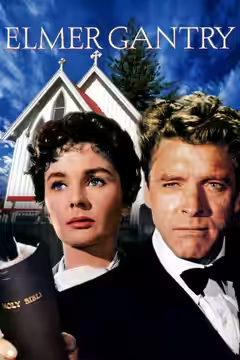
Elmer Gantry

1960 · Directed by Richard Brooks · 2h 26m · MPA NR

In a sentenceBurt Lancaster grins for two and a half hours and you keep reaching for your wallet

Drama

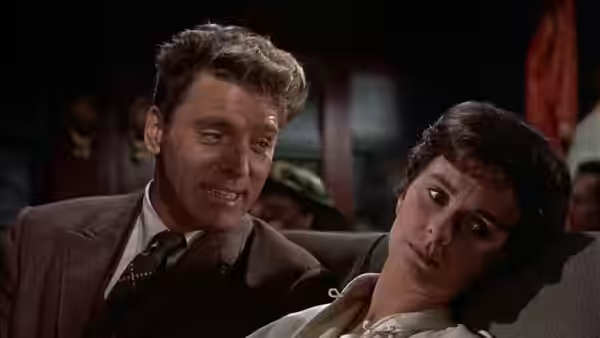
The American Midwest in the 1920s. Elmer Gantry (Burt Lancaster) is a travelling salesman with a sample case, a thirst and a memory full of scripture, which he uses to quiet a bar when the drinks run short. In a small town he wanders into the revival tent of Sister Sharon Falconer (Jean Simmons), an evangelist who fills the benches, managed by the careful William L. Morgan (Dean Jagger). Gantry wants Sharon, and the quickest route to her is the platform. He talks his way on to it and finds he is better at it than anyone in the tent. Jim Lefferts (Arthur Kennedy), a newspaperman following the show, waits for the con to show itself. Sharon has her eye on Zenith, and on the money there.

Fi1m review

Richard Brooks’s version of Sinclair Lewis’s novel gives Burt Lancaster the part of his life, a drinking, grinning salesman who discovers religion sells. The film around him is handsome and too long, and says everything twice, but the grin carries it.

Sinclair Lewis published Elmer Gantry in 1927 and it made a great many people angry. Richard Brooks, writing and directing, keeps the anger and much of the plot, and adds a love story Lewis would have sneered at. Elmer is a salesman who cannot hold a job, a drunk who can hold a room, and a man who knows every Bible verse that closes a sale. He walks into Sister Sharon Falconer’s tent and sees a woman he wants and a business he understands; the film is about those turning out to be the same thing. It runs 146 minutes, about twenty more than it needs.

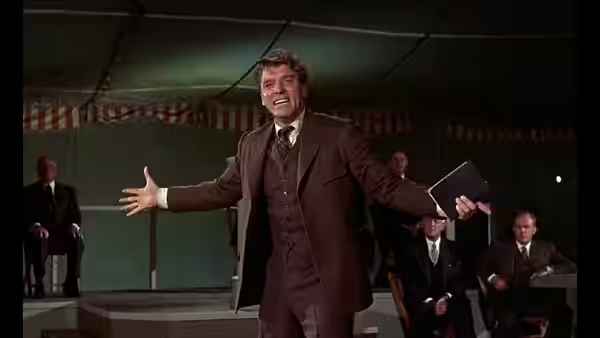
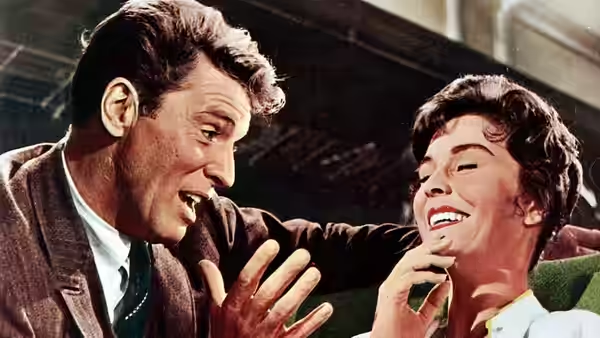
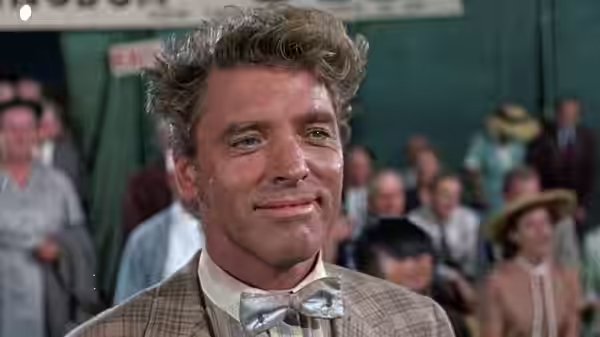
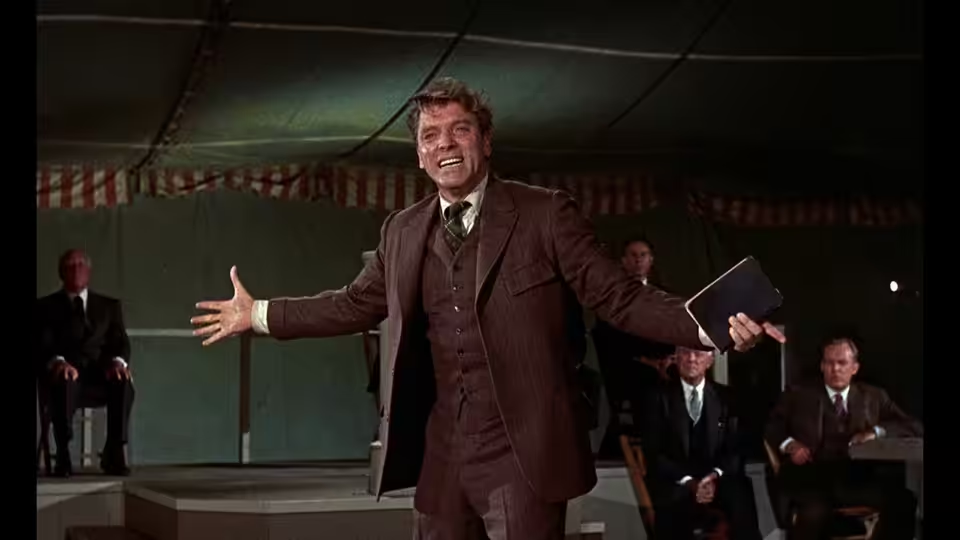
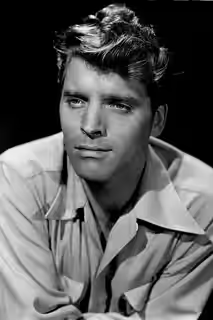
Lancaster is the reason to watch. He plays Gantry with his whole body, arms out, teeth bared, leaning into the congregation as if he means to climb over the rail. The first sermon he gives, uninvited, from the floor of Sharon’s tent, is the film’s best scene. We laughed at him, because Brooks lets us see the wheels turning, and then we noticed we had leaned forward. That is the trick: he is a fraud, he is having a wonderful time, and the pleasure is catching. Once or twice, in a hotel corridor, he lets us see there is nothing behind the grin but more grin.

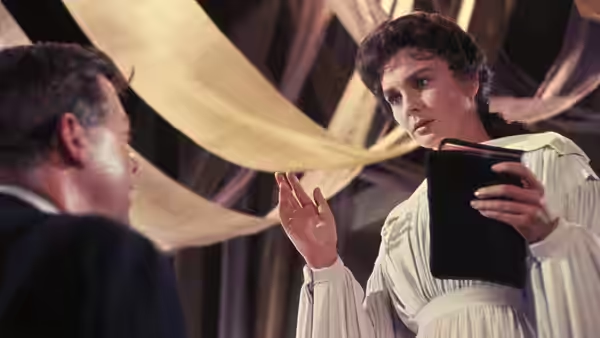
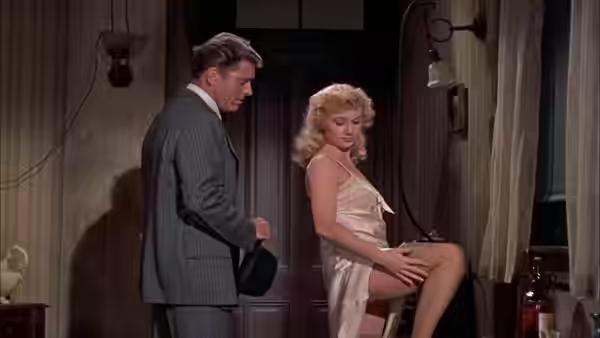
John Alton shoots the tent in colour, lantern light on faces and black canvas behind them, so the converts look lit from within and the sawdust aisle looks like a stage. He is better known for black and white, and he lets the dark do most of the work. Dorothy Jeakins puts Sharon in white from throat to hem and Gantry in loud checks and a straw hat, so that on the platform he looks like a bookmaker who has wandered into a christening. André Previn’s score is mostly brass and hymn tunes played slightly too fast. Marjorie Fowler cuts the sermons against the crowd, a farmer, a widow, a boy, and her rhythm as much as Lancaster’s makes the conversions feel like a sale being closed.

Jean Simmons is asked to do something harder: to play someone who might believe it. Her Sharon is not a fraud, or not a simple one, and Simmons keeps the question open. In one scene she tells Gantry, quietly, what she was before she was Sister Sharon, and it moved us more than we expected from a film this loud; Simmons plays it as a woman testing whether she can still say the words out loud. Arthur Kennedy’s Lefferts is a reporter who likes Gantry too much to destroy him and too little to leave him alone. Dean Jagger’s Morgan counts the collection and asks no questions. Edward Andrews, as George F. Babbitt, arrives with a cigar and a committee to explain what a revival is worth to Zenith’s shopkeepers. Shirley Jones turns up later as Lulu Bains, a woman with a claim on Gantry’s past, and is harder and better than anything else in that stretch.

The trouble is Brooks the screenwriter. Lefferts is given speeches that tell us what we have just watched, and the film cannot let a scene of hypocrisy pass without a character pointing at it. The converts are played for comedy more often than is kind: a woman throwing down her crutches, a drunk weeping into a hymn book. We laughed, then felt we had laughed at the wrong people; these are the marks, and the film wants our sympathy for them in the next scene. The second half turns to melodrama and the satire thins as the plot thickens.

Most critics rate it higher than we do, mostly for Lancaster. Brooks made Blackboard Jungle five years earlier and has the same gift here for a big room and a crowd turning, and the same habit of underlining. It is not as sharp as its source, and it knows less than Lewis did about how belief and money keep each other company.

Watch it for the tent scenes and forgive it the rest. When Lancaster gets up to preach, you will find yourself checking whether your wallet is still where you left it.
Critical consensus AI synthesised

83
Positive
6
Mixed
0
Negative
0

The reviews are unanimous in their approval, and the praise gathers almost entirely around Burt Lancaster. Most critics treat his conman evangelist as the reason the film works: a charmer whose sins the audience forgives because he is such good company. Richard Brooks’s direction and script come next, credited with pace, bite and a frankness about religious racketeering that several reviewers find bracing. John Alton’s colour photography and the supporting cast also draw praise.

The reservations are mild and cluster around depth. Time Out enjoys the film but thinks Brooks skims the surface of faith, corruption, sex and money, and The New Yorker, while admiring the indictment, never quite believes in the central characters. Empire notes the satire turns nastier as it goes, before a hellfire climax it admires. The spread is narrow: nobody dislikes it, and the argument is only over how much lies beneath the showmanship.

Radio Times
★★★★★ · Tony Sloman
100

The critic praises the perfect match of star and role with Burt Lancaster as the conman evangelist, along with brilliant supporting performances and John Alton's superb colour photography. Brooks's handling of the key scenes makes this a Hollywood classic and truly great movie.

Read the full review →
The New York Times
8 July 1960
90*

The film transforms Sinclair Lewis's novel into an exciting, briskly paced drama of a religious opportunist. It is a tribute to the artistry of Richard Brooks and a fine cast, capturing both the eye and mind as a living, action-packed screen study.

Read the full review →
Variety
31 December 1959 · Variety Staff
90*

Richard Brooks has framed a big story and bold subject with pungent pictorial imagery and frank, biting dialog. The production plays like a symphony building to a smashing crescendo, with Burt Lancaster delivering a memorable characterization as Gantry.

Read the full review →
Empire
1 January 2000 · Kim Newman
80*

The critic praises this adaptation of Sinclair Lewis's novel for its searing take on hypocritical evangelists, with Burt Lancaster's Oscar-winning performance as the charismatic, sinful preacher Elmer making the character entertaining despite his flaws. The film starts as biting satire but grows nastier, ending with an impressive hellfire climax.

Read the full review →
The New Yorker
9 July 1960 · John McCarten
70*

The film generates considerable excitement and presents a forceful indictment of religious racketeers, but it never quite succeeds in establishing the plausibility of its central characters. Brooks skillfully directs and honors the spirit of the source with sharp satire on Bible Belt promoters.

Read the full review →
Time Out
10 September 2012 · GA
70*

The critic finds it an entertaining and intelligent movie thanks largely to Burt Lancaster's magnetic performance as the charming charlatan. Brooks' script and direction do not delve deeply beneath the surface of its themes of faith, corruption, sex and money.

Read the full review →

Cast

Awards

Academy Awards, 1961

Nominated
Best Original Dramatic or Comedy Score
Nominated
Best Picture
Won
Best Actor
Won
Best Supporting Actress
Won
Best Writing, Adapted Screenplay

If you liked this, try…

A Face in the Crowd poster

A Face in the Crowd

1957 · Andy Griffith as a drifter who learns television sells him; the same grin, colder

Marjoe poster

Marjoe

1972 · A real revival preacher shows the documentary crew exactly how the trick is done

Wise Blood poster

Wise Blood

1979 · Huston films Flannery O’Connor’s street preachers with none of Brooks’s underlining

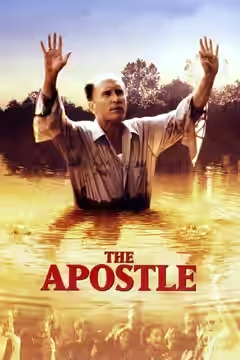
The Apostle poster

The Apostle

1997 · Robert Duvall’s preacher is a sinner who means every word; the harder case

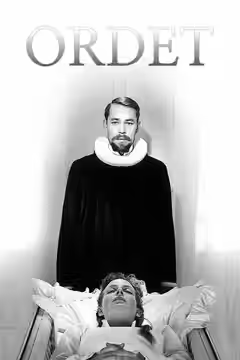
Ordet poster86

Ordet

1955 · Dreyer’s Danish farmhouse film takes faith seriously; the quiet answer to the tent