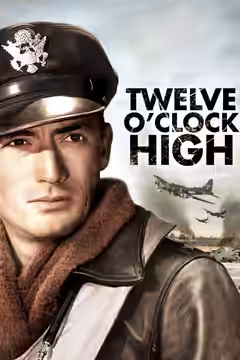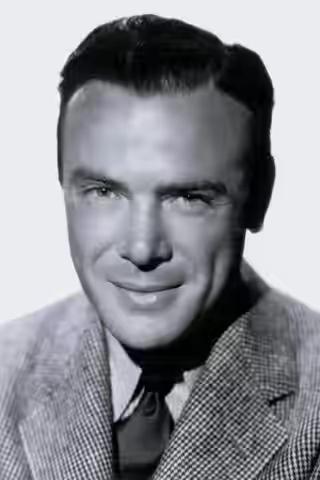
A supporting player for most of a long career, Dean Jagger was the older man the hero explained himself to, and he made patience look like a skill. In Twelve O'Clock High he could carry a shot by doing almost nothing.
Fi1m perspective
Watch Dean Jagger stand still. In Twelve O'Clock High (1949) he walks an empty airfield with a Toby jug under his arm, and the film needs nothing more from him than that he look at the grass while the soundtrack brings up engines that are not there. Directors saw that face and cast him as the one man present who would not panic: officers, sheriffs, principals, fathers. He was older than everyone and he played it as a qualification.
He had come up the slow way, through vaudeville, stock companies and Broadway in the 1920s, with a film debut in The Woman from Hell (1929) and a decade of small parts before Brigham Young (1940) gave him a lead and a Fox contract. The lead did not stick. From then on he was a supporting player, and he stayed one for the rest of his working life, which ran into the mid-1980s and included a long stretch on television as a high-school principal in Mr. Novak (1963–65). We do not think this was a failure. Some actors carry the argument of a film on their own, and some are the man the hero explains himself to. Jagger was the second kind.
The part that shows what he could do is Harvey Stovall, the adjutant in Henry King's bomber-group drama. Stovall is a lawyer in peacetime, and his job is paperwork; the script gives him one quiet act of defiance, slowing the transfer requests when every pilot on the base wants out, and Jagger plays it with a lawyer's patience rather than a soldier's. He moved us more than we expected to be moved by an adjutant, and he did it by doing almost nothing, letting Leon Shamroy's held shot of cracked concrete do the talking. Gregory Peck's colonel is the film's engine; Jagger is what tells you the engine cost something.
He was less well used four years later. The Robe (1953) gives him Justus, a part that is mostly a lesson to deliver, and deliver it he does, while Barbara McLean holds the cut until every word has landed. We were bored, and it was not Jagger's fault; nobody could have made a person out of what Philip Dunne and Albert Maltz wrote for him. Put him in front of a director who wants a man rather than a sermon and his stillness reads as thought. Put him in front of one who wants a sermon and it reads as furniture.
He said in 1951 that "it has always been important to 'feel' the part before I even allow myself to get interested in it," which is a modest way of describing a modest method. He worked twice with Henry Hathaway, turned up in westerns and war films, played a retired general in White Christmas (1954) and a supporting part in Elmer Gantry (1960), and the pattern held: the older man other people needed. Start with Twelve O'Clock High, and wait for the airfield. It is the whole career in one shot.
Biography
Dean Jagger (born Ira Dean Jagger) was an American actor of film, stage and television. He was born on 7 November 1903 in Columbus Grove, Ohio, and died on 5 February 1991 in Santa Monica, California. He is known for his role as Major (later Lieutenant Colonel) Harvey Stovall in the 1949 film Twelve O'Clock High, for which he won the Academy Award for Best Supporting Actor.
Jagger appeared in numerous films including The Robe (1953), White Christmas (1954), Bad Day at Black Rock (1955), Elmer Gantry (1960), Vanishing Point (1971), Game of Death (1978) and Alligator (1980). On television he played roles in series such as The Twilight Zone, Columbo and Kung Fu, and was nominated for two Primetime Emmy Awards for his work on Mr. Novak (1963–65). He also received a Daytime Emmy Award in 1980.
He made his film debut in the 1929 silent film The Woman from Hell and later received a star on the Hollywood Walk of Fame for his contributions to motion pictures.