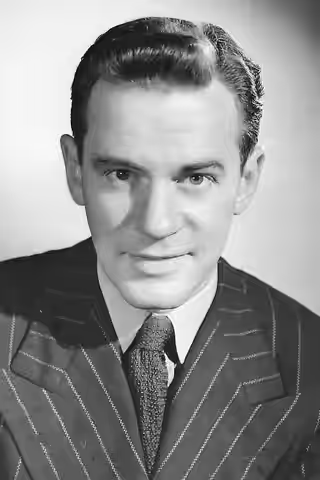
A pleasant, unfussy supporting man in the prestige pictures of the 1940s, Richard Carlson found his proper place a decade later: the scientist in the monster film who believes what he has seen. Our two reviews catch him before the turn, and it shows.
Fi1m perspective
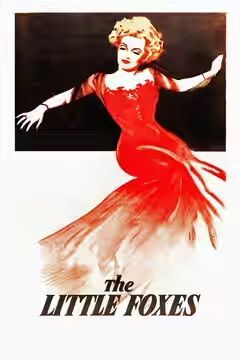
Richard Carlson's trouble, for most of the 1940s, was that nothing he did on screen was wrong. In William Wyler's The Little Foxes (1941) he plays David Hewitt, a newspaperman who is not in Lillian Hellman's play and has been added so that Teresa Wright's Zan has someone to be courted by between scenes. He is perfectly pleasant. She is perfectly pleasant. Every minute they spend together is a minute away from Bette Davis, and we spent those minutes waiting for the door to open again, then felt slightly unfair about it, because he does nothing to deserve the impatience.
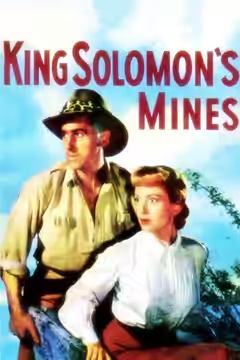
That is the shape of the early career. He came to films from Broadway, made his debut in The Young in Heart (1938), and spent the years up to the war in supporting parts in comedies and dramas, the thinking man who listened well and did not get the girl. Three years in the Navy, from 1943 to 1946, took the momentum out of it, and he came back to more of the same. King Solomon's Mines (1950) was the co-starring part that revived him, and our review is candid about what he does with it: as John Goode, the brother, he is decent and forgettable, which is what the part asks. Stewart Granger gets the sour lines about Africa and Hugo Haas gets the menace. Carlson holds the middle and is not remembered.
Then the 1950s, and the turn. Science fiction and horror wanted exactly what the prestige pictures had no use for: a man with no vanity who could stand in front of something impossible and take it seriously. He played John Putnam in It Came from Outer Space (1953) and Dr David Reed in Creature from the Black Lagoon (1954), both for Jack Arnold, and the earnestness that made him easy to look past beside Davis or Granger became the point when he was the one person in the frame who believed his own eyes. We have not reviewed those films and will not judge them at length here, but the reputation they gave him is the right one. On television he was Herbert Philbrick in I Led 3 Lives from 1953 to 1956. He directed as well, Riders to the Stars (1954) among them, made cheaply and not much helped by its premise.
He was clear-eyed about all this. "I was the guy who did not get the girl. I was not going any higher," he said in 1959, and he kept working, in guest television and the occasional film, until 1975. The two films of his we have reviewed are good films that would be no worse without him. Start elsewhere: with a lake, a scientist, and something under the surface that he, alone among the cast, has already decided is real.
Biography
Richard Carlson (29 April 1912 – 25 November 1977) was an American actor, director and screenwriter. Born in Albert Lea, Minnesota, he graduated with a master's degree in English from the University of Minnesota and briefly taught drama there before pursuing a career in theatre and film.
Carlson made his screen debut in The Young in Heart (1938) and appeared in supporting roles in films including The Ghost Breakers (1940), Hold That Ghost (1941) and The Little Foxes (1941). After serving in the US Navy during the Second World War, he took leading parts in King Solomon's Mines (1950), It Came from Outer Space (1953) and Creature from the Black Lagoon (1954). He also starred in the television series I Led 3 Lives (1953–1956) and directed episodes of several series.