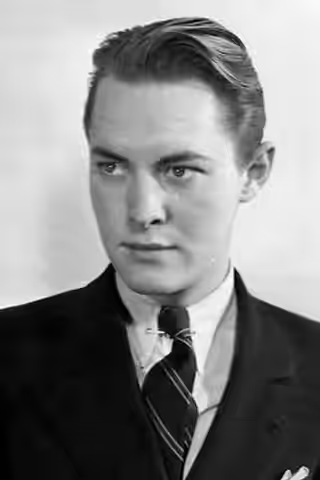
Richard Cromwell was the gentle, hurt young hero of early sound films, the boy who needed approving of. He played it sincerely and a little too much, and when he outgrew it the good parts stopped.
Fi1m perspective
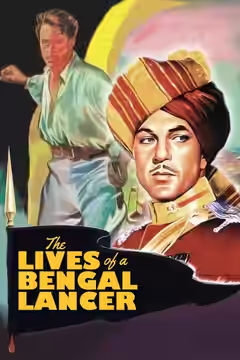
A young lieutenant walks into his father's office in The Lives of a Bengal Lancer (1935). The colonel calls him Mr Stone and dismisses him. Richard Cromwell, as the son, lets us see every bit of the hurt; Guy Standing, as the father, lets us see nothing, and the scene belongs to Standing. That was Cromwell's part, and Hollywood gave him versions of it for the best part of a decade: the sensitive boy in the melodrama or the adventure picture, waiting for somebody older to notice him.
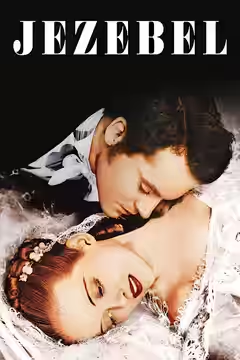
He came from art school, on a scholarship to the Chouinard Art Institute, and won the lead in Tol'able David (1930) in open auditions. Columbia signed him and stardom arrived at once. Emma (1932), on loan-out opposite Marie Dressler, kept him rising, and Bengal Lancer billed him alongside Gary Cooper and Franchot Tone. After that the parts got smaller and the films got better: Ted Dillard in William Wyler's Jezebel (1938), Matt Clay in John Ford's Young Mr. Lincoln (1939), both with Henry Fonda. Then the B-pictures of the 1940s, and by the end of that decade he had more or less stopped.
What he could do was be wounded on camera, and be believed. The young officer, the defendant, the boy with something to prove: he plays them without irony and without protecting himself, and in a period when leading men were often stiff, that earnestness reads as honesty. What he could not do, at least not in the film we have reviewed, is hold anything back. In Bengal Lancer we were moved, and it was the father who moved us, because Standing lets you watch a man deciding not to feel while Cromwell has already decided to feel everything. C. Aubrey Smith, explaining the colonel to the boy, does the same trick. Cromwell is the reason the scene exists and the least interesting person in it.
That is a young man's kind of acting, and it depends on a young man's face. Wyler used him twice, Fonda stood next to him twice, and it is telling that his late high points are supporting parts in other men's pictures, where an older star can do the withholding and Cromwell can supply the ache. Once the boyishness went, the studios had no idea what was underneath, and neither, on this evidence, do we.
See Bengal Lancer for Cooper and Tone bickering and for Standing's office. Watch Cromwell there as the instrument the scene needs rather than the player, and he does the job. It is not a bad thing to have been the boy every old soldier in Hollywood got to ignore.
Biography
Richard Cromwell, born LeRoy Melvin Radabaugh, was an American actor also credited as Dick Cromwell and Roy Radabaugh. He made his film debut in Tol'able David (1930) after training at the Chouinard Art Institute in Los Angeles.
Cromwell appeared as Donald Stone in The Lives of a Bengal Lancer (1935) with Gary Cooper and Franchot Tone. He later played supporting roles in Jezebel (1938) and Young Mr. Lincoln (1939). He received a star on the Hollywood Walk of Fame in 1960.
During the Second World War he served in the US Coast Guard. He was married to actress Angela Lansbury from 1945 until their divorce in 1946. Cromwell died in Hollywood in 1960.