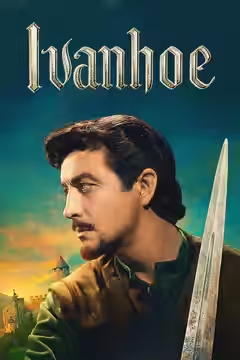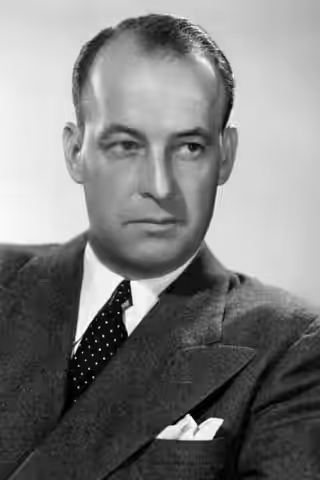
Richard Thorpe made more than a hundred films for MGM and left no fingerprints on any of them. He was quick, obedient to the script and good with a castle wall, and Ivanhoe shows both what that bought the studio and what it cost the film.
Fi1m perspective
Watch a scene in a Richard Thorpe film and the camera will be where you left it. In Ivanhoe (1952) the actors stand in the middle of the frame, the plot moves, and nothing is done to a scene beyond photographing it. That is not a lapse. It was the method, and it served for more than a hundred pictures.
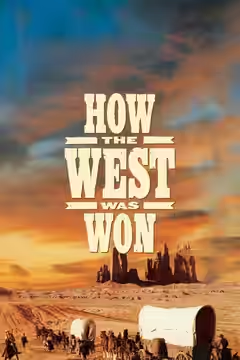
He came out of vaudeville and the stage, acted in silents from 1921, directed his first feature in 1923 and spent the rest of the twenties and the early thirties on cheap westerns, comedies and serials. MGM took him on in 1935 and handed him whatever needed making: Tarzan Escapes (1936), The Thin Man Goes Home (1944), and the historical cycle with producer Pandro S. Berman and Robert Taylor that began with Ivanhoe and continued with Knights of the Round Table (1953). Away from the armour he made Jailhouse Rock (1957) with Elvis Presley and the linking segments of How the West Was Won (1962). He retired after The Last Challenge (1967). Nobody has traced a personal style through that list, because there is none to trace.
What there is instead is a way of working. Thorpe began a scene in long shot and moved the camera closer only when somebody fluffed a line, so the mistake could be cut around rather than shot again. He stuck to the script and came in on schedule and on budget, which is why the studio trusted him with a Tarzan and an armoured epic in the same decade. It is also why Ivanhoe has a hero who is mostly a suit of armour. A director who does not go back for a second take gets what Robert Taylor brought to the set that morning, and no more.
We watched the siege of Torquilstone in Ivanhoe sitting forward, because Thorpe knows where to put a ladder and how long to hold on a wall before it goes, and it is the one stretch of the film that earns the evening by itself. Around it, George Sanders enjoys being unpleasant and Elizabeth Taylor gives the thing what heart it has, and Thorpe photographs them. He was good at action and good at leaving good actors alone. What he could not do, or did not think was his job, was find the joke Walter Scott had planted in his Normans and Saxons, or stop twelfth-century England sounding like a hotel lobby.
He said he was happy to do any kind of picture, and that with a good script any director could make a good one. It is a modest thing for a director to say and he seems to have meant it. Start with Ivanhoe, and watch the siege. It is Thorpe at his best, which is to say the studio at its best, with him standing a little way back.
Biography
Richard Thorpe (born Rollo Smolt Thorpe) was an American film director. He began his career in vaudeville and on stage, entered motion pictures as an actor in 1921, and directed his first silent film in 1923. He directed more than 180 films over four decades, working frequently at MGM from the mid-1930s.
Thorpe directed Ivanhoe (1952), produced by Pandro S. Berman and starring Robert Taylor. He was the original director of The Wizard of Oz (1939) before being replaced after two weeks of shooting. Other credits include several Tarzan films, Jailhouse Rock (1957) and How the West Was Won (1962, as special guest director). He retired after The Last Challenge (1967) and received a star on the Hollywood Walk of Fame.