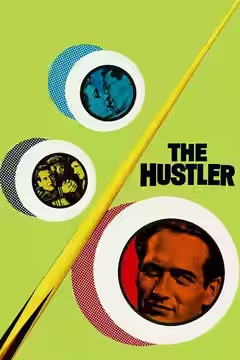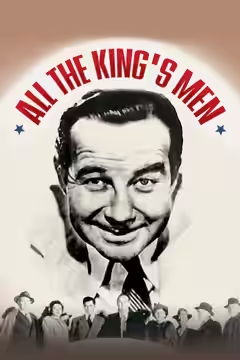
Robert Rossen made films about men who want to win and what the winning costs them, and he was best when the arena was smallest. The Hustler is very good; All the King's Men is good for an hour and hurried after that.
Fi1m perspective
A man walks into a roadside bar pretending to be a salesman who has had a few. He bets too much on a trick shot, makes it, and takes the money. That is how Robert Rossen opens The Hustler (1961), and it is how he liked to begin: with someone who wants something, a room full of people who do not yet know it, and a table between them. He did it with politics, with boxing and with pool.
He came out of New York theatre, as an actor, stage manager and director, and went to Hollywood in 1936 to write for Warner Bros. His first features as director, Johnny O'Clock and Body and Soul, came in 1947, the second a boxing film with John Garfield, who worked with him twice. All the King's Men (1949), which Rossen wrote, produced and directed, was the peak of that first run, and then there is a gap of twelve years before The Hustler. Lilith (1964), shot partly in England, was his last. He died in 1966.
What he could do was direct actors. Broderick Crawford fills Willie Stark to the edges; Paul Newman has rarely been as alive as he is as Eddie Felson; George C. Scott is quietly poisonous; Jackie Gleason is worth the price of the evening for his hands alone. Rossen cast stars beside character players and got the same seriousness from both. He also liked ugliness. "Real life is ugly, but we can't make good pictures until we're ready to tell about it," he said in 1947, and Eugen Schüfftan, who shot two of his films, gave him pool halls in black and white that look like rooms someone has smoked in. The scenes in Sarah Packard's flat, two people who have each decided not to want anything and are failing at it, moved us more than any of the pool, and Piper Laurie plays them without once asking for pity.
What he could not do was leave the point alone. In The Hustler people say loser, winner and character out loud, as if he were afraid we would miss it, and Laurie is handed speeches that stop her scenes dead. In All the King's Men the first hour is about as good as American cinema has been on how a decent man goes into politics and what politics does with him; the second has years to cover in too few minutes, and Louis Gruenberg's brass arrives every time a headline is printed. Rossen trusted his pictures right up to the moment he did not, and then he explained them.
Start with The Hustler, late at night, and do not expect to like Eddie. Then All the King's Men for Crawford, for McCambridge and for the first hour. When somebody on screen starts talking about character, look at the table.
Biography
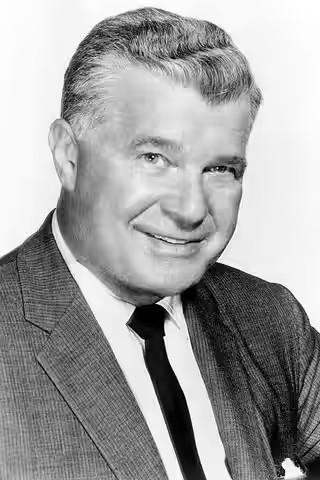
Robert Rossen (1908–1966) was an American screenwriter, film director and producer. After directing and writing for the stage in New York, he moved to Hollywood in 1937 and worked as a screenwriter for Warner Bros. on films including Marked Woman (1937), They Won’t Forget (1937) and The Roaring Twenties (1939).
He wrote, directed and produced All the King’s Men (1949), adapting Robert Penn Warren’s novel. The film won the Academy Award for Best Picture, with Rossen nominated for Best Director and Best Adapted Screenplay. He was blacklisted after initially refusing to testify before the House Un-American Activities Committee in 1951 regarding communist party membership, but later cooperated. His later credits include The Hustler (1961), which he wrote, directed and produced.