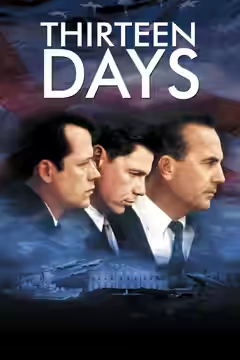
Roger Donaldson is at his best with a handful of people behind a closed door and a decision that cannot wait, and at his least interesting once the cast spreads out and the explosions get louder. Thirteen Days is the one to start with.
Fi1m perspective
In Thirteen Days (2000) a general tells the President of the United States that he is in a pretty bad fix, and means it as advice. Nothing explodes. Nobody draws a gun. Roger Donaldson keeps his camera in the Cabinet Room and lets Bruce Greenwood's tired, careful Kennedy listen while the men around him argue about whether a blockade counts as an act of war. We knew how October 1962 came out and we were tense anyway, because Donaldson lets the argument run at the length and in the order the men might actually have had it. That is his gift, and it is rarer than it sounds.
He has said that he thinks of every film he makes as a thriller, whatever the subject, and the career bears him out. He started in New Zealand with no film school behind him, moving from photography and advertising into documentaries, then into Sleeping Dogs (1977), the first colour 35mm feature made entirely in that country, and Smash Palace (1981), a domestic drama he wrote and produced himself. The Bounty (1984) took him to Hollywood and No Way Out (1987), a Washington thriller with Kevin Costner, kept him there. What followed was thirty years of steady work: Cocktail (1988), Species (1995), Dante's Peak (1997), The Recruit (2003), The Bank Job (2008), The November Man (2014). He has worked twice each with Costner, Anthony Hopkins and Pierce Brosnan, and he has gone home periodically, most tellingly for The World's Fastest Indian (2005), which grew out of a documentary he had made in 1971.
What works is the argument. Give him a table, a clock and a cast who disagree and he will hold a plot with half a dozen strands together without dropping one, which is the skill The Bank Job is admired for. What works less well is daylight. In Thirteen Days the date captions, the family breakfasts and the swelling brass make a well-built 145 minutes look like expensive television, and the twenty minutes that could go are all the ones spent away from the table. The pattern holds across the career. The New Zealand films are the ones called distinctive; the studio pictures from the late eighties on, Cocktail above all, are the ones called formulaic and uneven. He takes the job in front of him, and some of the jobs were better than others.
Start with Thirteen Days, then No Way Out, then work outwards. The further you get from a closed door and a bad decision, the more the brass swells.
Biography
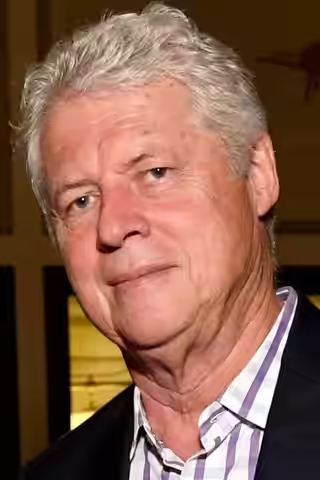
Roger Donaldson is an Australian-born New Zealand film director, producer and writer. Born on 15 November 1945 in Ballarat, Australia, he moved to New Zealand in 1965. He began his career in photography and television commercials before directing documentaries and short films.
Donaldson co-produced and directed his first feature, Sleeping Dogs (1977), the first colour 35 mm feature film made entirely in New Zealand. His second feature, Smash Palace (1981), brought international attention. He later directed Hollywood films including No Way Out (1987), Cocktail (1988), Species (1995), Dante's Peak (1997), Thirteen Days (2000), The World's Fastest Indian (2005) and The Bank Job (2008).