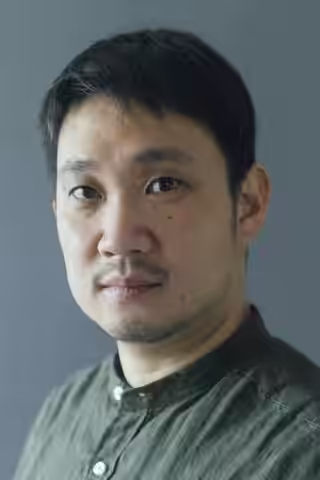
Hamaguchi makes long films out of people talking, and makes the talking do the work most directors give to plot. Table reads, car journeys and flat recitation are the method, and in Drive My Car (2021) it pays off.
Fi1m perspective
Actors sit round a table and read Chekhov with no feeling in their voices, for days. Hamaguchi does not cut away. He lets us get as impatient as they are, and then two of them run a scene on a park bench and something happens that the reading has made possible. That is the whole of his method in one stretch of Drive My Car (2021): the text goes in first, flat, and the emotion is allowed to arrive later, on its own or not at all. He has said that "the lines in a script are actually a vehicle, and they carry on regardless of what the actor thinks about them", and he directs as though he believes it.
He trained under Kiyoshi Kurosawa at Tokyo University of the Arts, and after the 2011 Tohoku earthquake spent two years making documentaries with Kō Sakai. The documentary habit has stayed with him: he listens to people until they say something they did not plan to, and his fiction is built to leave room for that. Happy Hour (2015), five hours long and made with a cast he workshopped, is where most people outside Japan first met him. Asako I & II (2018) followed, then two films in a single year, Wheel of Fortune and Fantasy (2021), three stories about coincidence, and Drive My Car, which is the most controlled thing he has done and the one we would send a stranger to.
The car is his favourite room. Kafuku's red Saab in Drive My Car, where a widowed director learns his lines from a cassette his dead wife recorded, is where the film's most guarded people finally talk, because a car is a room nobody can leave and in which nobody has to look at anybody. Takamasa Ōe co-wrote that film with him; Eiko Ishibashi has scored two of his films. We were moved in it more than we could account for by two actresses doing Chekhov at each other in Korean Sign Language and Mandarin, and the reason was the days of flat reading that came before. He had trained us the way Kafuku trained his cast.
What does not work is small and consistent. He does not always know when to stop explaining, and Drive My Car says aloud near its end what the previous three hours had already shown. The reviews of his other films return to a different complaint, that the endings open out rather than close, and some viewers find the length a trial. The length is not a flaw in itself. It is the method, and it asks to be sat through whole. Do not split it across two evenings. Evil Does Not Exist (2023) took him out of the city and into the woods, and All of a Sudden (2026) takes him out of Japanese and into French. We are curious to see whether the flat reading survives translation.
Biography
Ryusuke Hamaguchi is a Japanese film director and screenwriter. Born on 16 December 1978 in Kawasaki, Kanagawa, he graduated from the University of Tokyo and earned a master's degree from Tokyo National University of Fine Arts and Music.
He first gained attention in Japan with his graduation film Passion (2008). International recognition followed with Happy Hour (2015) and Asako I & II (2018). In 2021 he released Wheel of Fortune and Fantasy and Drive My Car, the latter earning Academy Award nominations for Best Director and Best Adapted Screenplay; the film won Best International Feature Film and was nominated for Best Picture, the first Japanese production to achieve the latter.
Subsequent films include Evil Does Not Exist (2023) and All of a Sudden (2026).