Film review

Drive My Car

2021 · Directed by Ryusuke Hamaguchi · 2h 59m · MPA NR

In a sentenceA widower, a driver, a cassette of his dead wife reading Chekhov, and nobody in the car raises their voice

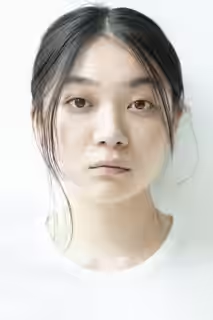
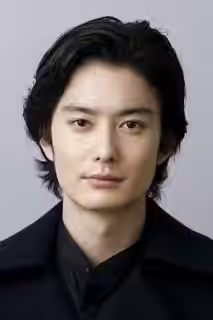
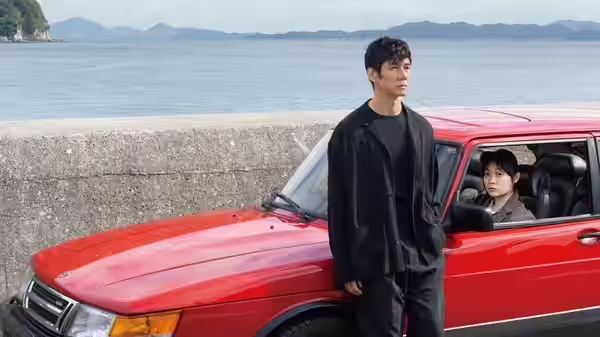
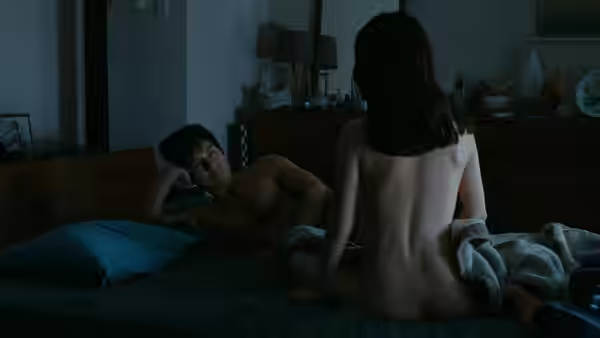
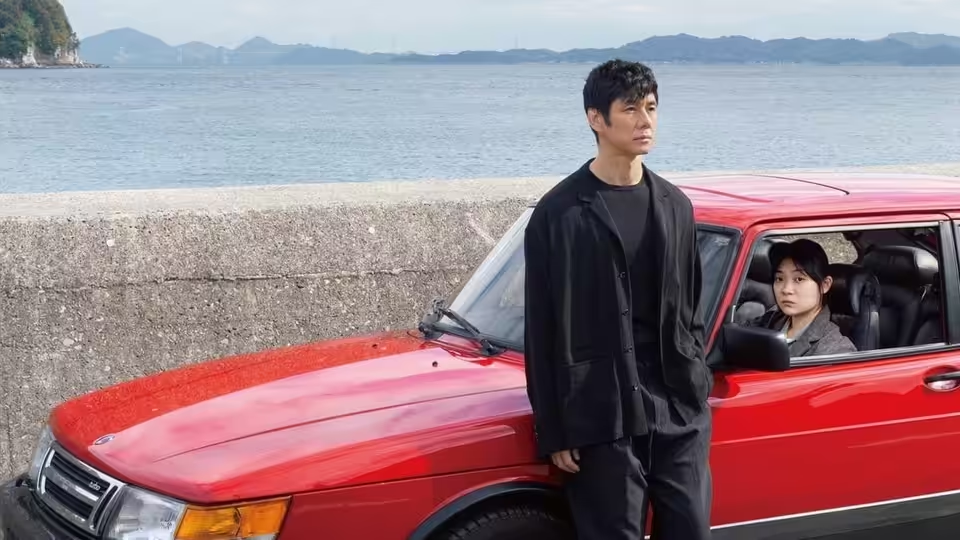
Tokyo. Yūsuke Kafuku (Hidetoshi Nishijima), a stage actor and director, is married to Oto (Reika Kirishima), who writes for television and tells him stories after sex that become her scripts. He learns his lines in his red Saab from a cassette of Oto reading the other parts of Uncle Vanya. Home early from a cancelled flight, he sees her with a young actor, Kōshi Takatsuki (Masaki Okada), and says nothing. Then Oto dies. Two years later Kafuku goes to Hiroshima to direct Vanya with a cast performing in Japanese, Korean, Mandarin and Korean Sign Language. The festival will not let him drive and assigns him Misaki Watari (Toko Miura), a young woman who says little. Takatsuki turns up to audition.

Plays from YouTube when you press play; nothing loads from them until then.

Fi1m review

Ryusuke Hamaguchi’s three-hour film about a widowed theatre director, his young driver and a multilingual Uncle Vanya is quiet, exact and, late on, more moving than we expected. It says too much aloud near the end. See it anyway.

Ryusuke Hamaguchi has taken a short story by Haruki Murakami and made a film that runs 179 minutes, and it is worth the whole of your evening. It is not slow in the way people mean when they warn you about a slow film. Things happen in it constantly, to people who have decided not to react, and the film waits for the moment when one of them does.

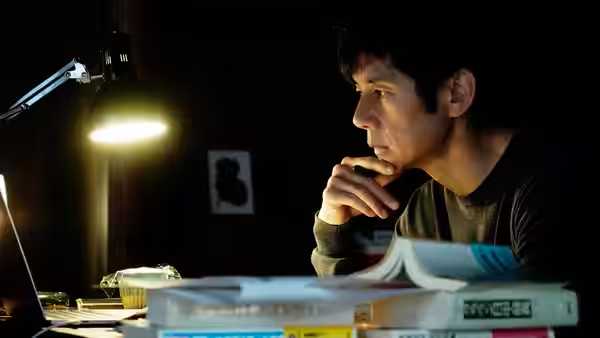
Yūsuke Kafuku (Hidetoshi Nishijima) is a stage actor and director in Tokyo. His wife Oto (Reika Kirishima) writes for television, and the stories she tells him after sex become her scripts. He learns his lines in his red Saab from a cassette she has recorded of Uncle Vanya, every part but his. Hamaguchi and his co-writer Takamasa Ōe spend about forty minutes on this marriage before the title card, and it is the best-judged opening we have seen in a while: a home, a habit, a thing glimpsed through a doorway and never mentioned. Then Oto dies. Two years later Kafuku is in Hiroshima, directing Vanya with a cast speaking Japanese, Korean, Mandarin and Korean Sign Language, and being driven by a young woman he did not ask for.

The driver is Misaki Watari (Toko Miura), from Hokkaido, cap pulled low, and Miura plays her so quietly it takes an hour to see how much she is doing. Kafuku’s first remark about her is that he cannot feel the car move. Hidetoshi Shinomiya and Lee Tae-hun shoot the Saab from outside at night, a red box on grey expressway, and from the back seat by day, two faces in the mirror not looking at each other. Seo Hyeon-Seon gives the rehearsal room a long table, bare walls and a window onto the water, so the reading sessions look like work. Haruki Koketsu puts Kafuku in greys and Misaki in one dark jacket for the whole film.

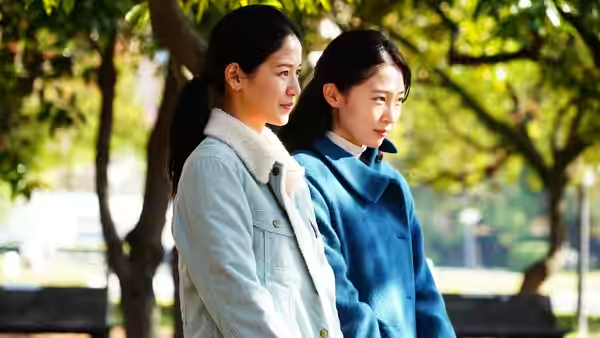
Kafuku’s method is to have the cast read the play flat, round the table, with no feeling, for days. Hamaguchi lets us sit through enough of it to share the actors’ impatience. Then Lee Yoo-na (Park Yu-rim), who plays Sonya in Korean Sign Language, and Janice Chang (Sonia Yuan), who plays Yelena in Mandarin, run a scene on a park bench, and Kafuku stops the rehearsal to say that something happened. It had. We were moved more than we can quite account for, by two women doing Chekhov at each other in languages neither shares, and the reason is the flatness that came before. The film has trained us the way Kafuku trains his cast.

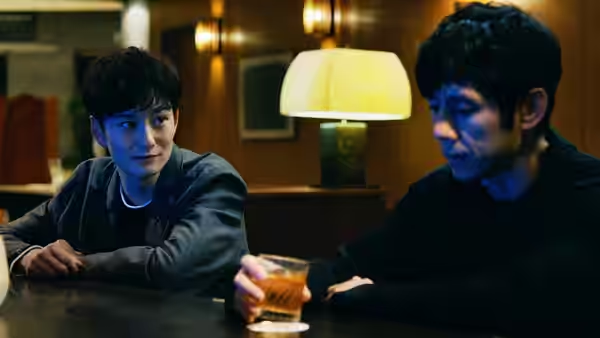
Jin Dae-yeon plays Gong Yoon-su, the festival’s Korean coordinator, who interprets and frets and gets the one dinner scene that made us laugh aloud. Masaki Okada plays Kōshi Takatsuki, the young television actor Kafuku casts as Vanya without saying why. Okada is handsome, eager and slightly wrong in every scene, and late on he is given a long speech in the back of the car, held on his face, that we will not describe. It is the best acting in the film, and Nishijima, listening, does not blink. Eiko Ishibashi’s score, with Yoshitaka Fujimoto, is a soft run of drums, bass and electric piano that arrives over the driving and stays out of the flat and the rehearsal room. Azusa Yamazaki cuts to the pace of the car, long on the road and shorter indoors. We did not check the time.

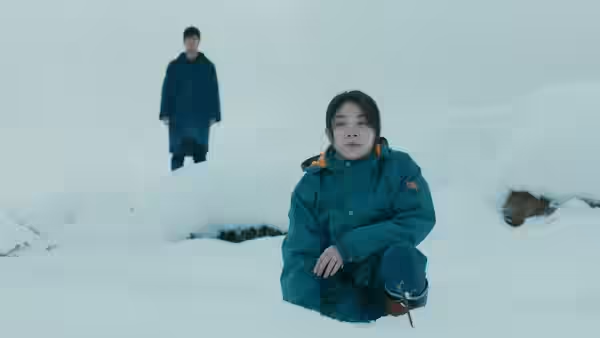
The flaw is in the last hour. Kafuku and Misaki take a long drive north, and what they have carried in silence for two hours they now say to each other in full sentences. It is well acted and well written and it is more than we needed, because Chekhov had already said it. A few critics found this stretch melodramatic. We would not go that far, but the film that trusted us in the car does not quite trust us in the snow. There is also a coda, which we will not describe, that puzzled us on first viewing and has stayed with us since.

Hamaguchi has made long films about people talking before, Happy Hour in 2015 among them, and this is the most controlled thing he has done: fewer people, fewer rooms, one car. It is a 15 certificate, for sex that is talked over more than shown, and it is three hours. Do not split it across two evenings. The last hour only works if you have sat through the first two.
Critical consensus AI synthesised

78
Positive
19
Mixed
1
Negative
2

Most critics take to this warmly, and the praise lands in the same places. The reviews single out Ryusuke Hamaguchi’s direction, and in particular the way he expands a short Murakami story into a three-hour film that most say never feels padded. The performances of Hidetoshi Nishijima and Toko Miura are widely admired for their restraint, and several critics point to the long conversations in the red Saab as the film’s centre, where grief and guilt are finally spoken aloud. The multilingual Uncle Vanya rehearsals and the script draw repeated mention.

The reservations are almost all about pace. Several find the film glacial, and a few warn that the Chekhov-heavy second half asks for the right mood. The spread is otherwise narrow, with two sharp dissents: Slant Magazine and The Wrap both admire the opening and think the later sections undo it, one blaming explanatory backstory, the other melodrama. HeyUGuys finds it obtuse for anyone new to Hamaguchi.

Financial Times
24 March 2022 · ★★★★☆ · Danny Leigh
90*

The critic hails the low-key Japanese marvel about truth, loss and a red Saab, praising the subtle glide of the storytelling and the director’s deft handling of eccentric character traits as everyday. It singles out the car-tone sanctuary of the old red Saab carrying souls in transit amid grief and connection.

Read the full review →
Los Angeles Times
29 November 2021 · Justin Chang
90*

The critic hails it as a haunting masterpiece of art and life, melancholy and wise. It follows an actor-director through experimental theater work and personal loss, finding catharsis in performance and human connection.

Read the full review →
The New Yorker
24 November 2021 · Richard Brody
90*

The review praises the film as an overwhelmingly powerful tale of guilt and confession centered on artists’ collaborations. It highlights the continuity between personal relationships and artistic achievements in a grandly literary drama.

Read the full review →
The New York Times
24 November 2021 · Critic's Pick · Manohla Dargis
90*

The critic calls the film a quiet masterpiece that considers grief, love, work, and the power of art. It expands on its source material to explore an actor-director’s emotional journey and unexpected connection with his driver.

Read the full review →
Variety
11 July 2021 · festival review · Guy Lodge
90*

The review describes a deliberate, deeply moving tale of grief, renewal, and driving pleasure in this aching emotional epic. It adapts a short Murakami story into a slow, wise three-hour film that never feels overextended.

Read the full review →
Empire
19 November 2021 · Ian Freer
85*

The film is a beautiful, enigmatic picture that rewards attention despite its long runtime, with Hamaguchi's direction refined and the performances of Nishijima and Miura delivering modulated portraits of melancholy. It stands out as a visually striking work teeming with ideas about grief, betrayal and creativity, and the most successful cinematic Murakami adaptation.

Read the full review →

Cast

Awards

Academy Awards, 2022

Nominated
Best Picture
Won
Best International Feature Film

FIPRESCI Grand Prix, 2022

Won
FIPRESCI Grand Prix

International Submission to the Academy Awards, 2022

Nominated
International Submission to the Academy Awards

Golden Globes, 2021

Won
Best Non-English Language Film

Japan Academy Prize for Picture of the Year, 2021

Won
Japan Academy Prize for Picture of the Year

If you liked this, try…

Vanya on 42nd Street poster

Vanya on 42nd Street

1994 · Louis Malle films a rehearsal of the same play in a derelict theatre; talk, no sets.

Burning poster72

Burning

2018 · Lee Chang-dong’s Murakami adaptation; slower, angrier, and it ends where this one starts.

Certified Copy poster84

Certified Copy

2010 · Kiarostami puts two people in a car in Tuscany and lets them argue about marriage.

Still Walking poster

Still Walking

2008 · Kore-eda’s family gathering; grief managed by cooking, with nobody saying the thing.

Happy Hour poster

Happy Hour

2015 · Hamaguchi’s five-hour film about four friends in Kobe; longer, looser, same patience.