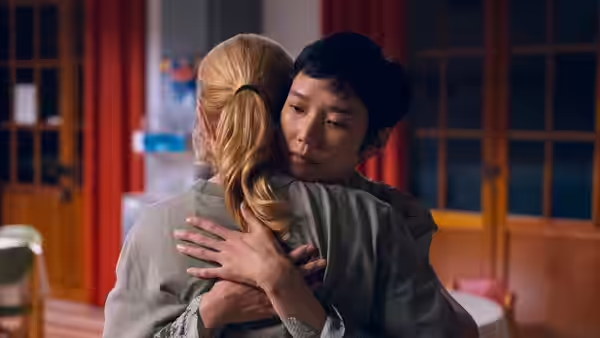
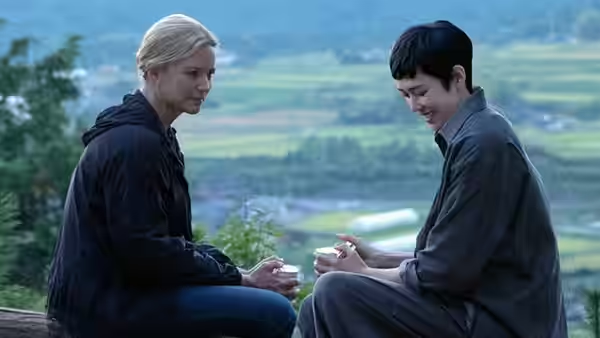
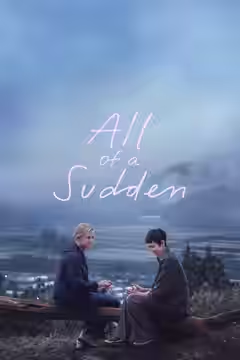
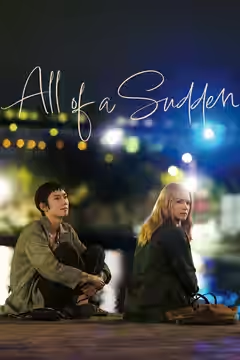
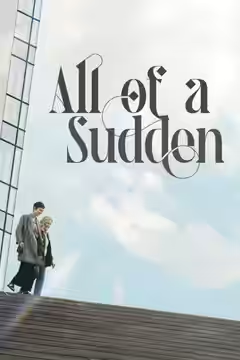
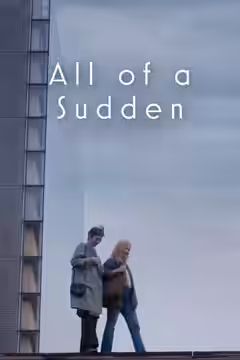
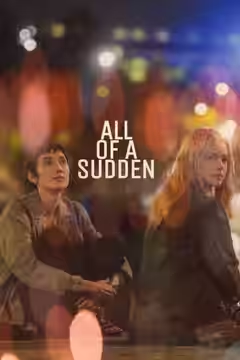
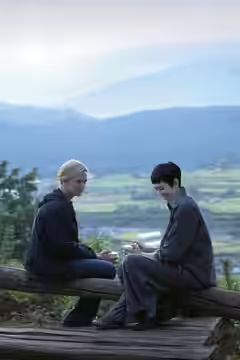
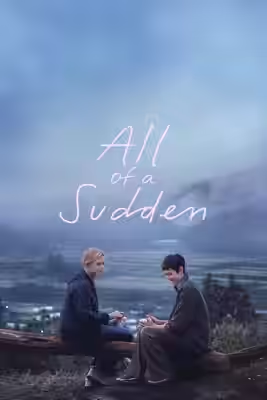
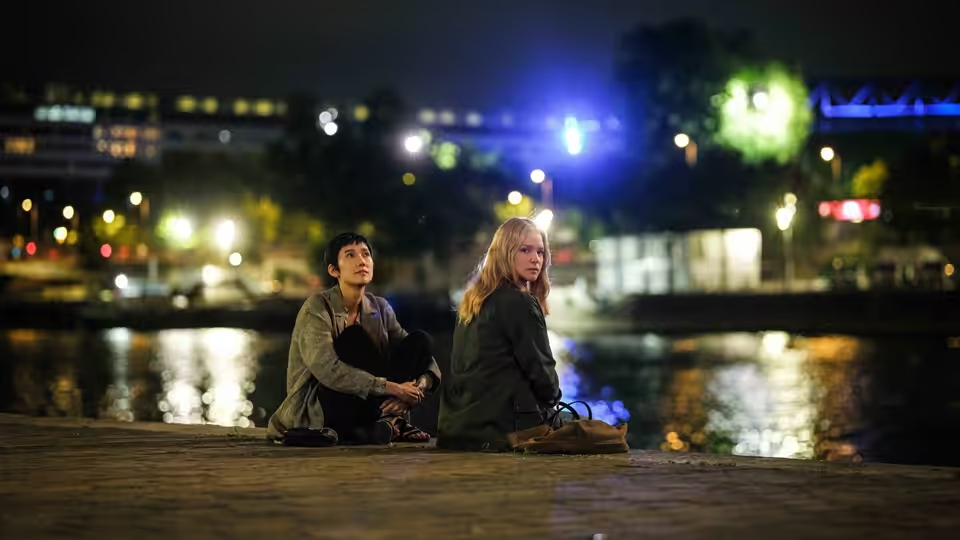
Marie Lou-Fontaine (Virginie Efira) and Mari Morisaki (Tao Okamoto) sit beside a river at night
Film review

All of a Sudden

2026 · Directed by Ryusuke Hamaguchi · 3h 16m · MPA PG-13

In a sentencePeople listening properly to one another for three hours is a rather pointed way to spend an evening

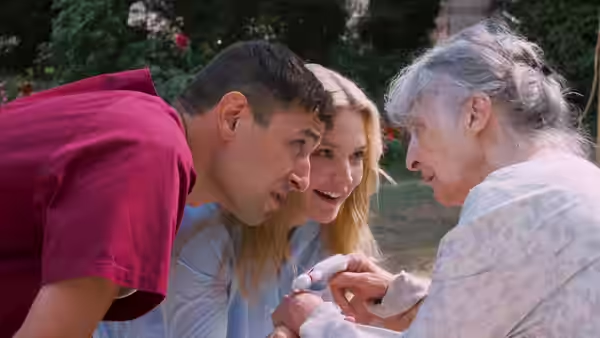
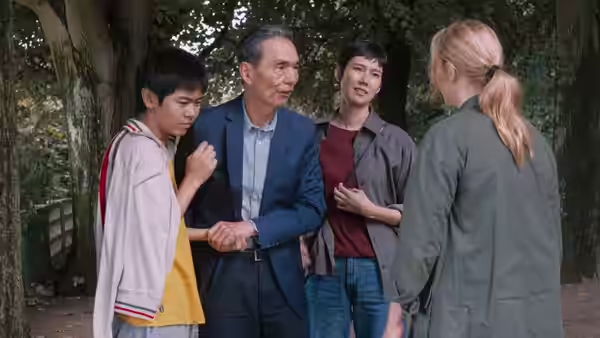
Marie-Lou Fontaine (Virginie Efira) and Mari Morisaki (Tao Okamoto) develop a friendship through conversations about care, dignity and the help people need from one another. Their story also includes Goro Kiyomiya (Kyōzō Nagatsuka), alongside encounters between caregivers and patients. As the women’s relationship grows, their exchanges raise questions about dependence, difference and how people might live together. The responsibilities of looking after others give these discussions practical consequences, while problems in health care connect individual needs to wider concerns about how care is provided and whose needs receive attention.

Plays from YouTube when you press play; nothing loads from them until then.

Fi1m review

Ryusuke Hamaguchi’s drama makes good company of Virginie Efira and Tao Okamoto, and gives care the attention it deserves. The conversations reward patience, though the more instructive stretches could use firmer editing.

All of a Sudden is worth a long evening for anyone who enjoys a drama that takes its time over conversation. Ryusuke Hamaguchi follows the friendship between Marie-Lou Fontaine and Mari Morisaki into questions about how people look after one another. At 196 minutes, the film gives those questions considerable attention. Much of that time is rewarding, although some conversations continue after their point is clear.

Virginie Efira plays Marie-Lou Fontaine, with Tao Okamoto as Mari Morisaki, and their companionship is the most persuasive reason to stay. There is a warmth between them that makes the philosophical discussion feel connected to actual people. Tao Okamoto’s delicacy is particularly valuable in a film so ready to spell out its beliefs. The friendship needs room to develop, and these performances give the leisurely pace a purpose.

The attention to caregivers and patients gives those beliefs something practical to address. Dignity can become a comfortable word in a script; the business of caring for somebody gives it consequences. We find that emphasis moving, particularly the insistence that tenderness belongs among everyday necessities. The quieter encounters make the case more convincingly than the explanatory passages, because the people receiving care matter as much as the people giving it.

Alan Guichaoua handles the cinematography, Mila Preli the production design and Samuel Andreyev the music. The visual and sound work has drawn praise for its sensitivity, an appropriate quality in a film this interested in listening. A drama of long conversations needs to make time spent together feel worthwhile. The natural companionship between the leads is the clearest reason this one does.

Azusa Yamazaki’s editing is central to that question of attention. A brisker version would risk reducing the friendship to a succession of useful points, and the film deserves credit for allowing it to develop. Still, its length gives the more prescriptive conversations time to become tiresome. We would have preferred a little less explanation once the actors have already made the humane point clear.

Ryusuke Hamaguchi and Léa Le Dimna’s screenplay is strongest when it trusts the friendship to carry its ideas. Its optimism is welcome, and the attention to caregiving gives it more substance than a general request for everyone to be nicer. But the tendency to prescribe better ways of living can make the conversations feel too carefully directed towards agreement. The occasional sweetness is easier to forgive than the feeling that an answer has been approved before the discussion begins.

For a drama built around conversation, the test is whether we want to remain in the company of the people speaking. These two leads make a persuasive case, including through stretches that could be shortened. We recommend it for its patient performances and its willingness to treat care as something worthy of sustained attention. Allow a whole evening, and perhaps agree beforehand who gets to stop the discussion afterwards.

Critical consensus AI synthesised

78
Positive
12
Mixed
2
Negative
1

Most critics respond warmly to All of a Sudden, praising its hopeful treatment of care, friendship and human connection. Praise centres on Virginie Efira and Tao Okamoto, whose rapport gives the long conversations emotional weight. The reviews also credit Hamaguchi’s patient direction and attentive dialogue with making caregiving compelling drama. For its strongest supporters, the optimism feels earned through the tenderness of the performances.

The spread is wide, however, with the leisurely pace and three-hour runtime dividing opinion. The AV Club finds the length justified, while Deadline argues that excessive length and lecture-like passages weaken the emotional impact. The Guardian admires the quieter exchanges between caregivers and patients but finds the film overly precious and self-conscious. Even favourable reviews acknowledge moments of sentimentality or overly prescriptive thinking; the main disagreement is over how much these intrude on the relationships.

The AV Club
18 May 2026 · festival review · Luke Hicks
95*

The critic calls the film transcendent and says it earns its three-hour runtime. They single out Hamaguchi’s insightful screenplay and delicate direction, especially the film’s careful visual and sound design.

Read the full review →
Variety
15 May 2026 · festival review · Jessica Kiang
95*

Kiang gives the film an ecstatic review, praising its generous, life-affirming story about care and connection. She singles out the long conversations and the leads’ performances for creating an unusually intimate, transformative experience.

Read the full review →
Little White Lies
festival review · David Jenkins
90*

Jenkins finds the film overwhelmingly affirmative and philosophically rich. He especially praises its performances and the way its careful dialogue makes caregiving a means of human connection.

Read the full review →
Sight and Sound
26 May 2026 · festival review · BFI
90*

The critic is strongly positive, finding the film’s patient portrait of friendship quietly transformative. They single out Hamaguchi’s attentive direction and the way dialogue and care foster connection.

Read the full review →
Slant Magazine
24 September 2026 · ★★★½/4 · Keith Uhlich
88

Uhlich finds the film scattershot and occasionally treacly, but says its earned optimism feels like a balm. He especially praises the natural emotional and physical kinship between Virginie Efira and Okamoto Tao.

Read the full review →
IndieWire
15 May 2026 · B+ · David Ehrlich
83

Ehrlich finds the film a light, lovely, and increasingly hopeful argument for a more humane future, despite its overly prescriptive ideas. He praises its care-centered perspective and Tao Okamoto’s delicate, ethereal performance.

Read the full review →

Straight answers AI written, from our review

Is All of a Sudden worth watching?
All of a Sudden is worth watching if we enjoy patient, conversation-led drama, and we score it 78 out of 100. Virginie Efira and Tao Okamoto make its friendship warm and persuasive, while the attention to caregiving is moving. At 196 minutes, it asks for a whole evening, and some discussions keep explaining what the performances have already made clear.
How long is All of a Sudden, and what is it rated?
All of a Sudden runs 3h 16m and is rated PG-13 by the MPA in the US. It is a drama film.
Where can I watch All of a Sudden in the US?
All of a Sudden is not on any streaming or rental service in the US at the moment. Availability is checked daily.
How violent or frightening is All of a Sudden, and is it suitable for children?
All of a Sudden has a US rating advising parental caution for children under 13, but no UK certificate is provided. That rating alone does not establish how violent or frightening it is. Its 196-minute running time and extended conversations about care and dignity make it better suited to patient teenagers and adults than younger children.
How does All of a Sudden compare to The Farewell?
All of a Sudden offers a more prolonged, conversational treatment of care than The Farewell, whose family disagreements centre on honesty and deception. We favour The Farewell for humour and painful family tensions, and All of a Sudden for the gradual development of a friendship. Both benefit from persuasive performances, though both can explain their ideas too neatly.
What should I watch after All of a Sudden?
After All of a Sudden, try The Farewell (2019, Fi1m 84): Care becomes complicated when a family cannot agree what honesty requires. Then Amour (2012, Fi1m 88): For a harsher examination of illness, devotion and the daily work of care; and Secrets & Lies (1996, Fi1m 88): Patient performances make difficult conversations matter long before anyone raises their voice.

Cast

If you liked this, try…

  1. Still Walking (2008) · not reviewed yetFamily conversation gradually exposes old grievances and the limits of affection.

  2. The Farewell (2019, Fi1m 84)Care becomes complicated when a family cannot agree what honesty requires.

  3. Amour (2012, Fi1m 88)For a harsher examination of illness, devotion and the daily work of care.

  4. Secrets & Lies (1996, Fi1m 88)Patient performances make difficult conversations matter long before anyone raises their voice.

  5. Ikiru (1952, Fi1m 92)Illness prompts a public servant to reconsider what useful work might mean.

Free account

Know what to watch tonight

Two lists that know where things are streaming, collections you can share, your own score beside ours, and Discover that remembers what you have seen.

  • Want to see, sorted by what is streaming now
  • Seen, with your score out of ten
  • No adverts, ever