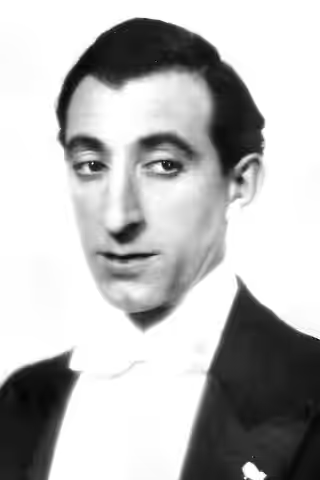
Sig Arno makes fuss funny by treating it seriously, using precise gestures and an earnest manner even when the comedy is absurd. We value his supporting work most when a film gives him more to do than sound foreign.
Fi1m perspective
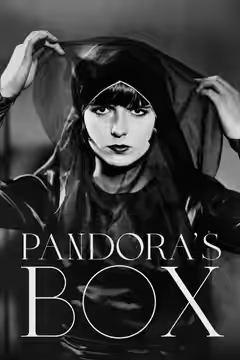
In G.W. Pabst's Pandora's Box (1929), Sig Arno's stage manager waves both arms as the backstage preparations gather speed. Fleisler cuts between him, stagehands, dancers in feathers, a drum and Louise Brooks's sulking Lulu, making the rhythm faster as the curtain approaches. Arno gives the bustle a useful focus: someone has to get this performance started, and he is taking the job seriously. We were delighted by his urgency, because those flailing arms make the pressure funny without holding up the scene.
His German screen roles in the 1920s tended towards comic underdogs and eccentrics, drawing on cabaret timing and precise physical comedy. The earnest, deadpan manner mattered as much as the movement; he could play farce without seeming to find it amusing himself. Pabst also cast him in Diary of a Lost Girl (1929), as a brothel visitor. Hollywood, where he arrived in 1939, offered plenty of work but often little space within it. Waiters, maîtres d'hôtel and eccentric Europeans became regular assignments, with his accent helping to keep him in small parts.
Preston Sturges gives him a more distinctive task in The Palm Beach Story (1942). As Toto, a suitor of the wealthy Princess Centimillia, Arno speaks heavily accented nonsense with the seriousness that makes his comic work effective. The pursuit gives him something to play beyond the sound of his own voice: he wants something, however ridiculous he may appear while asking for it. We rate the film highly, though its farce sometimes feels overworked. Arno's earnestness fits a comedy whose complications need the performers to keep believing in them.
The restriction in those Hollywood roles is worth keeping in mind: playing a foreigner can become the entire joke, however carefully the actor times it. Arno's physical expressiveness gives us more to watch than that description promises, especially in the silent work. He is worth noticing without pretending that every brief appearance amounts to a fully drawn character. Start with the backstage sequence in Pandora's Box, and watch how much a supporting actor can contribute while the editor keeps cutting away.
Biography
Sig Arno (born Siegfried Aron) was a German stage and film actor. Born in Hamburg, he began his career as a stage comedian in Germany before appearing in around ninety films there, primarily in comic roles, from the early 1920s. These included G. W. Pabst's Pandora's Box (1929), in which he played the Stage Manager.
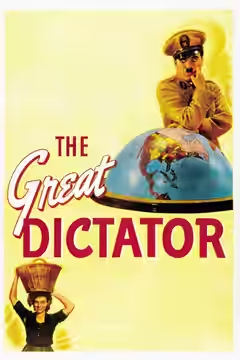
Arno left Germany in 1933 and worked in Europe before moving to Hollywood in 1939. There he appeared in over fifty films, often in supporting comic parts such as Toto in The Palm Beach Story (1942), the Tailor in The Hunchback of Notre Dame (1939) and roles in The Mummy's Hand (1940) and The Great Dictator (1940). He also appeared on Broadway, including in Song of Norway and Time Remembered (for which he received a Tony Award nomination in 1958), and received an honorary award at the German Film Awards in 1966.