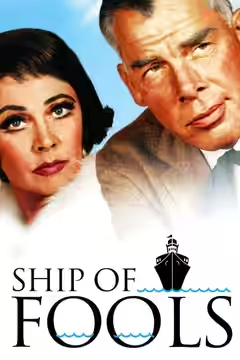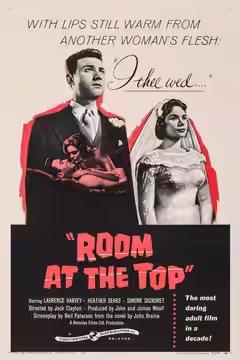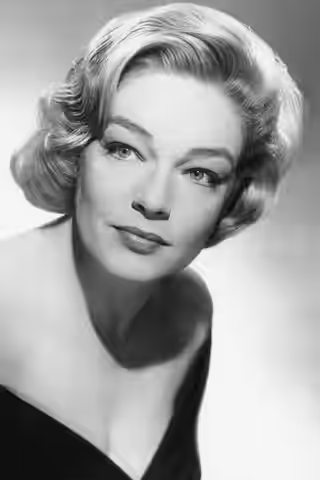
Signoret did less than almost any actor of her time and let the camera find the rest. She listened, waited and told men the truth about themselves, and in Room at the Top that is the whole film.
Fi1m perspective
Early in Room at the Top (1958), before the affair has gone anywhere it cannot come back from, Alice Aisgill straightens Joe Lampton's collar as he leaves her flat. Signoret barely looks at him while she does it. It is a wife's gesture, offered to a man who is not her husband, and it tells you what she has decided before she has admitted it to herself. That is how she worked. Where others built a performance out of speeches, Signoret built one out of what a woman does with her hands and her eyes while somebody else is talking.
She came up without training, starting as an extra in the 1940s and taking her first notable parts at the end of that decade, among them Dédée d'Anvers (1948) for Yves Allégret. Casque d'Or (1952) made her a star in France, and Les Diaboliques (1955) showed the same stillness could go cold: Nicole Horner watches a plan unfold and does not blink. The early parts ran to prostitutes and unhappy wives, and she was cast that way often enough for it to become a complaint. Room at the Top brought her an international audience, as a Frenchwoman married to a man who speaks to her as if she were staff. After that she worked mostly in Europe through the 1960s and 1970s, in Ship of Fools (1965) and, for Jean-Pierre Melville, in Army of Shadows (1969), which was largely overlooked when it came out.
What works is the listening. In the pub in Room at the Top, Joe talks about money and Alice does not argue; she waits, and when she speaks it is to tell him something true about himself that he did not want to hear. She has worked out exactly what he is and has decided to love him anyway, and Signoret lets us see both halves of that at once. It moved us more than we expected, and we were a little ashamed of it, because the film has made plain she deserves better and is not going to give it to her. Laurence Harvey is the weaker half of the pairing, and she plays to him as though he were not, which is the kindest thing in the performance and the saddest.
The limits are real. A style built on doing so little needs a director willing to hold the shot, and not every director she worked with was. The early success in prostitute parts got her cast as one more often than it should have. She said, "I got old the way women who aren't actresses grow old," and she meant it: she let her face change on screen and went on being cast in older parts she did not soften. Start with Room at the Top. If the collar does its work on you, Casque d'Or and Les Diaboliques will show you the same woman warm and then cold.
Biography
Simone Signoret was a French actress. Born Simone Henriette Charlotte Kaminker on 25 March 1921 in Wiesbaden, Germany, she grew up in Neuilly-sur-Seine near Paris. She began her career in the 1940s and became known for roles in French films including Casque d'Or (1952) as Marie and Diabolique (1955) as Nicole Horner.
Signoret achieved international recognition for her performance as Alice Aisgill in the British film Room at the Top (1958). She received an Academy Award for Best Actress, a BAFTA Award and the Cannes Film Festival Award for Best Actress for the role. Other notable credits include La Ronde (1950), Army of Shadows (1969) and The Cat (1971). She was married to actor Yves Montand from 1951 until her death on 30 September 1985.