Tony Richardson filmed bedsits for four years and then filmed the eighteenth century as though nobody had told him it was over. The early films are the ones to see; Tom Jones is the one to enjoy, and it paid for everything after.
Fi1m perspective
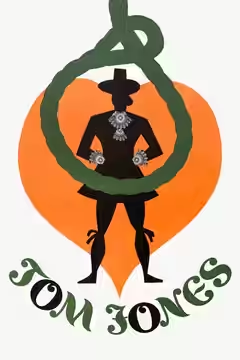
Albert Finney, in Tom Jones (1963), turns to the camera to complain about a woman, and later puts his hat over the lens. That is Tony Richardson in a single shot: a director who could not leave a scene alone, who liked a wipe, a freeze frame, a chase run at double speed and a narrator who kept talking over the top. It was not how he started. Four years earlier he had been filming bedsits.
He came out of the theatre. In 1955 he co-founded the English Stage Company at the Royal Court and the following year directed the first production of John Osborne's Look Back in Anger; with Osborne and Harry Saltzman he then set up Woodfall to put that kind of play on film. Look Back in Anger (1959) was his first feature. A Taste of Honey (1961), from Shelagh Delaney, and The Loneliness of the Long Distance Runner (1962), from Alan Sillitoe, followed, shot on location among the people the plays were about. Those three films are a good deal of what the British New Wave meant. Walter Lassally, who would shoot four of his films, was behind the camera for the best of it.
Then came the holiday. He called Tom Jones exactly that to his cast and crew ("This is our holiday film."), and it looks like one. Lassally lights it so that people appear to sweat, John Addison's harpsichord rattles under a silent-comedy prologue, and Antony Gibbs cuts it fast and loose. The best of it is at the inn at Upton, where Finney and Joyce Redman eat a whole meal at each other without a word and Richardson, for once, stops cutting. We laughed out loud at that scene and then laughed again at how long he let it run, because it is the one place in the film where he trusts the actors more than the editing. Actors were what his theatre years gave him, and it shows every time he holds still long enough to let them work.
The trouble is that the tricks became a habit. Our review of Tom Jones found the style a pleasure for an hour and a habit after, and the film slows to a walk once it reaches London. The reviews of what came next were harsher. The Loved One (1965) is where the flamboyance is usually said to have taken over, and The Charge of the Light Brigade (1968), a large, sour historical satire, had a troubled production and a hostile reception from which his career never quite recovered. He spent his later years mostly in America, and Blue Sky (1994), released after his death, is generally spoken of as a return of energy. We have not reviewed those films and will not judge them here.
What he could do, at his best, was put a writer's voice on screen without sanding it down: Osborne, Delaney, Sillitoe and Fielding all come through sounding like themselves. What he could not do was sit still. Start with the bedsits, then take the holiday, and do not feel obliged to stay to the end of it.
Biography
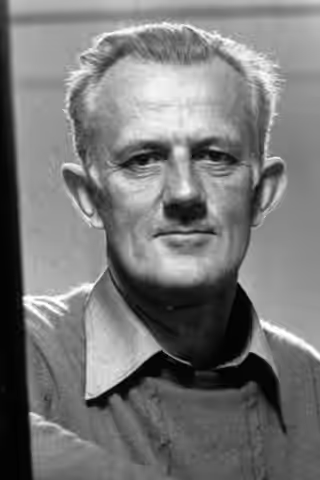
Tony Richardson was an English theatre and film director and producer. Born in Shipley, Yorkshire, he was educated at Wadham College, Oxford, and began his career directing for the BBC before co-founding the English Stage Company at the Royal Court Theatre in 1956.
He became a leading figure in the British New Wave, directing stage and screen adaptations of works by the 'angry young men', including Look Back in Anger (1959), A Taste of Honey (1961) and The Loneliness of the Long Distance Runner (1962). Richardson directed and produced the period comedy Tom Jones (1963), which won Academy Awards for Best Picture and Best Director.
His other notable films include The Charge of the Light Brigade (1968) and The Hotel New Hampshire (1984). He was married to actress Vanessa Redgrave from 1962 to 1967.