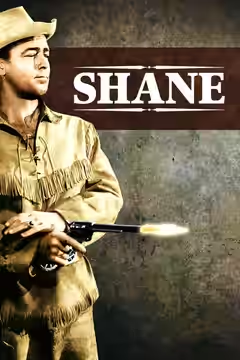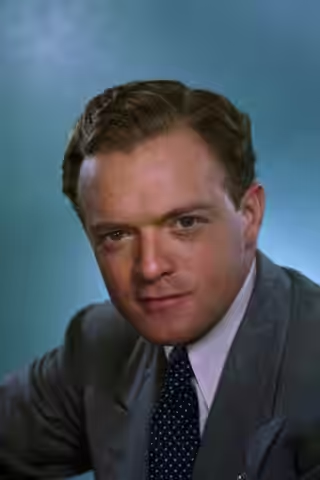
Van Heflin played the man the story is not about: the husband, the rancher, the fellow at the next table. He did it with a stubborn plainness other actors could not fake, and in Shane it is the best thing on screen.
Fi1m perspective
In Shane (1953) there is a moment when Joe Starrett notices his wife watching the hired man wash at the pump. Van Heflin does not narrow his eyes or square his shoulders. He lets Joe see it, understand it and go on trusting her, and the whole decision passes across his face as something closer to tiredness than jealousy. Nobody praises this kind of acting, because it looks like a man standing in his own yard. It was Heflin's trade for more than thirty years, and he was better at it than almost anyone.
He came to films from Broadway, where he had been working since 1928, and made his debut in A Woman Rebels (1936) opposite Katharine Hepburn, who had noticed him on stage. MGM found a use for him as the second man in the frame, most visibly as Jeff Hartnett in Johnny Eager (1942). The war took him away as a combat cameraman between 1943 and 1945, and when he came back the parts got darker. The Strange Love of Martha Ivers (1946) put him opposite Barbara Stanwyck, the first of three films they made together, and The Prowler (1951) let him play a corrupt policeman with the same steady manner he used for the honest ones. He left MGM in 1949 and worked freelance from then on, which is how he ended up on a homestead for George Stevens and, in 3:10 to Yuma (1957), as Dan Evans, the rancher. After that the parts shrank, and his last was D. O. Guerrero in Airport (1970).
He knew what he was and what he was not. "Louis B. Mayer once looked at me and said, 'You will never get the girl at the end.' So I worked on my acting." He never did become a leading man of the first rank; his face was ordinary and the studios cast him accordingly, and there are stretches of the career where he is plainly better than the part. But the ordinariness is the point. Put him beside Alan Ladd's pale buckskin stillness and Heflin looks like the only man in the valley who has ever lifted anything heavy. We found, watching Shane again, that we cared more about whether Joe kept his fences than whether Shane ever drew, and that is Heflin's doing: he plays Joe as stubborn, decent and a little slow, a man who knows he is being outshone at his own kitchen table and refuses to be small about it.
What he could not do was surprise you. The self-contempt in his crooked men and the resolve in his straight ones come from the same refusal to make either look attractive, and once you have seen it you can see it coming. That is a small complaint against an actor who was so rarely false. Start with Shane, and this time watch the husband.