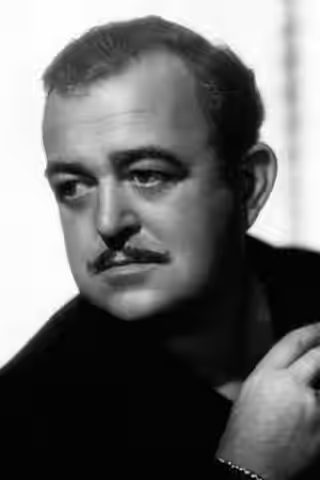
A violinist who took up directing and never stopped composing, Victor Schertzinger treated a song as a scene rather than a break between scenes. The films around the songs are often plain; the songs themselves, and the way he lets them run, are why he matters.
Fi1m perspective
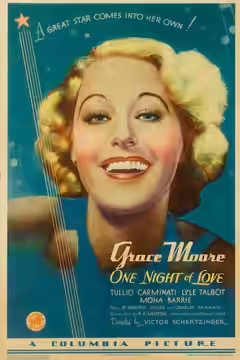
The scene to know is the café in One Night of Love (1934). Grace Moore starts a song for a room full of diners, the diners join in one by one, and the film does not cut away until it is finished. It is a small thing and it is most of Victor Schertzinger's method. We grinned through that number like a fool, at a table of strangers singing along with a soprano, and it was the warmth of the café rather than the size of the voice that did it. That kind of gathered-round-the-piano feeling almost never survives being filmed. It survives here because he trusted the number to hold the screen on its own.
He was a musician before he was anything else. He trained as a violinist and conductor, wrote the first original orchestral score for a feature film with Civilization (1916), and turned director the following year, making twenty-one silents with Charles Ray. When sound arrived he did both jobs at once, composing the songs and scores for the films he directed and freelancing through the 1930s on musicals and whatever else came along. He had opinions about how the studios used music: some of what he had seen in Hollywood, he told the New York Times in 1929, "would make Wagner turn over in his grave."
One Night of Love is the one we have reviewed, and it is the case for him in full. The plot could have been assembled from a kit. What he brings is a light hand, a musician's sense of when a scene has gone on long enough, and the nerve to let Moore sing whole numbers when other directors would have trimmed them. He wrote the non-operatic songs with Gus Kahn; Johnny Mercer was among his lyricists later. He put James Cagney in a musical, Something to Sing About (1937), writing and producing as well as directing; he put Gilbert and Sullivan into Technicolor with The Mikado (1939); and he started the Road series with Road to Singapore (1940), a job that mostly asks a director to keep out of Hope and Crosby's way, which he did. The Fleet's In (1942) came out after his death and left behind two standards, "I Remember You" and "Tangerine".
The limits are real. He had no dancer and no wit on the payroll, and beside the musicals being made at the same time his look a little plain. His camera does what the music needs and rarely more, and when the music stops the films tend to wait politely for it to start again. Later opera films by other hands were stiffer than his, which is praise of a sort, but nobody goes to a Schertzinger picture for the dialogue.
He is little remembered now, which is odd for a man who wrote music for the screen before the screen could carry sound and was still writing it the year he died. If you want to know why the songs in a 1940s musical stopped feeling like interruptions, he is part of the answer, and the café is where to start.
Biography
Victor Schertzinger (8 April 1888 – 26 October 1941) was an American film director, composer, producer and screenwriter. Born in Mahanoy City, Pennsylvania, he studied music at the University of Brussels and began his career as a violinist and composer before entering the film industry in the silent era.
He directed One Night of Love (1934), for which he also composed the music, and co-directed Paramount on Parade (1930). Other directing credits include Something to Sing About (1937), Road to Singapore (1940) and Road to Zanzibar (1941). He composed songs such as "I Remember You" and "Tangerine", both featured in The Fleet's In (1942).