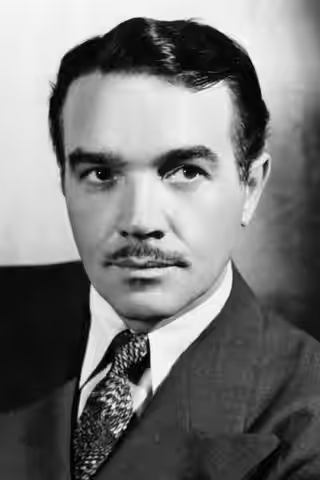
Walter Abel spent forty years in Hollywood as the man behind the desk: the commander, the prosecutor, the inspector who is told things and nods. He was seldom the reason to see a film, and almost never the reason to regret one.
Fi1m perspective
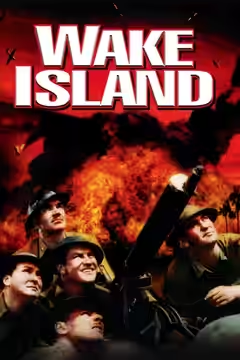
In Wake Island (1942) Walter Abel's Cmdr. Roberts stands still while other men explain the situation to him. He listens, he takes it in, he gives the order that the plot requires. It is the part he was given most often, and he played it without fuss: the rugged face and the husky voice made him look like a man who had earned the desk, and the stage training made him sound like one who meant what he said.
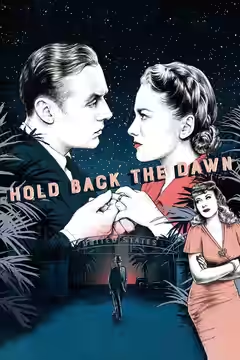
He had started somewhere else. A silent-film bit in 1918, a Broadway debut in 1919, early Eugene O'Neill productions in the mid-1920s, then Merrily We Roll Along on stage in 1934, which won him d'Artagnan in The Three Musketeers (1935). That was the one lead, and it did not make him a leading man. What followed was more than sixty films through the 1940s and 1950s, nearly all of them as authority: the district attorney in Fritz Lang's Fury (1936), the inspector in Hold Back the Dawn (1941), the commander on Wake Island, George Trellis opposite Bette Davis in Mr. Skeffington (1944). He was still working in Mirage (1965) and took his last screen role in Grace Quigley (1985), two years before he died.
The exception people remember is Danny Reed, the agent in Holiday Inn (1942), where the same sincerity is sped up and pointed at Bing Crosby and Fred Astaire and turns out to be funny. Critics noticed the timing there, and in Arise, My Love (1940), and it is a fair reminder that the calm he brought to the desk was a choice rather than a limit.
We will be honest about the two films of his we have reviewed. In Wake Island we caught ourselves waiting for Roberts to do something of his own, and he never does; John Farrow's film is about a garrison, not about people, and Abel plays a man who receives reports. In Hold Back the Dawn he gives Brackett and Wilder's script an immigration inspector who does his job and leaves Charles Boyer and Olivia de Havilland to do the film, and we found no reason to single him out. That is not a complaint. A character actor who is never the problem is worth more to a studio than one who is occasionally the point.
Abel himself had a view on how he got there. "I'd advise any young fellow, or girl, too, who wants a theatrical career, to get his acting experience in the theatre," he told Motion Picture Magazine in 1936. Watch Wake Island for the garrison and Hold Back the Dawn for de Havilland, and notice, in both, the man in the background who is not acting badly. That was the career.
Biography
Walter Abel (1898–1987) was an American stage, film and radio actor. He trained at the American Academy of Dramatic Arts, graduating in 1917, and made his Broadway debut in Forbidden in 1919. He appeared in early Eugene O'Neill productions and many other stage roles, including Merrily We Roll Along.
Abel began film work in the silent era and became a prolific character actor, appearing in more than sixty films. Notable credits include Fury (1936), Hold Back the Dawn (1941) as Inspector Hammock, Holiday Inn (1942), Mr. Skeffington (1944) and Mirage (1965). He served as a vice president of the Screen Actors Guild and was married to concert harpist Marietta Bitter from 1926 until her death in 1979.