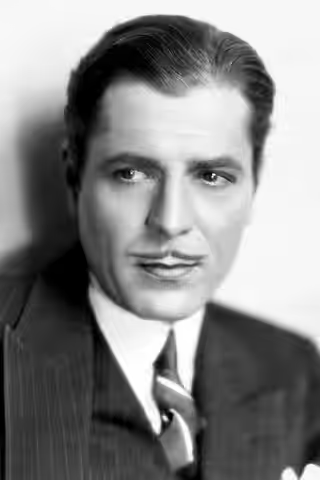
Warner Baxter's trick was ease: the hat lifted, the courtesy that never quite meant it, a man at home in front of a microphone when everyone around him was shouting at it. The parts he got rarely deserved him, and the studios rarely noticed.
Fi1m perspective
Watch Warner Baxter lift his hat in In Old Arizona (1928). He does it at every entrance, to every woman, and never quite means it, and it is the most modern thing in the film. Around him Edmund Lowe shouts every line as if the sound engineer were a field away; Baxter talks to the microphone as if it were a friend across a table. That was the trick, and in 1928, with the microphones only just taken outdoors, almost nobody else had it. His accent as the Cisco Kid is a stage-Mexican thing that would not pass today. The ease underneath it still does.
He had been at it a long time before anyone heard him: an extra from 1914, a lead from 1921, dozens of silents through the decade, among them The Great Gatsby (1926) and, opposite Lon Chaney, West of Zanzibar (1928). In Old Arizona made him a star, and the studios did what studios do with a hit and asked for it again. He spent the 1930s as a charming Latin bandit or a suave professional man, the Cisco Kid repeated and varied, until the persona hardened into a type. By the 1940s he was in B-pictures, and the ten films of the Crime Doctor series, from 1943, kept him working until the end.
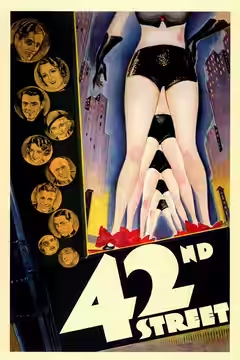
The performances people reach for are the ones where the ease is taken away. As Julian Marsh, the harried director of 42nd Street (1933), he is all drive and desperation, a man with no time to lift his hat. As Dr Samuel Mudd in The Prisoner of Shark Island (1936), the doctor who treated Lincoln's assassin, he did what most critics call his finest acting. We have not reviewed either and will not pretend to a verdict. We note only that both are parts in which a courteous man is pushed past courtesy, and that this is where the type broke open.
Our own moment with him is smaller. In Old Arizona is slow, stagey and thinly written, and for ninety minutes we mostly admired the sound of eggs in a pan. Then the second half takes a turn we will not describe, and Baxter's light manner, which had looked like the whole performance, turns out to have been a way of not showing us something. It unsettled us more than it had any right to, and it is the one place in the film where his ease and Tom Barry's script pull in the same direction.
The caveat is the material. Baxter was at its mercy more often than not, and his years at Fox are full of parts that asked him for the hat and nothing else. He is worth your evening when the film gives him somewhere to go. When it does not, he lifts the hat anyway, and you can watch him not quite mean it, which is more than most of his co-stars managed.
Biography
Warner Baxter was an American film actor active from the 1910s to the 1950s. He began in vaudeville and Broadway before entering silent films, with early roles including appearances in West of Zanzibar (1928).
Baxter gained prominence for playing The Cisco Kid in In Old Arizona (1929), for which he received the Academy Award for Best Actor. He reprised similar characters in the 1930s and appeared in other notable films such as 42nd Street (1933) and The Prisoner of Shark Island (1936). In the 1940s he starred as Dr. Robert Ordway in the Crime Doctor series. He received a star on the Hollywood Walk of Fame.