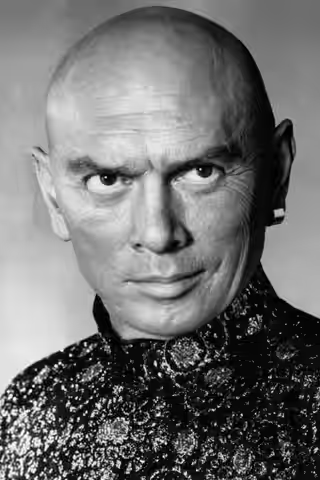
Yul Brynner played kings, pharaohs and gunfighters with his chest out, his fists on his hips and his voice pitched for the back row. It is a large, stylised way of acting, and in the right film it is exactly the right size.
Fi1m perspective
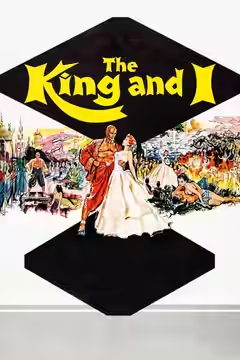
Watch what Yul Brynner does with his hands in The King and I (1956). They go to his hips and stay there, elbows out, so that a barefoot man in silk trousers takes up as much of the wide frame as Deborah Kerr's hoop skirt. He barks "et cetera, et cetera, et cetera" at anyone who finishes a thought before he does. He does not move like a film actor. He moves like a man who has to be seen from the back of the gallery, and he had been: he had played Mongkut on stage since 1951, and he went on playing him until the year he died.
The training explains a good deal. He was a circus acrobat, then a theatre apprentice in Paris, and he arrived in America in 1941 with a body that knew how to hold a pose and a voice that could fill a hall. Broadway came first, with Lute Song in 1946; the film debut was Port of New York in 1949. Then came 1956, and three films in it: The King and I, The Ten Commandments as Rameses, and Anastasia as General Bounine. Hollywood had decided what he was for, which was a foreign man in charge. He knew it, and said so without complaint: he played, in his words, "a lot of strange characters in a lot of strange lands".
The strange lands soon included the Old West. The Magnificent Seven (1960) put him at the head of the gunfighters as Chris Adams, the one who talks least and is obeyed most, and it is the King with the volume turned down: the same stillness, the same posture, the same sense that everyone else has to arrange themselves around him. He worked three times with Anatole Litvak and kept at the epics and Westerns through the sixties, and by Westworld (1973) he was playing a robot gunslinger, which is where a career of playing men who never blink was always going to arrive.
The complaint, made since 1956, is that this is ham: flamboyant, stylised, every gesture too clean. Sometimes it is. Comedy did not suit him and nor did ordinary Americans in ordinary clothes, and the films that asked for either left him stranded. But look at Shall We Dance?. Brynner puts his hand on Kerr's waist, she shows him the polka, and the shot is held as they go round the floor and round again. We thought we knew the scene, and our throat tightened anyway, because for two minutes a man who has spent the whole film striking attitudes stops striking them and simply dances with someone he cannot have.
He shaved his head for Mongkut and never grew the hair back. He played the part 4,625 times. Few actors have been so certain what they were for, or kept proving it for so long.
Biography
Yul Brynner, also credited as Yuli Borisovich Bryner, was a Russian-born American stage and film actor. He was born on 11 July 1920 in Vladivostok and died on 10 October 1985 in New York City.
Brynner achieved prominence for his portrayal of King Mongkut of Siam in the Rodgers and Hammerstein musical The King and I, which he performed more than 4,000 times on stage from 1951 onwards and reprised in the 1956 film adaptation, for which he won the Academy Award for Best Actor. He also played Rameses in Cecil B. DeMille’s The Ten Commandments (1956).
Other notable film roles include Chris Adams in The Magnificent Seven (1960) and the Gunslinger in Westworld (1973). He maintained a shaved head as a personal trademark after adopting it for The King and I.