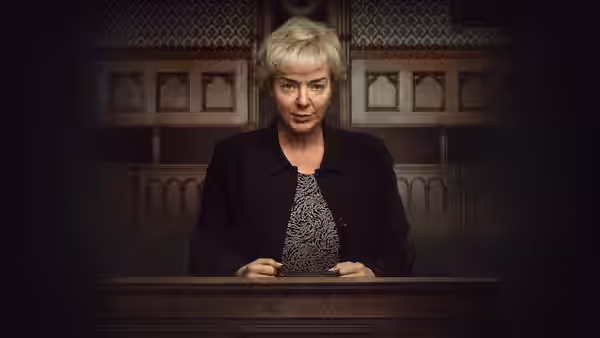
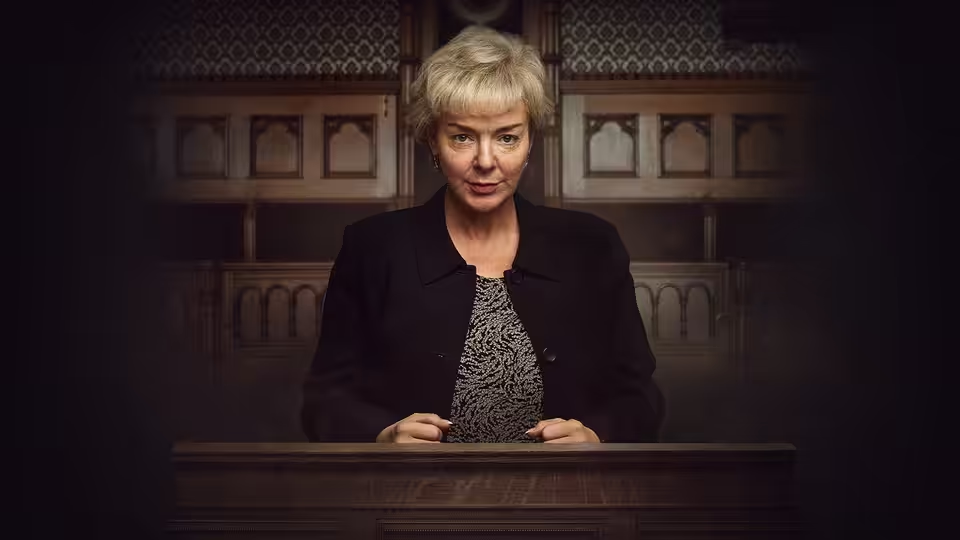
Ann Ming (Sheridan Smith) stands behind a wooden lectern in a courtroom
Series review

I Fought the Law

2025 · Created by Ann Ming, Jamie Crichton · Series

In a sentenceA Teesside mother, a bath panel, and a legal principle that had never met anyone as stubborn as her

Billingham, Teesside, 1989. Julie Hogg (Victoria Wyant), a young mother, does not come home one night, and her mother Ann Ming (Sheridan Smith) goes to the police. Officers search Julie’s house and find nothing. Ann and her husband Charlie (Daniel York) take in Julie’s small son Kevin (Buddy Wignall-Ho) and wait by the phone with their own two children, Gary (Marlowe Chan-Reeves) and Angela (Olivia Ng). Weeks later Ann goes back to the house herself and finds what the police did not, behind the bath panel. A local man, William Dunlop (Jack James Ryan), is arrested. What follows, over four episodes, is Ann’s long argument with the English legal system, which has a rule called double jeopardy that she has never heard of and will come to know by heart.

Fi1m review

Sheridan Smith plays Ann Ming, the Teesside mother who took on the double jeopardy rule after her daughter’s murder, and she is the reason to watch. The series around her is built from the standard true-crime kit, and it knows it.

I Fought the Law is a four-part drama about Ann Ming, written by Jamie Crichton, directed by Erik Richter Strand, and created by Crichton with Ann Ming herself. That last credit tells you most of what you need to know about its intentions. This is her account, told her way, and it does not pretend otherwise. It is a good programme, worth four evenings if British true-crime drama is a genre you can bear, and Sheridan Smith is the reason it is more than that.

Smith plays Ann as a woman who was never going to be a campaigner and becomes one because nobody else will. She is small and quick and ordinary, a nurse with a kitchen to run, and the performance is built out of plain actions: making tea, answering the door, telling a sergeant he is wrong. There is very little big acting in it. When Ann is frightened she goes quiet, and when she is furious she goes quieter, and Strand has the sense to keep the camera close and let her do it.

The scene in the bathroom horrified us, and not because of what is shown, which is almost nothing. It is the time it takes. Ann has been told the house is clear, she is cleaning it so the family can let it go, and she notices the panel. Smith does not scream. She makes a sound we had not heard from her before and had not expected, and then she does the practical thing, which is worse. We thought about it for the rest of the night.

Around her the cast is solid and the writing less so. Daniel York plays Charlie Ming with great patience, a husband who holds the house together while his wife is on the phone to lawyers, and the script gives him almost nothing to want for himself. Jack James Ryan is careful as William Dunlop, never playing him as a monster and never asking for sympathy either, which is the right choice and a brave one. Luke Cinque-White and George Potts, as Sergeants Murphy and Wilkinson, have the thankless job of being the police who got it wrong, and they play it straight. Jake Davies, as Matthew Hogg, gets a handful of scenes and makes them count.

The trouble is the shape. Once the series leaves the house and goes to court, it reaches for the usual furniture: the montage of letters, the sympathetic politician, the lawyer who explains that this is simply how it is. We have seen each of these beats in a dozen other programmes, and Crichton does not find a way to make them new. A strand about the racism the Mings face, Charlie being Chinese and Billingham being Billingham, is raised in the first episode and then put down, as if someone had noted it was important and then run out of hours. Smith carries these stretches on her own, and they are the only parts of the series where you can feel her carrying.

There is also the matter of the argument. Double jeopardy, the rule that a person acquitted cannot be tried again for the same crime, exists for reasons, and they are not stupid ones. The series gives those reasons to men in wigs who are there to be overcome. Ann Ming was right, in our view, and the law agreed with her in the end, but a drama that had let the other side make its case properly would have made her victory look harder and so larger. With the subject in the creators’ chair, that was never likely.

Still, we were moved more than we expected, and we are not easily moved by this genre. It was the kitchen that did it, the four of them around the table with a child who does not understand why his mother is not coming back, and nobody making a speech.

Watch it in two sittings rather than four, and resist looking up the real case until you have finished. The programme is in no hurry to tell you how it comes out, and neither are we.

Critical consensus AI synthesised

77
Positive
4
Mixed
0
Negative
0

With only 4 reviews in so far, the lean is uniformly favourable and the praise clusters almost entirely on Sheridan Smith, whom every critic names as the reason the series works, playing a bereaved mother pursuing justice with what one review calls quiet precision. Most find the drama moving despite a familiar true-crime shape, with the supporting cast and the care taken over the material also noted. The reservations are few and specific: The i Paper finds the character of Charlie underwritten and the handling of racism shallow, and The Guardian considers the structure formulaic, though neither holds it against the whole.

The Guardian
31 August 2025 · Lucy Mangan
80*

Mangan finds the drama genuinely moving despite its formulaic structure. She singles out Sheridan Smith’s performance for elevating the script, with strong support from the cast.

Read the full review →
Radio Times
31 August 2025 · Jon O'Brien
75*

The review presents the series as a heart-rending true-crime drama, with Sheridan Smith delivering a strong performance. It singles out her portrayal of a bereaved mother seeking justice for her murdered daughter.

Read the full review →
The i Paper
31 August 2025 · Hannah Bentley
75*

The review finds the drama a moving tribute to Ann Ming’s fight for justice, led by Sheridan Smith’s powerful performance. It praises Smith’s quiet precision but criticises Charlie’s underdeveloped character and the storyline’s shallow treatment of racism.

Read the full review →
Digital Spy
31 August 2025 · Janet A Leigh
80*

The critic finds the series harrowing but compelling, ultimately calling it unmissable. Sheridan Smith’s emotionally grounded performance is especially praised, alongside the sensitive storytelling and supporting cast.

Read the full review →

Straight answers AI written, from our review

Is I Fought the Law worth watching?
I Fought the Law is worth watching if British true-crime drama is a genre you can bear, and we scored it 74. Sheridan Smith, as the Teesside mother Ann Ming, is the reason to see it: the four episodes around her reach for the usual courtroom furniture, and she carries them. Watch it in two sittings rather than four.
Where can I watch I Fought the Law in Türkiye?
I Fought the Law is not on any streaming or rental service in Türkiye at the moment. It is available in 4 other countries; change your country at the top of the page to see where. Availability is checked daily.
How violent or frightening is I Fought the Law, and is it suitable for children?
I Fought the Law has no certificate and shows almost no violence; what disturbs is a murdered daughter and the moment her mother finds what the police missed behind a bath panel. That scene horrified us for how long it takes rather than for anything on screen, and grief is the subject throughout. It is not for children; the squeamish will cope, the easily upset may not.
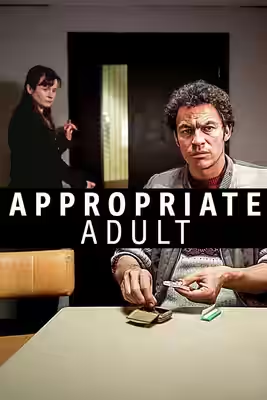
How does I Fought the Law compare to Appropriate Adult?
I Fought the Law and Appropriate Adult are both British true-crime dramas carried by one woman's performance, and Appropriate Adult is the tighter and more exact of the two. Over four parts the newer series leans on familiar legal-drama beats that Sheridan Smith has to hold up alone; Neil McKay's two-parter rarely wastes a scene. Choose the film for restraint, the series for Smith's stubborn Ann Ming.
What should I watch after I Fought the Law?
After I Fought the Law, try Appropriate Adult (2011, Fi1m 84): Emily Watson sits in a police interview room with Fred West and listens. Then In the Name of the Father (1993, Fi1m 83): A wrongful conviction, a father and son in the same cell, and Pete Postlethwaite.

Cast

If you liked this, try…

  1. Appropriate Adult (2011, Fi1m 84)Emily Watson sits in a police interview room with Fred West and listens.

  2. Three Girls (2017) · not reviewed yetRochdale, the families, and the officials who did not want to know.

  3. In the Name of the Father (1993, Fi1m 83)A wrongful conviction, a father and son in the same cell, and Pete Postlethwaite.

  4. The Investigation (2020) · not reviewed yetA Danish murder inquiry that never shows the killer and is better for it.

  5. Anne (2022) · not reviewed yetMaxine Peake as a Hillsborough mother who would not let the inquest lie.

Free account

Know what to watch tonight

Two lists that know where things are streaming, collections you can share, your own score beside ours, and Discover that remembers what you have seen.

  • Want to see, sorted by what is streaming now
  • Seen, with your score out of ten
  • No adverts, ever