David Attenborough’s history of life is absorbing, clear and often moving. The teaching occasionally hurries past an animal we would like to watch longer, but the series rewards the concentration it asks for.
Life on Earth makes a persuasive case for spending time being taught something. David Attenborough’s account of evolution is clear, absorbing and often moving, even when the amount it needs to explain makes an individual passage feel hurried. Across 13 episodes, the ambition is to connect living creatures with the history that produced them. That gives the animal encounters a purpose beyond the pleasure of seeing something unfamiliar, though that pleasure is never treated as beneath the programme.
David Attenborough is both writer and presenter, and the continuity of the explanation matters. His narration makes the subject approachable without pretending that a few memorable animals can account for all of it. We are asked to follow relationships and changes, to keep one explanation in mind while another develops. For a nature documentary, that is a demanding approach: attention has to last longer than the excitement of a new creature appearing.
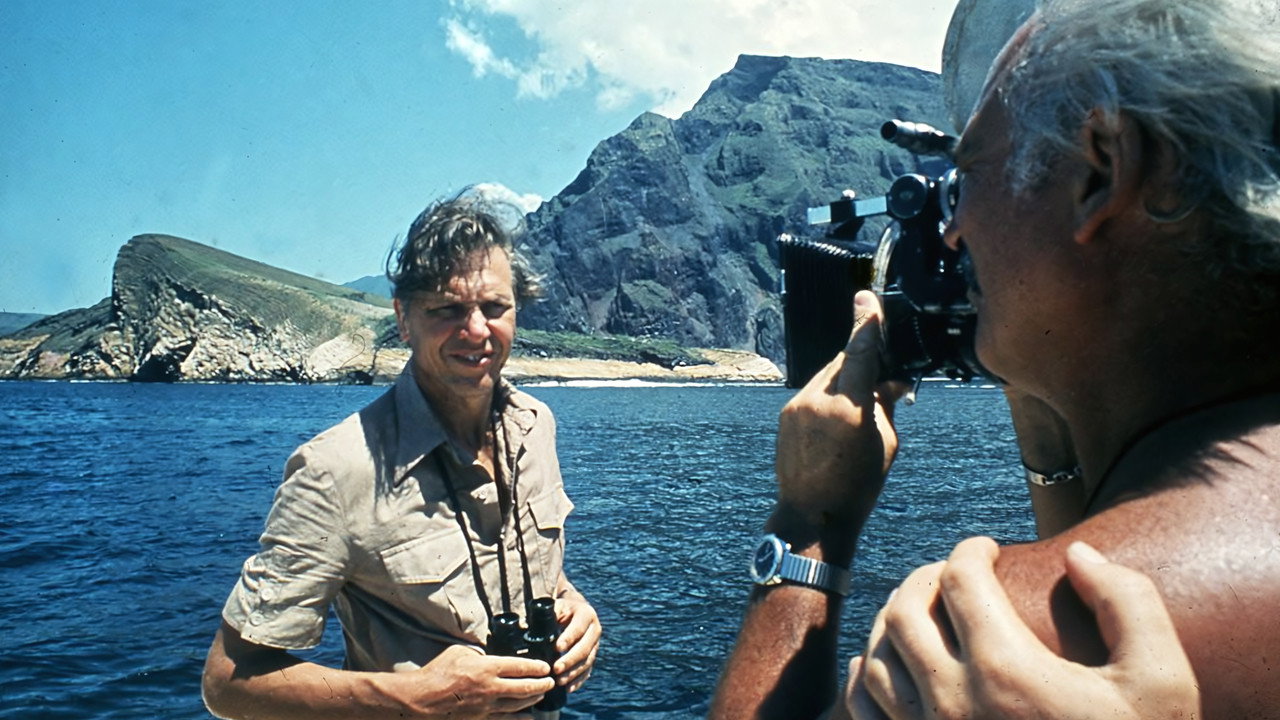
The encounter with gorillas in the Virunga Mountains is the moment when that account feels most immediately relevant. We were moved by the closeness of David Attenborough and the animals. Having a person there gives us some sense of what it might be like to share their space, and his presence does not make them less interesting in their own right. The evolutionary history matters here because we have been encouraged to look for connections between living things.
Maurice Fisher’s cinematography supports that close attention. The animals remain worth watching while the explanation unfolds, and the pictures do more than illustrate the next piece of narration. In the gorilla encounter, the proximity itself is enough to hold us; extra insistence would only get in the way. The photography is strongest when it allows us time to look at an animal and notice something for ourselves before the explanation moves on.
Alec Brown, Ron Martin, David Barret, Peter Simkins and Betty Block are credited as editors. The editing has to carry an explanation through changes of subject, and it generally leaves us able to follow the thinking without losing interest in the animals. Edward Williams’s music is useful in support, though the spoken account supplies most of the momentum. Across the series, we can usually understand why we have been shown a particular creature and how it connects to what came before.
The difficulty comes when the programme seems ready to move on as soon as an explanation is complete. We occasionally wanted longer with an animal, even at the risk of learning less about the next one. At 55 minutes, each episode asks for sustained concentration, and the amount of information can become tiring. The encounters give the series room to relax, but the teaching sometimes seems impatient to get to its next point.
We do not need a nature programme to sound astonished on our behalf. Life on Earth gives us the information with which to make our own discoveries, and that makes it unusually good company. Its 13 episodes deserve to be taken in order rather than treated as a queue to be cleared. Watch one, give it your attention, and leave enough of the evening to think about it.