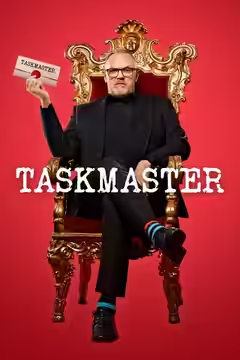
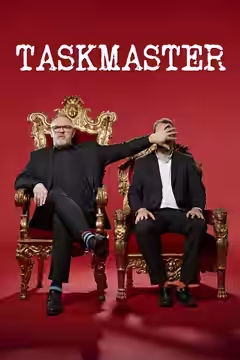
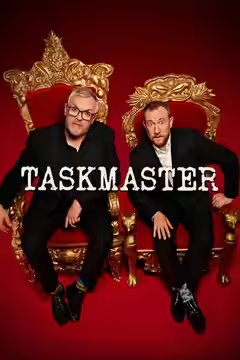
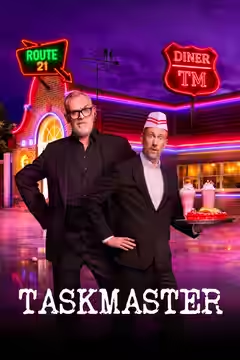
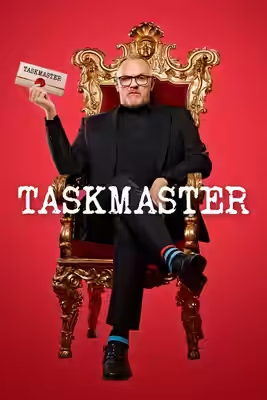
Greg Davies and Alex Horne sit on ornate red-and-gold thrones in a decorated room
Series review

Taskmaster

2015 · Created by Alex Horne · Series · MPA TV-14

In a sentenceWe would not normally accept this much supervision while eating doughnuts

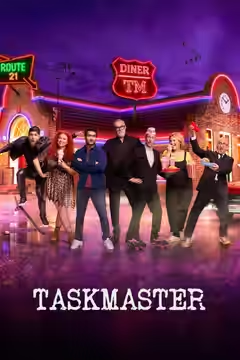
Greg Davies presides as the Taskmaster, with Alex Horne serving as his assistant and devising the games. Participants across the series include Asim Chaudhry, Russell Howard and Jack Dee, all appearing as themselves. Their job is to tackle challenges that can involve something as ordinary as eating doughnuts, with each participant bringing a different approach to the assignment. The changing line-up faces the tasks and one another, while Greg Davies and Alex Horne retain their overseeing roles. The games provide the immediate problem; the participants’ responses and their relationships with one another shape what follows.

Fi1m review

Taskmaster makes inventive games feel like an evening in good company. Alex Horne and Greg Davies provide the dependable centre; the chief caveat is that some line-ups give the silliness considerably more life than others.

Taskmaster is an inventive, companionable comedy whose chief weakness is how much depends on the changing company. Alex Horne, its creator and writer, gives people games that make their different approaches worth watching, without requiring us to care deeply about the competition. That sounds like a modest ambition, and it is one that comedy programmes can spoil by trying to look more important. There is no embarrassment here about the prospect of an evening spent being silly.

Greg Davies is the Taskmaster, with Alex Horne as his assistant, and the arrangement supplies a useful degree of ridiculous authority. A game involving doughnuts hardly requires such grand job titles, which is part of the pleasure. We laughed at the doughnut-eating challenge because it made the adults’ willingness to bother feel so recognisable. There is something cheering about a programme that takes this sort of play seriously enough to make it work.

The writing deserves credit for choosing activities that leave room for personality. An elaborate puzzle can reduce everyone to the same puzzled expression; these games offer scope for an approach we might admire, question or recognise as uncomfortably close to our own. Alex Horne’s inventiveness is valuable because the amusement continues beyond the initial explanation of the task. We become interested in how particular people will respond, and a simple activity can sustain more attention than its description would suggest.

Andy Devonshire directs, while James Dillon handles production design, and our strongest impression of their work is that it supports the foolishness without demanding separate admiration. This is a programme we remember through participants and games rather than through individual images. The production feels proportionate to the pleasure on offer, which matters when the subject is adults entertaining themselves. We never need an eating challenge to look like a major event; we need to enjoy the people attempting it.

The caveat is casting. A line-up can be perfectly capable and still fail to give the games much extra life. When the contestants enjoy one another’s company, the exchanges feel worth hearing even if the task itself is slight; a less responsive group makes us notice how much repetition the premise involves. We are more indulgent of an ordinary game than of an episode in which the people never quite interest us. Inventing another challenge cannot fully repair that.

That limitation is familiar in ensemble comedy, but it is particularly noticeable here because so much pleasure rests on temperament. We do not need every participant to be relentlessly funny, and the effort to dominate can be less enjoyable than a relaxed contribution. The programme is at its most welcoming when there is room for several different ways of being amusing. Its childishness helps: a shared appetite for messing about gives these people sufficient reason to spend time together, without needing to manufacture much else.

We would recommend it with that casting caveat, especially to anyone tired of comedy that seems anxious to prove its intelligence. Some company will suit us better than others, and an uneven line-up need not put us off the programme. There is no need to demand more seriousness from it. Watch it with someone whose approach to a simple problem has long puzzled you.


Critical consensus AI synthesised

68
Positive
3
Mixed
0
Negative
1
The Guardian
8 May 2019 · Jack Seale
85*

Seale finds the series a carefree, comfortingly childish hit despite a somewhat underpowered new cast. He praises its silly charm and inventive games, especially the doughnut-eating challenge.

Read the full review →
The i Paper
11 September 2019 · ★★★★ · Sarah Hughes
80

Hughes says this episode restores her faith in the series, with its comedy driven by the chemistry among the contestants. She especially praises the laid-back partnership of Jo Brand and David Baddiel, whose relaxed detour becomes a highlight.

Read the full review →
Radio Times
6 October 2020 · Lauren Morris
75*

Morris presents the new series as a silly, much-needed dose of escapism. The page’s description singles out its side-splitting humor, though the full review is unavailable.

Read the full review →
Vulture
17 June 2026 · Roxana Hadadi
30*

Hadadi finds Nanjiani’s season 21 run middling and argues his celebrity status and the show’s casting choices left him struggling to fit in. She praises Jason Mantzoukas’s distinctive, chaotic approach as a strong contrast that helped make him memorable.

Read the full review →

Straight answers AI written, from our review

Is Taskmaster worth watching?
Taskmaster is worth watching for inventive games and companionable comedy, and we score it 82. Alex Horne and Greg Davies provide a dependable centre, but our enjoyment depends on the changing contestants: some groups make even an ordinary challenge entertaining, while others expose the repetition.
How long is Taskmaster, and what is it rated?
Taskmaster is rated TV-14 by the MPA in the US. It is a comedy series.
Where can I watch Taskmaster in the US?
Taskmaster is streaming on Hulu and Disney+ in the US, and it is also available to buy from Apple TV. Availability is checked daily; the links above go straight to each service.
How violent or frightening is Taskmaster, and is it suitable for children?
Taskmaster carries a UK 15 certificate and a US TV-14 rating, so its silly games should not be taken as a recommendation for younger children. The comedy centres on adults tackling challenges, including eating doughnuts; those certificates suggest a teenage-and-adult audience, but do not by themselves establish particular levels of violence or frightening content.
How does Taskmaster compare to The General?
Taskmaster shares The General’s pleasure in practical ingenuity, but we find the film the stronger choice for sustained action comedy. Buster Keaton’s railway adventures offer more spectacle, while the programme finds its humour in different personalities attempting simple tasks. We recommend Taskmaster for relaxed company, with the caveat that its changing line-ups make it less consistent.
What should I watch after Taskmaster?
After Taskmaster, try The General (1926, Fi1m 91): For the pleasure of watching practical ingenuity meet spectacularly awkward circumstances. Then PlayTime (1967, Fi1m 88): For anyone who enjoys watching ordinary objects defeat otherwise capable adults; and Detectorists (2014, Fi1m 87): Quieter companionship and small obsessions, with the same affection for human eccentricity.

Cast

If you liked this, try…

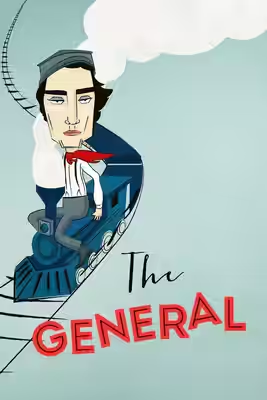
  1. The General (1926, Fi1m 91)For the pleasure of watching practical ingenuity meet spectacularly awkward circumstances.

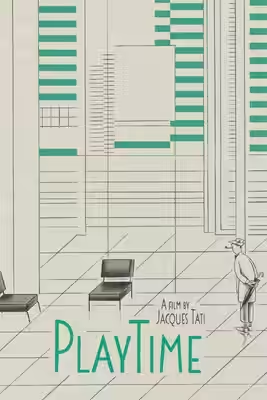
  2. PlayTime (1967, Fi1m 88)For anyone who enjoys watching ordinary objects defeat otherwise capable adults.

  3. Takeshi's Castle (1986) · not reviewed yetPhysical challenges make adult dignity expendable, with considerably more falling into water.

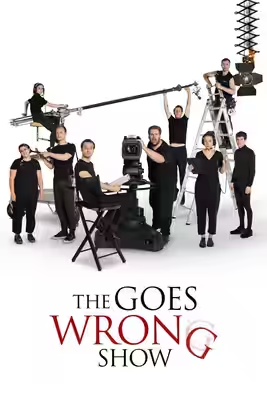
  4. The Goes Wrong Show (2019) · not reviewed yetAnother carefully organised comedy built around people failing at apparently manageable jobs.

  5. Detectorists (2014, Fi1m 87)Quieter companionship and small obsessions, with the same affection for human eccentricity.

Free account

Know what to watch tonight

Two lists that know where things are streaming, collections you can share, your own score beside ours, and Discover that remembers what you have seen.

  • Want to see, sorted by what is streaming now
  • Seen, with your score out of ten
  • No adverts, ever
Taskmaster (2015) review: Silly games with some uneven company (the US) | Fi1m