Kim Seong-hun’s thriller about a crooked detective and the body he cannot get rid of is fast, funny and precisely built. The people in it are thin and the last act is louder than it is clever, but the first hour is hard to fault.
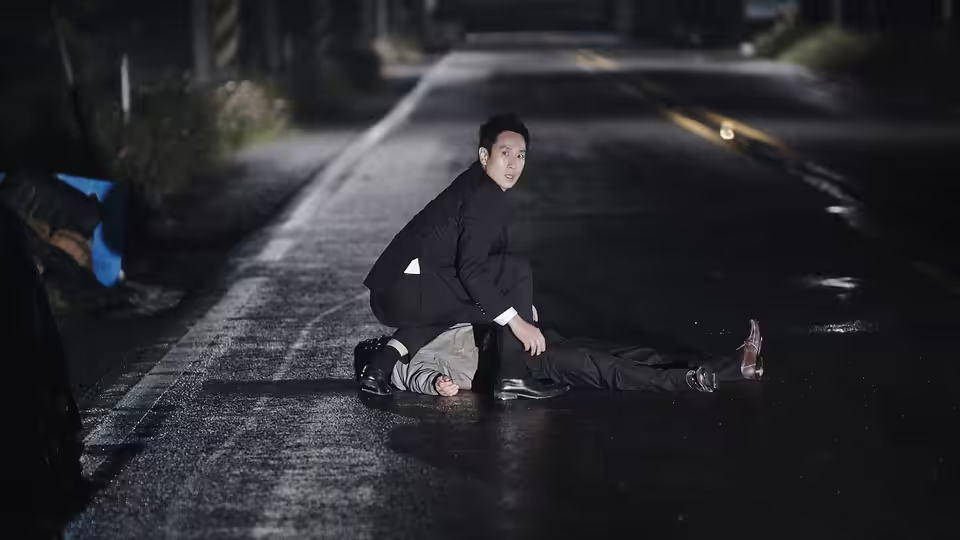
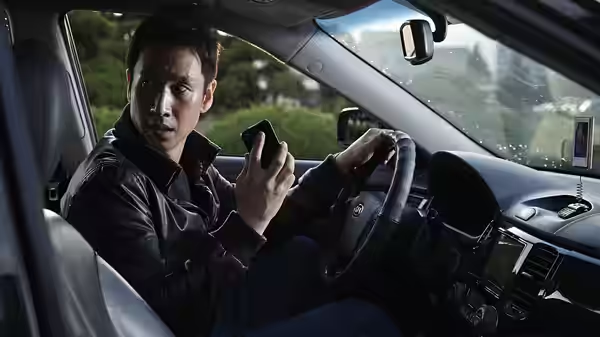
Go Gun-su (Lee Sun-kyun) is a homicide detective who has been taking money, and A Hard Day finds him on the night everything comes due at once. His mother has died, inspectors are going through his squad’s desks, and on the way to the funeral home he runs a man down on an empty road. Kim Seong-hun, who wrote the script with Jang Hang-jun, builds the first hour out of that one night, and the building is the pleasure of the film. Each thing Gun-su does to get out of trouble puts him in more of it.
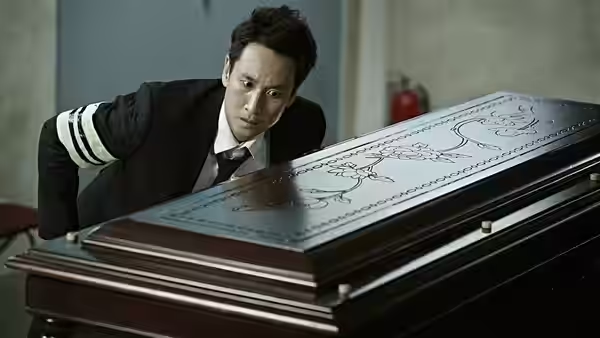
The sequence people will tell you about is in the funeral home. Gun-su has a corpse in his car and a coffin with his mother in it, and he works out that the coffin is the one place nobody will look. Getting the body there without anyone noticing is the set piece, and it is built from whatever is in reach. We laughed at it, loudly, and then felt slightly ashamed of ourselves, because what we were laughing at was a man climbing into his own mother’s coffin while his sister (Shin Dong-mi) knelt in the next room. Kim Chang-ju’s editing cuts between the mortuary and the mourners so that every laugh arrives with a wince attached.
Lee Sun-kyun holds his face almost still and lets the rest of him do the acting. At the drink-driving checkpoint he plays an entire argument with himself through one wet eye on the rear-view mirror. Later he climbs, falls, is hit by doors and cars, and never looks like a man enjoying it. Cho Jin-woong, as the man on the phone, is pleasant and soft-spoken and smiles a lot, which is more frightening than shouting. Jeong Man-sik and Shin Jung-geun, as Gun-su’s colleagues, are too busy shredding paper to care what has happened to him.
Kim Tae-sung shoots the road at night in headlight glare and orange street light, and the funeral home in flat white fluorescent, so the two halves of Gun-su’s problem look like different films. Lee Mi-kyoung’s production design gives the squad room stacked boxes and locked drawers, a place with things to hide. Mok Yeong-jin’s score is low drums and something like a ticking clock, and for most of the first hour it keeps time. Later it starts to push.
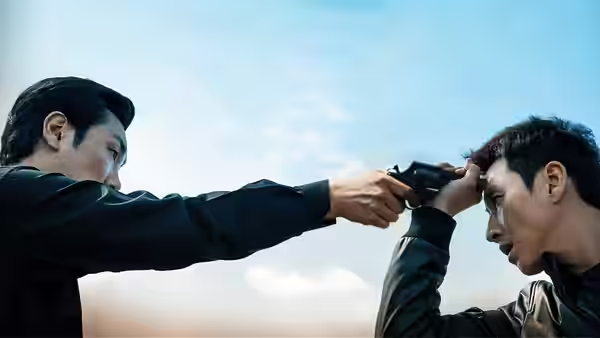
So does the film. Once Gun-su knows who he is up against, the story takes a turn we will not describe, and it stops being about a man who cannot tell anyone anything and becomes two men hitting each other. The fights are well staged, in a stairwell, a flat and a car park, but they are fights, and we have seen fights. The invention of the first half, where every object in reach had to be used for something it was not meant for, gives way to force. We did not get bored, but we noticed we were no longer leaning forward.
Then there is Gun-su himself. He is a crook from his first scene and never feels bad about anything, and the film does not ask him to. That is fine for a farce, and this is a farce with blood in it, but it means the last act is about who is left standing, not who deserves to be. Most critics have made both complaints, the loud second half and the thin people, and we agree. Neither spoiled the evening.
The Korean police thriller usually arrives with weight, Memories of Murder being the standard. This one is lighter and nearer to Blood Simple: a trap built from one bad decision, with the pleasure in watching it close. At 111 minutes it is the right length. Watch it with your phone face down. The plot runs on a telephone, and you will not want reminding that you own one.