Guillaume Brac’s hour-long comedy about a shy man, a seaside town after the season and a mother and daughter who are kind to him is small, funny and unexpectedly tender. It is slight by design, and once or twice it likes its hero more than it should.
Guillaume Brac’s film runs 58 minutes, which makes it either a long short or a very short feature, and it does not much care which. It is set in Ault, a small resort on the Picardy coast, at the point in late summer when the town starts to empty, and its hero is Sylvain (Vincent Macaigne), who lets holiday flats and has too little to do. Into one of them arrive Patricia (Laure Calamy) and her teenage daughter Juliette (Constance Rousseau), down for a few days by the sea. Sylvain hands over the keys and then finds reasons to stay. That is the whole film. It is small, funny and kind, and we liked it a great deal.
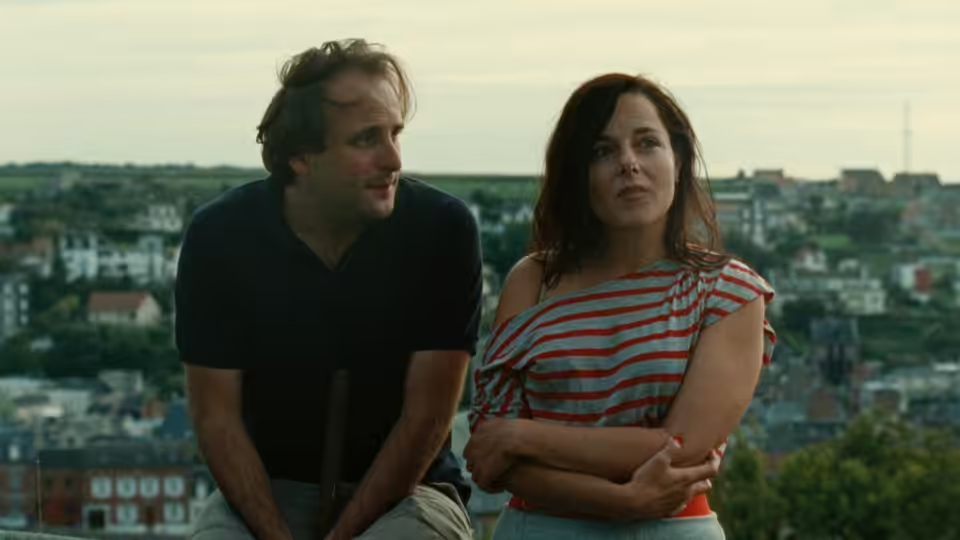
Macaigne is the reason it works. Sylvain is bearded, balding and heavy, with a laugh that arrives a second before anything is funny, and he speaks in sentences that trail off into apologies. He is the sort of man who rehearses a casual remark for ten minutes and then delivers it too loudly. Macaigne never asks us to feel sorry for him, and so we did. We laughed at him the first few times, and then, watching him hover on the beach a few yards from the two women, dressed for a different season and pretending to look at the sea, we stopped laughing and felt something closer to recognition. Most of us have been that man for an afternoon. Sylvain is him for life.
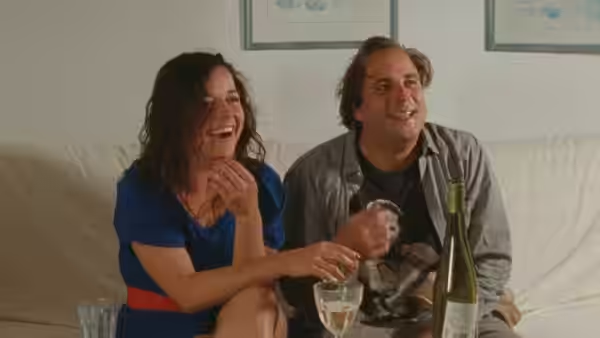
Calamy plays Patricia as a woman who flirts out of habit and kindness in roughly equal parts, and who notices Sylvain’s devotion without quite knowing what to do with it. Rousseau’s Juliette watches everyone, says little and misses nothing. Laurent Papot’s Gilles is the film’s cleverest piece of casting: good-looking, comfortable in a room full of strangers, everything Sylvain is not. Brac and his co-writer Hélène Ruault put the two friends side by side and never once make Gilles the villain. He is simply the man women look at, and he knows it, and he is not unkind about it, which is worse.
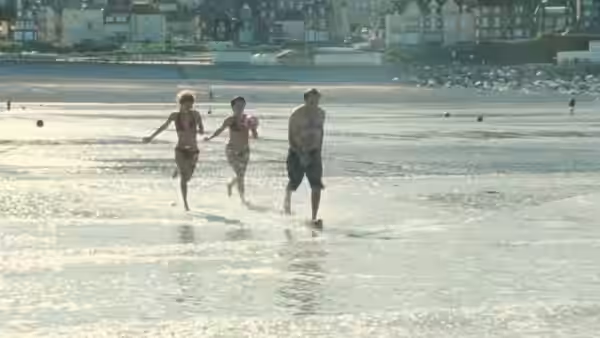
Tom Harari shoots the town in flat grey Channel light, the chalk cliffs pale behind the beach and the streets quiet enough that a passing car counts as an event. There is no attempt to make Ault pretty, and it becomes rather lovely as a result. Harari also supplies the music, and uses almost none of it; most scenes play to wind and gulls and the scrape of a chair. Damien Maestraggi cuts patiently. When a conversation goes wrong, the camera stays for the silence afterwards rather than rescuing anyone, and the film’s best jokes live in those extra seconds. A night at the local club, past Eric Hannier’s bouncer and into a room where everyone is twenty years younger than Sylvain, is staged as gently as it could be and is still hard to watch.
The flaws are the flaws of scale. An hour is enough for Sylvain but not for anyone else; Patricia gets one good scene of her own and Juliette is a sketch, alert and unfinished. The young men working the beach (Terry Fouache, Geoffrey Boulanger and Cédric Cailleux, credited as beach chat-up artists) are there to show us what confidence looks like from the outside, and they do that and nothing more. And Brac’s affection for Sylvain, which is the film’s great strength, occasionally tips into indulgence: there are moments where the script lets him off a hook a sharper film would have left him on. The title, meanwhile, promises an argument about men and women. It is a joke about one man’s week, and a good one, but readers expecting a thesis should lower their sights.
Brac had already tried Sylvain out in an earlier short, Le Naufragé, and this is the fuller portrait. Set against the long French tradition of holiday films in which people talk beautifully about their feelings, it is notable for how badly its people talk. Nobody here can say what they mean. That is the comedy and, by the end, the sadness, and Brac trusts us to find both without help.
Watch it on a grey evening at the end of a holiday you did not quite enjoy. It is over before the kettle has boiled twice, and it will stay with you longer than most films twice its length.