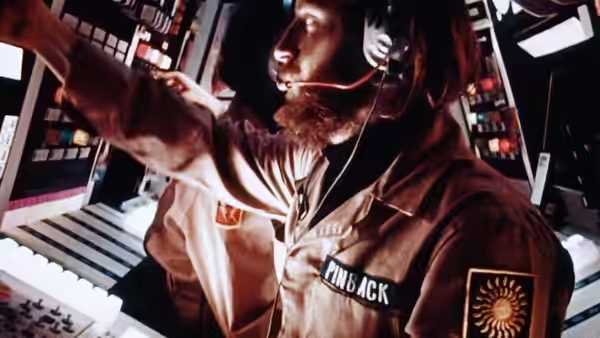
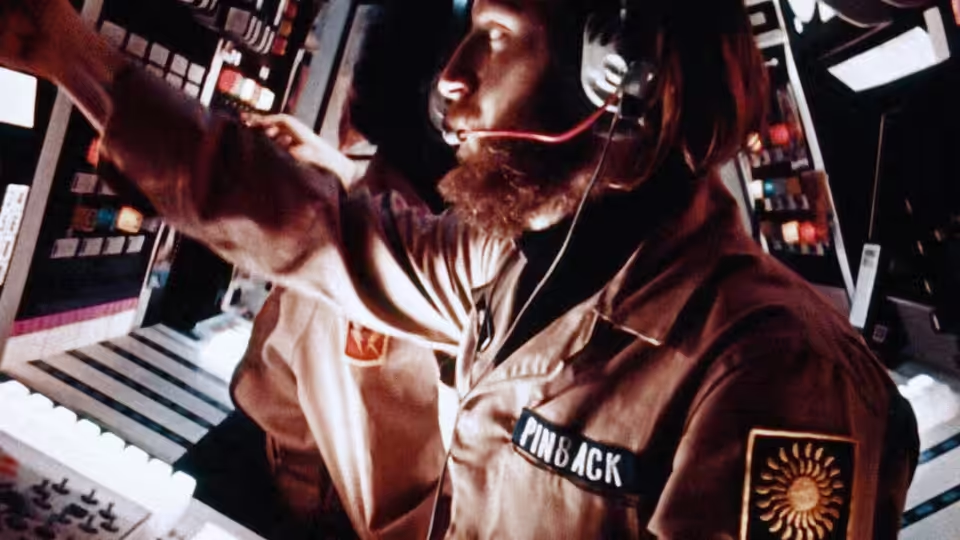
Sgt. Pinback (Dan O'Bannon) reaches across illuminated control panels in the spacecraft cockpit
Film review

Dark Star

1974 · Directed by John Carpenter · 1h 23m

In a sentenceTwenty years in deep space and the only one aboard with a plan is the bomb

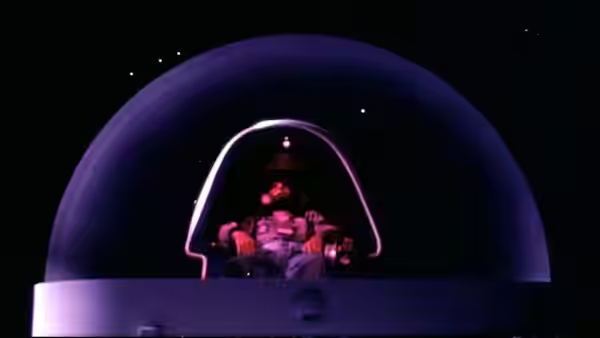
The scout ship Dark Star is twenty years into a mission to blow up unstable planets. Its commander, Powell (voiced by Joe Saunders), is dead and kept in cold storage, where he can still be consulted. Lt. Doolittle (Brian Narelle) has command and would rather be surfing. Boiler (Cal Kuniholm) cleans guns. Talby (Dre Pahich) sits alone in the observation dome and watches the stars. Sgt. Pinback (Dan O’Bannon) keeps a video diary in which he insists he is not Pinback at all, and looks after the ship’s alien, a painted beach ball with feet. The bombs are intelligent and talk, and when a fault tells Bomb #20 (voiced by Adam Beckenbaugh) to arm itself while still in the bay, the crew have to reason with it.

Plays from YouTube when you press play; nothing loads from them until then.

Fi1m review

John Carpenter’s first feature is a plywood spaceship crewed by bored men and a bomb that wants to discuss things. It is slow, thinly acted and often charming, and two sequences are as good as anything he made later.

John Carpenter’s first feature began as a student film and was stretched to 83 minutes with almost no money and a good deal of cardboard. It is a comedy about boredom, which is a risk, because a film about bored men can easily become a boring film, and for stretches this one does. It is also, in two or three sequences, inventive and sad in ways that science fiction with far larger budgets rarely manages. We came out fond of it and unable to pretend the middle half hour had not dragged.

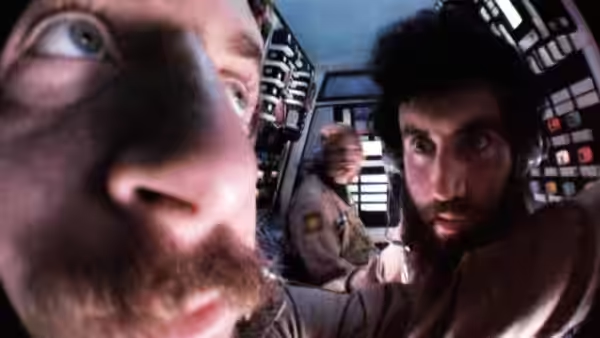
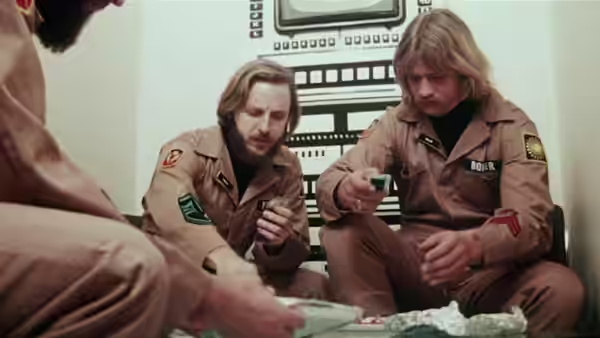
The joke is 2001: A Space Odyssey with the dignity removed. Kubrick’s astronauts were calm, clean and tended by a computer that took an interest; Carpenter and O’Bannon’s are unwashed, sulking and tended by a computer (Cookie Knapp) with the manner of a tired school secretary. The crew mark time. Doolittle plays an organ he has built from bottles, Pinback records diary entries nobody will watch, Talby will not come down from the dome. The bombs are the idea that lifts it above spoof: they are polite, literal-minded and keen to do their job, and when one is told to arm itself while still bolted to the ship, the crew have to talk it round like a man on a ledge.

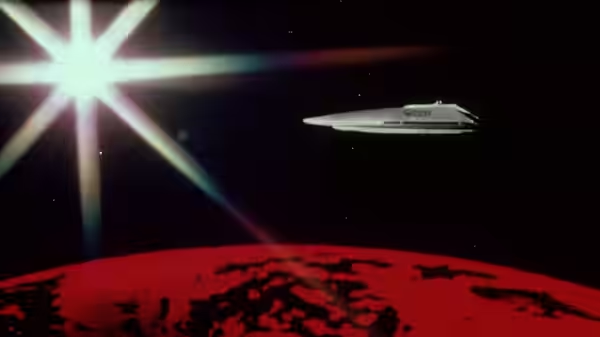
O’Bannon designed the ship, and it looks like what it is, a run of grey corridors and painted panels with the seams showing. Douglas Knapp shoots them flat and front-on, as if there were nowhere else to put the camera, which there probably was not, and then lights the dome so that Talby’s face is lit by nothing but stars. The model shots of the ship sliding past a red planet are better than they have any right to be. Carpenter wrote the music himself: a plain, pulsing synthesiser line under the corridors, and over the opening titles a country song, Benson, Arizona, sung by a man homesick for a town he will not see again. The song is the best thing in the film and it tells you in three minutes what the next eighty are about.

The alien chase is the set piece everyone remembers, and rightly. Pinback goes to feed the beach ball, is bitten, chases it into a lift shaft, and ends up wedged beneath a lift that is about to move. We laughed out loud, more than once, at a man in a boiler suit losing a fight with an inflatable, and O’Bannon, who also cut the film, knows exactly how long to hold the shot before the lift starts. As an actor he plays Pinback as someone who has been making the best of things for far too long and has run out of best.

Then there is Talby. Dre Pahich spends the film in the dome, his lines dubbed by Carpenter, talking about the Phoenix Asteroids, a cluster that passes through once in an age and glows as it goes, and he wants to see them. We expected to laugh and found instead that it got to us: a man two decades from home whose only wish is to be allowed to look out of the window. Nothing in the film is played straighter, and nothing in it lands harder.

What does not work is most of the rest. Narelle and Kuniholm are not actors in any sense that helps, and the script gives them little to do between set pieces but lie in bunks and complain. The diary scenes repeat a joke that was thin the first time. Several gags run a beat long because there was plainly nothing else to cut to. Around the forty-minute mark we were bored, and not in the way the film intended.

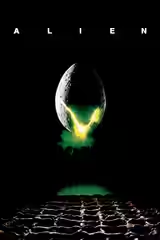
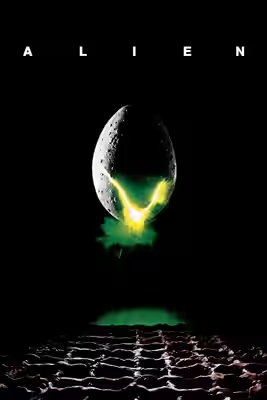
Much of what both men did later is already here in rough form. O’Bannon took the fractious crew, the pet that bites and the unhelpful computer to Alien five years on, and gave the beach ball teeth. Carpenter took the synthesiser and the patient, wide framing to Assault on Precinct 13 and Halloween. Nick Castle, the man inside the beach ball, would wear a different mask for Carpenter in 1978.

The last twenty minutes are the reason the film is still talked about, and we will not describe them, beyond saying that the bomb gets the best dialogue. Watch it late, with company, and be forgiving for the first hour. It runs 83 minutes and carries a PG.

Critical consensus AI synthesised

55
Positive
2
Mixed
1
Negative
2
Empire
1 January 2000 · Adam Smith
85*

The critic finds the film a distinctive, warmly human comedy whose desperation and melancholy lift it beyond spoof. They praise how Carpenter turns the tiny budget and shabby sets into an effective contrast with the polished science fiction of 2001: A Space Odyssey.

Read the full review →
Slant Magazine
3 November 2010 · ★★★½ · Simon Abrams
70

Abrams finds the DVD edition a worthwhile update despite its disappointing picture quality. He praises the abundant special features, especially the informative production documentary and interviews.

Read the full review →
Time Out
· MA
67*

The page identifies this as a review and describes the film as Carpenter’s fondly remembered first feature. The accessible text singles out its space-bound take on Waiting for Godot, but the review’s full verdict is unavailable.

Read the full review →
Variety
31 December 1973 · Variety Staff
20*

Variety judges the film a limp, dim comedy and a weak parody of 2001: A Space Odyssey. It singles out the remarkably believable special effects, achieved on a very small budget, as the main reason to pay attention.

Read the full review →
Eye for Film
22 April 2004 · Martin Gray
25*

Gray finds the film tedious and poorly acted, with too few ideas to sustain its comedy. He singles out the beach-ball alien chase as the highlight and praises Carpenter’s music for keeping him awake.

Read the full review →

Straight answers AI written, from our review

Is Dark Star worth watching?
Dark Star is worth watching for anyone curious about John Carpenter's beginnings or fond of science fiction with the dignity removed, and we scored it 68. It is slow and thinly acted, and the middle half hour drags, but the alien chase and Talby in the observation dome are as good as anything Carpenter made later. Watch it late, with company, and be forgiving.
How long is Dark Star, and what is it rated?
Dark Star runs 1h 23m. It is a comedy and science fiction film.
Where can I watch Dark Star in Türkiye?
Dark Star is not on any streaming or rental service in Türkiye at the moment. It is available in 11 other countries; change your country at the top of the page to see where. Availability is checked daily.
What should I watch after Dark Star?
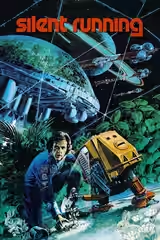
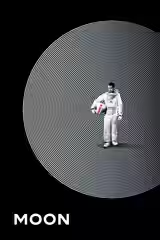
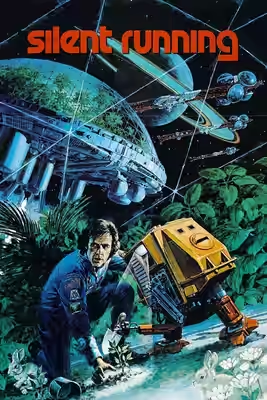
After Dark Star, try Silent Running (1972, Fi1m 76): Another lonely man in a ship with the wrong companions, played straight and sadder. Then Alien (1979, Fi1m 92): O’Bannon’s crew again, same grumbling, but this time the pet means it; and Moon (2009, Fi1m 83): One bored man, one polite computer, a small budget spent exactly where it counts.

Cast

If you liked this, try…

  1. Silent Running (1972, Fi1m 76)Another lonely man in a ship with the wrong companions, played straight and sadder.

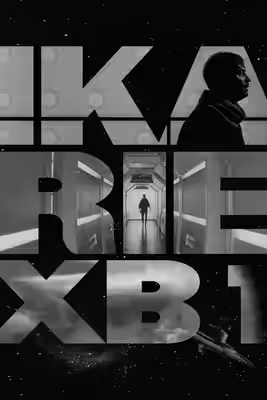
  2. Ikarie XB-1 (1963) · not reviewed yetCzech deep-space tedium and dread, shot with the elegance Carpenter could not afford.

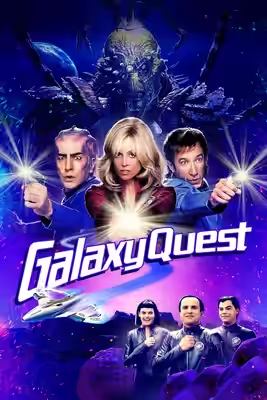
  3. Galaxy Quest (1999) · not reviewed yetSpace opera sent up by people who plainly love it, with a budget this crew never saw.

  4. Alien (1979, Fi1m 92)O’Bannon’s crew again, same grumbling, but this time the pet means it.

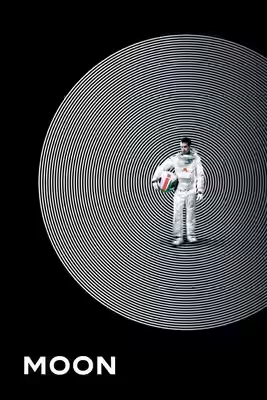
  5. Moon (2009, Fi1m 83)One bored man, one polite computer, a small budget spent exactly where it counts.

Free account

Know what to watch tonight

Two lists that know where things are streaming, collections you can share, your own score beside ours, and Discover that remembers what you have seen.

  • Want to see, sorted by what is streaming now
  • Seen, with your score out of ten
  • No adverts, ever