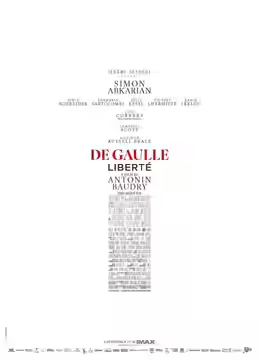
The second half of Antonin Baudry’s two-film account of de Gaulle is brisk, handsome and easy to be carried along by, with Simon Abkarian and Simon Russell Beale bickering their way to Paris. It is also a national anthem played at full volume for 159 minutes.
Antonin Baudry has split the war years of Charles de Gaulle across two films, and this is the second, the one where the general stops being a nuisance in exile and becomes the man France is waiting for. The pitch is simple. De Gaulle (Simon Abkarian) has almost nothing: no territory, no money, an ally who cannot stand him and an American rival the Americans prefer. He wins anyway, because he refuses to consider any other outcome. Baudry and his co-writer Bérénice Vila have made a film that shares that refusal entirely, and it is both the pleasure and the problem.
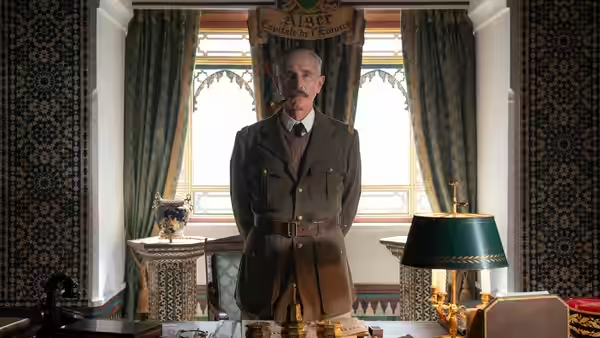
It is a pleasure first. Baudry moves. The script hops from London to the North African desert to occupied France and back with the confidence of a serial, and Rehman Nizar Ali’s cutting keeps every strand short enough that we never lose the thread of another. Pierre Cottereau shoots the desert in hard white light and the London offices in the brown of old varnish, so that you always know where you are before anyone speaks. Benoît Barouh has dressed those offices with the clutter of an organisation run on borrowed furniture, and it is a nice touch that de Gaulle’s headquarters looks poorer than everyone else’s.
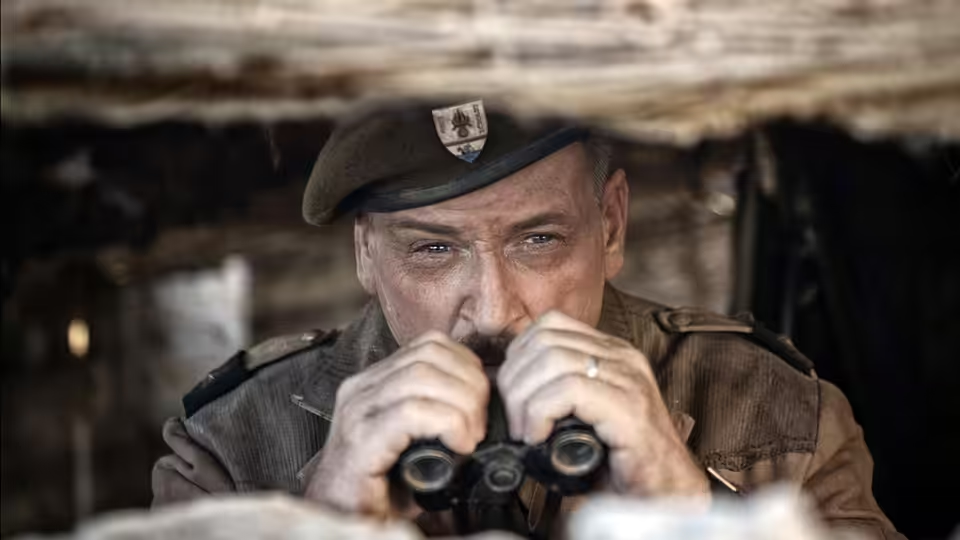
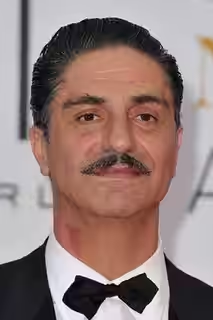
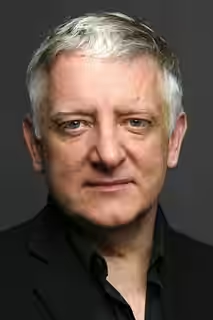
Abkarian is the reason it holds. He plays de Gaulle as a man who has decided that vanity and patriotism are the same thing and sees no reason to apologise for either. He is funny, in a dry, appalled way, and he is never once likeable, which is braver than it sounds in a film this fond of its subject. Simon Russell Beale’s Churchill is his match: a man who knows he is being used, knows he is right to allow it, and hates every minute. Their scenes together, with Tom Mison’s Eden and Anthony Calf’s Spears wincing at the edges, are the best writing in the film, and we could have watched another hour of them.
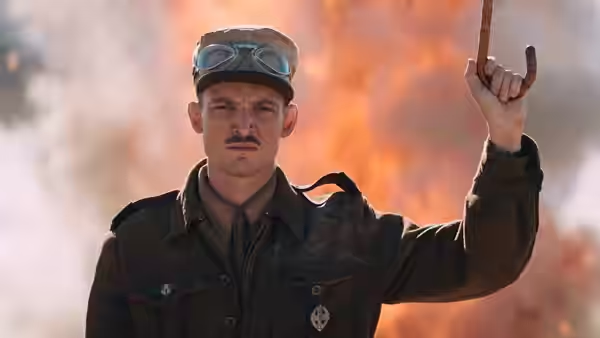
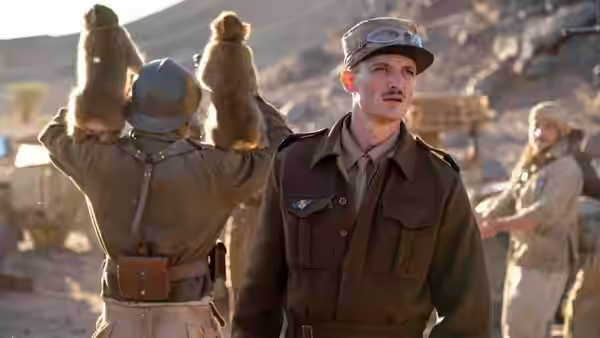
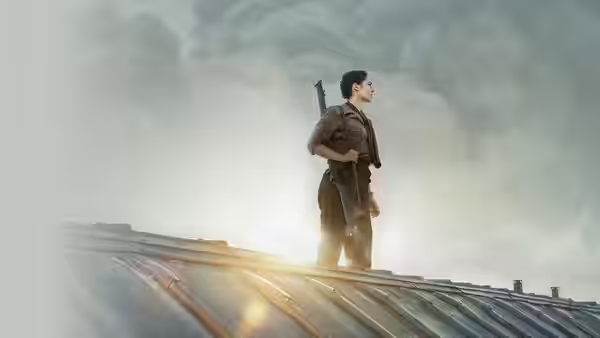
The other strands are livelier than they are deep. Niels Schneider gives Général Leclerc a lean, sunburnt impatience that suits the desert sequences, and Noémie Schmidt’s Susan Travers, driving him across it, is a character we wanted more of than the script had time for. Anamaria Vartolomei, as the resistance courier Livia, does the most with the least: a woman who has learned to be forgettable, watching a room. Karim Leklou’s Blazej is the film’s conscience about who did what under occupation, and Baudry writes him with a sharper, more modern tongue than anyone else. Thierry Lhermitte’s Giraud is played, fairly or not, as a decent dim man being outmanoeuvred, and Lhermitte plays it without a hint of complaint.
Then there is the volume. Théo Cascio’s score does not so much accompany the film as escort it, brass under the speeches, strings under the flags, and by the second hour we had stopped noticing when it was on because it never was not. The Times is right that the patriotism is unembarrassed. What it costs is doubt. Nobody in this film wonders whether de Gaulle is worth it; the Americans are wrong, the Vichy men are wrong, Churchill is wrong until he is not. A story about a man who bet on himself would be stronger if the film ever let us think the bet could fail.
We were stirred anyway, and we should say when. It was a broadcast scene, a single microphone in a small room and a voice going out to people we have just watched hide from soldiers, and Cottereau simply holds on the faces listening. No score, for once. That is the film working, and it works because it is quiet. The battle sequences that follow are well staged and easy to read, but they moved us less than that room did.
The second half heads where history heads, through D-Day to Paris, and we will not describe how Baudry stages the arrival. We will say that at 159 minutes the film starts to feel its length about twenty minutes before it ends, and that the flag-waving, which we forgave for two hours, becomes hard to forgive in the third.
If you saw the first film, you will want this one, and it is the better of the two at moving. If you did not, it explains itself well enough. Take it as a war serial with excellent character actors and a national anthem for a score, and you will have a good evening. Take it as history and you will spend the drive home arguing.