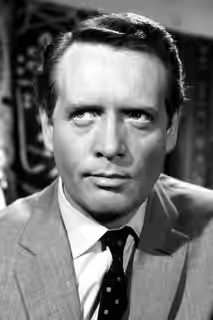
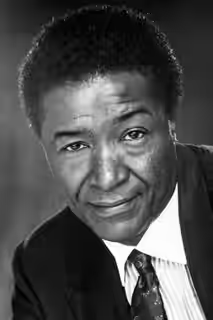
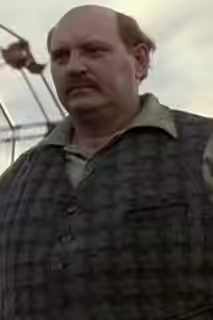
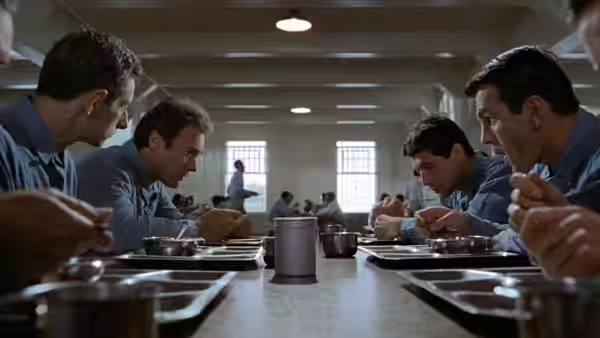
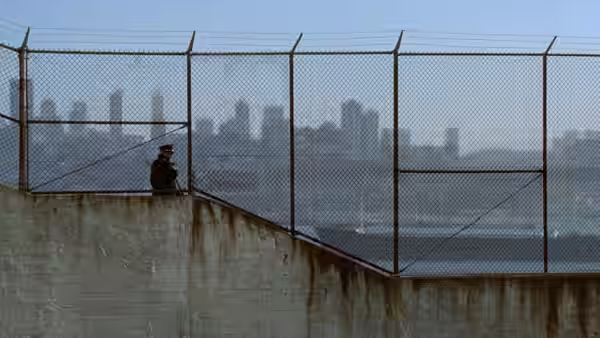
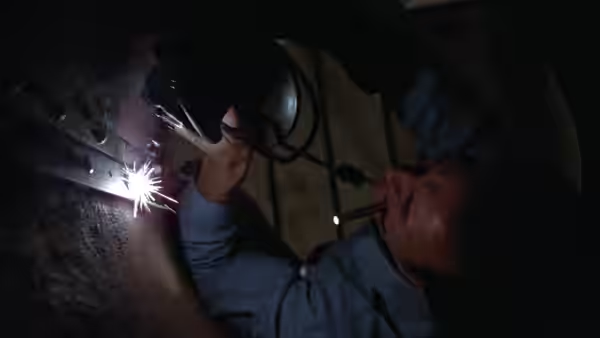
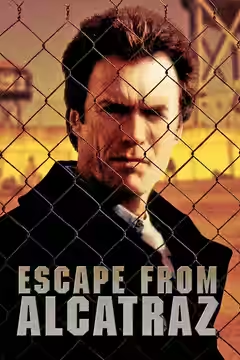
Frank Morris (Clint Eastwood) stands on rocky shore, facing the water beyond Alcatraz
Film review

Escape from Alcatraz

1979 · Directed by Don Siegel · 1h 53m

In a sentenceA man scrapes at a wall with a spoon for two hours and we never once wanted him to stop

San Francisco Bay, 1960. Frank Morris (Clint Eastwood), who has broken out of other prisons, is brought by boat through the rain to Alcatraz, stripped, searched and walked naked down the cellblock to his cell. Next morning the Warden (Patrick McGoohan) clips his nails and tells him that nobody has ever escaped from the island and nobody ever will. On the yard Morris meets Doc (Roberts Blossom), an old man who paints portraits, English (Paul Benjamin), who runs the library, and Litmus (Frank Ronzio), who keeps a mouse in his shirt. In the showers he meets Wolf (Bruce M. Fischer), who wants him. Then the Anglin brothers (Jack Thibeau and Fred Ward) arrive, and Morris notices the concrete around the vent grille crumbles under a nail clipper.

Fi1m review

Don Siegel’s prison film is stripped to the bone: a man, a cell, a spoon and a wall. It is patient, cold and quietly gripping, Eastwood has never been better used, and Patrick McGoohan’s warden is the best thing in it.

Don Siegel and Clint Eastwood, who had made Dirty Harry (1971) together, here make a prison film with almost nothing in it. A man arrives on an island. He finds that the wall is softer than it should be. Richard Tuggle’s screenplay has no speeches, no flashbacks and no family waiting on the mainland, and Siegel directs it as if any of those would have been an embarrassment. It is lean, cold and quietly gripping, and we recommend it, with one caveat: it will tell you nothing about how anyone in it feels.

The opening twenty minutes are close to wordless. Morris crosses the bay in the rain and is stripped, searched and walked naked down the block, and Bruce Surtees shoots it with so little light that we see him mostly by the wet on his shoulders and the whites of his eyes. The interiors stay dim throughout: the cells grey and green, the yard overcast, the nights lit by a searchlight and nothing else. Allen E. Smith’s cells are exactly as small as they need to be, and the vent grille Morris studies sits low, where a man has to kneel to work at it.

Then McGoohan arrives, and the film gets its opponent. His Warden clips his nails while telling Morris the rules, and speaks in a soft, reasonable, slightly amused voice that promises nothing good. Where Eastwood underplays, McGoohan underplays further, and their few scenes together are contests to see who can give less away. The script makes him a plain villain, and McGoohan is too intelligent an actor to leave it there. He lets us see that the Warden is bored, and that the cruelty comes from the boredom.

Eastwood has never had much range and here he does not need any. Morris watches, measures and waits, and Eastwood never asks for our sympathy, which is why we give it. The inmates around him are types rather than people. Roberts Blossom’s Doc paints portraits and grows chrysanthemums; Paul Benjamin’s English holds the top step of the yard and runs the library; Frank Ronzio’s Litmus keeps a mouse in his shirt; Larry Hankin’s Charley Butts, in the next cell, is nervous and eager. Each gets one trait and plays it well. Jack Thibeau and Fred Ward, as the Anglin brothers, are good-natured, practical and mostly there to carry things.

Here is the part we did not expect. Midway through, Morris is chipping at concrete with a sharpened spoon, a guard’s footsteps come along the walkway, and we found we had stopped breathing. Jerry Fielding’s score is a handful of low notes at the start and the finish and almost nothing between, so the sound of the film is the prison itself: doors, keys, boots on metal, the foghorn across the water. Ferris Webster cuts the digging as routine, the same few shots repeated night after night, and every repeat is another chance to be caught. We have sat through car chases that gripped us less than a man scraping plaster into a towel.

Doc’s story takes a turn that we will not describe. It is the one moment when the film shows what the place does to someone who cannot leave it, and it is over in a minute. We were shaken, and then slightly cross that the film treated it as a plot point. That is the limit of this kind of film: when it needs us to feel, it has to borrow the moment rather than build it.

Siegel had made a prison film before, Riot in Cell Block 11 (1954), and that one was angry about the system. This one accepts that Alcatraz is a rock full of men and asks only whether one of them can get off it. It is far quieter than Dirty Harry, and the one in which Siegel’s plainness pays off most completely. It runs 113 minutes and carries a 15, mostly for the shower block.

Watch it in the dark with the sound up. The film is made of small noises, and most of them will frighten you more than any speech would have.


Critical consensus AI synthesised

72
Positive
2
Mixed
2
Negative
0
Variety
31 December 1978 · Variety Staff
85*

The review praises the film as relentlessly tense and exceptionally efficient, with only its ambiguous ending cited as a possible fault. It singles out Patrick McGoohan’s performance as the key counterpoint to Clint Eastwood’s character.

Read the full review →
Time Out
· GA
75*

The review is clearly favorable, describing it as Siegel’s strongest work since The Shootist. It singles out the supposedly successful escape from Alcatraz as the film’s central appeal.

Read the full review →
RogerEbert.com
64*

The page could not be accessed, so the critic’s verdict is unavailable. No specific praise or criticism can be verified from the supplied text.

Read the full review →
The New York Times
22 June 1979
64*

The page content is inaccessible, so the critic’s verdict cannot be established. No specific praise or complaint is available to summarize.

Read the full review →

Straight answers AI written, from our review

Is Escape from Alcatraz worth watching?
Escape from Alcatraz is worth watching for anyone who can sit with a slow, quiet thriller, and we scored it 82. Don Siegel strips the prison film to a man, a cell, a spoon and a wall, and the digging grips harder than most car chases. It will tell you nothing about how anyone in it feels, which is the one caveat.
How long is Escape from Alcatraz, and what is it rated?
Escape from Alcatraz runs 1h 53m. It is a drama and thriller film.
Where can I watch Escape from Alcatraz in Estonia?
Escape from Alcatraz is not on any streaming or rental service in Estonia at the moment. It is available in 21 other countries; change your country at the top of the page to see where. Availability is checked daily.
How violent or frightening is Escape from Alcatraz, and is it suitable for children?
Escape from Alcatraz carries a UK 15, mostly for the shower block, where another inmate makes his intentions towards Morris plain, and it is not for children. There is little blood and the fear comes from small sounds, footsteps on a walkway and keys in a door, rather than from anything shown. Teenagers who can take tension without release will be fine.
How does Escape from Alcatraz compare to A Man Escaped?
Escape from Alcatraz is the more conventional of the two, with a named villain in McGoohan's Warden and a cast of inmate types, where A Man Escaped is sparer still, built from hands, spoons and silence. Bresson's is the purer and the more demanding film; Siegel's is the easier evening. Both make sound carry the danger.
What should I watch after Escape from Alcatraz?
After Escape from Alcatraz, try A Man Escaped (1956, Fi1m 90): Bresson’s prison break, even sparer than Siegel’s, built from hands, spoons and silence. Then Le Trou (1960, Fi1m 88): Five men dig out of a Paris cell in near real time; the digging is the film; and Cool Hand Luke (1967, Fi1m 84): Paul Newman on a chain gang, warmer and talkier, with the same contempt for the warden.

Cast

If you liked this, try…

  1. A Man Escaped (1956, Fi1m 90)Bresson’s prison break, even sparer than Siegel’s, built from hands, spoons and silence.

  2. Le Trou (1960, Fi1m 88)Five men dig out of a Paris cell in near real time; the digging is the film.

  3. Brute Force (1947) · not reviewed yetDassin’s angry prison noir, with Hume Cronyn as the sadistic captain McGoohan might have studied.

  4. Cool Hand Luke (1967, Fi1m 84)Paul Newman on a chain gang, warmer and talkier, with the same contempt for the warden.

  5. A Prophet (2009, Fi1m 86)Audiard’s French prison drama, about learning the place rather than leaving it.