A woman in a coat stands before broad stone steps as people pass behind her
Film review

Finding Vivian Maier

2014 · Directed by John Maloof, Charlie Siskel · 1h 23m

In a sentenceWe would happily trade several theories about Vivian Maier for another look at her photographs

Vivian Maier is a Chicago nanny who keeps her street photographs private. John Maloof brings that work to public attention and sets out to learn about the woman who made it. He narrates the search, with Maier appearing in archive footage and gallery owner Howard Greenberg among the interviewees. The investigation has photographs to examine and people to question, but Maier’s guarded life complicates the effort to assemble her biography. Maloof follows the discovery of the work into an inquiry about the photographer’s independence, habits and reasons for keeping the pictures to herself.

Plays from YouTube when you press play; nothing loads from them until then.

Fi1m review

An engaging introduction to Vivian Maier’s photographs, weakened by too much speculation about their maker. John Maloof and Charlie Siskel keep the search moving, but the pictures deserve more attention than the personal mystery.

Finding Vivian Maier is a worthwhile, sometimes frustrating introduction to a photographer whose pictures deserve more time than the film gives them. John Maloof and Charlie Siskel organise it around the discovery of her work and the attempt to understand its maker. That gives the documentary a clear purpose and an engaging line of enquiry. It also means that looking at a photograph can start to feel like a pause in the more pressing business of investigating the photographer.

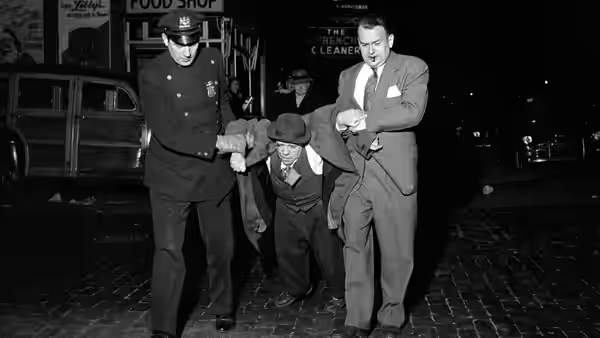
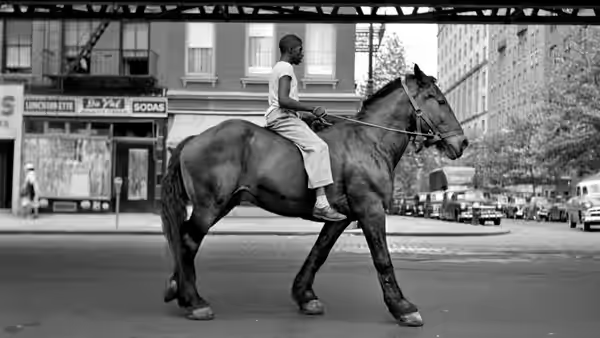
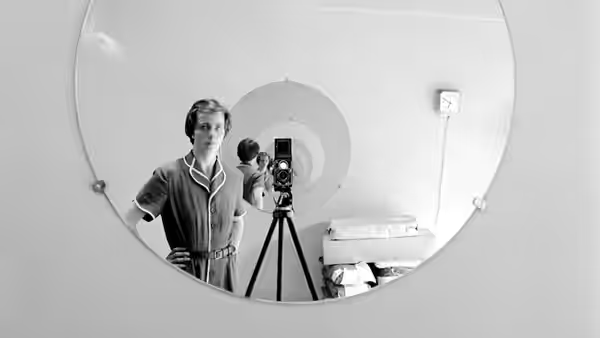
Maier’s street photographs are the strongest reason to watch. The film lets them establish her ability, so that we can understand Maloof’s excitement without simply taking his word for it. We were moved by these pictures, then frustrated when the documentary hurried back to questions about her private habits. A longer look at the work would also help us assess the enthusiasm expressed in the interviews.

Maloof’s position makes this more interesting than a routine portrait assembled at a distance. He is the narrator, co-director and the person responsible for bringing the photographs to light, so his curiosity has a practical purpose. We can follow the investigation without needing to be persuaded that there is something worth finding. His commercial interest in the work nevertheless deserves closer scrutiny, because the film is also helping to establish the reputation of the photographer whose work he promotes.

John Maloof’s cinematography keeps the interview material visually plain, allowing the photographs to command attention. The interviews give the search a human presence, although they also help make other people’s impressions feel more authoritative than they should. Aaron Wickenden’s editing makes the enquiry easy to follow, moving between the work and the accounts of Maier with a fluency that keeps curiosity alive. The drawback is that this momentum encourages us to wait for another personal detail rather than sit with an image.

The more troublesome passages treat Maier’s independence and difficult behaviour as clues to something wrong with her. Unflattering testimony belongs in a biography, but it needs careful handling when the subject’s motives remain uncertain. The film too often invites diagnosis, with curiosity tipping into gossip. Her choice to keep work private warrants a question; the persistence of the questioning starts to make privacy itself look suspect. This is where the documentary’s sympathy feels least secure.

J. Ralph’s score lends warmth to the investigation, encouraging sympathy even when the questioning becomes intrusive. That is useful, though the photographs scarcely need musical help to hold our attention. The film also raises resistance from the art establishment without giving it the sustained examination it gives Maier’s personality. We would have welcomed a closer look at who gets to decide that unfamiliar work deserves attention.

As documentary detection, it holds the attention across its 83 minutes. Anyone hoping for sustained discussion of how Maier made her photographs should temper their expectations: the film spends much of that time on the search and the testimony. We would recommend it to viewers interested in photography, with reservations about how it handles its subject. Go for the pictures, and take the amateur psychology cautiously.

Critical consensus AI synthesised

69
Positive
9
Mixed
6
Negative
0

Most critics find Finding Vivian Maier an absorbing documentary, with praise clustering around Maier’s street photographs and the investigation into her elusive life. The images provide the strongest point of agreement: reviews repeatedly single out their power, while many find the gradual portrait of their maker compelling. Several also value John Maloof’s direct involvement in the discovery, which gives the film access to a story its subject kept private.

Reservations concern how that story is told, with responses ranging from warm approval to mixed assessments. Some critics find the mystery insufficiently resolved; others think the pursuit of personal revelations displaces attention to the art. The Skinny objects to gossipy psychological speculation, while The New Yorker challenges the tendency to treat Maier’s independence and difficult behaviour as pathology. Maloof’s financial stake also divides opinion: Vulture explicitly rejects the suggestion that his commercial interests undermine the film.

Vulture
28 March 2014 · Jerry Saltz
90*

Saltz warmly praises the absorbing documentary and credits Maloof with bringing Maier’s work to light. He singles out the power and intensity of her photographs, while rejecting criticism that Maloof’s commercial interests undermine the film.

Read the full review →
Radio Times
★★★★ · Adam Smith
80

The review finds the documentary compelling and skilfully, sympathetically made. It particularly praises the story of Maier’s discovery and the film’s portrayal of her complex character.

Read the full review →
The Guardian
17 July 2014 · Peter Bradshaw
78*

Bradshaw finds the documentary fascinating and praises Maier as a brilliant, undiscovered talent. He particularly highlights the striking street photographs and the mystery surrounding Maier’s life.

Read the full review →
Los Angeles Times
27 March 2014 · Kenneth Turan
75*

Turan finds the documentary gripping and its central mystery fascinating, while noting that Maier remains elusive. He praises the film’s direct access to the story through co-director John Maloof, whose determination to uncover Maier’s life drives the investigation.

Read the full review →
RogerEbert.com
28 March 2014 · ★★★/4 · Sheila O'Malley
75

The review regards the documentary as an engaging portrait that leaves Vivian Maier’s mystery intact. It singles out the photographs and the film’s exploration of the elusive photographer for praise.

Read the full review →
Variety
14 September 2013 · festival review · Rob Nelson
75*

Nelson finds the documentary initially playful and ultimately haunting, praising its balance of insider knowledge and universal intrigue. He singles out the vivid photography and the slow, compelling portrait of Maier, while noting the film’s limited exploration of art-world resistance.

Read the full review →

Straight answers AI written, from our review

Is Finding Vivian Maier worth watching?
Finding Vivian Maier is worth watching for viewers interested in photography, though its intrusive speculation makes our recommendation a qualified one; we score it 68 out of 100. The photographs moved us, and the investigation holds our attention, but we wish the film spent longer examining Maier’s work and less time trying to explain her private habits.
How long is Finding Vivian Maier, and what is it rated?
Finding Vivian Maier runs 1h 23m. It is a documentary film.
Where can I watch Finding Vivian Maier in Hong Kong?
Finding Vivian Maier is streaming on MUBI in Hong Kong. Availability is checked daily; the links above go straight to each service.
How does Finding Vivian Maier compare to The Gleaners and I?
Finding Vivian Maier offers an engaging photographic investigation, but we recommend The Gleaners and I more warmly for the space Agnès Varda gives people to speak. Both documentaries attend to what gets kept, discarded and overlooked; Varda’s wandering curiosity occasionally frustrates, while the questioning of Maier’s private life too often tips into gossip.
What should I watch after Finding Vivian Maier?
After Finding Vivian Maier, try The Gleaners and I (2000, Fi1m 85): Another documentary alert to what gets kept, discarded and overlooked. Then Faces Places (2017, Fi1m 82): Photography becomes a shared activity, with room for curiosity and affection.

Cast

Awards

Academy Awards, 2015

Nominated
Best Documentary Feature Film

If you liked this, try…

  1. The Gleaners and I (2000, Fi1m 85)Another documentary alert to what gets kept, discarded and overlooked.

  2. Bill Cunningham New York (2010) · not on Fi1m yetAnother private photographer whose daily habits prove both revealing and elusive.

  3. Camera Buff (1979) · not on Fi1m yetA man’s urge to record everyday life brings uncomfortable questions about responsibility.

  4. The Salt of the Earth (2014) · not on Fi1m yetA photographer’s life considered through the images that demand our attention.

  5. Faces Places (2017, Fi1m 82)Photography becomes a shared activity, with room for curiosity and affection.