Agnieszka Smoczyńska’s science-fiction thriller is lit in red and blue like a nightclub at the end of the world, and we could not tell you with confidence what happens in it. There is a concert worth the evening; the story around it is not.
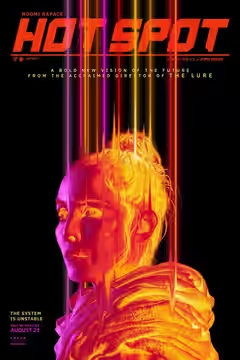
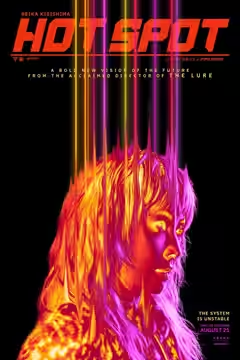
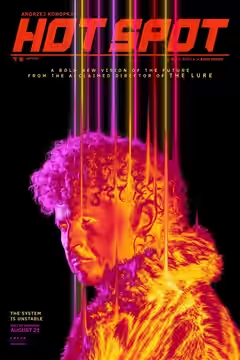
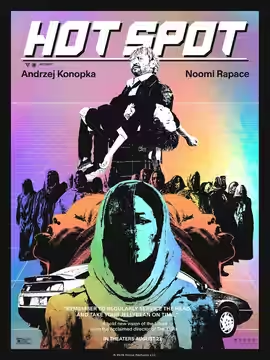
Agnieszka Smoczyńska’s Hot Spot is a science-fiction thriller that runs 101 minutes and spends most of them declining to tell you what it is about. The tagline reads “The system is unstable”, and that is as much of a premise as the film is prepared to hand over. Robert Bolesto’s script gives us a man called Jan 623 (Andrzej Konopka), a woman called Rana (Noomi Rapace), a woman called Ayka (Reika Kirishima), a soldier, a train and a concert, and leaves us to make the connections ourselves. Our verdict is that the connections are not there to be made, and that a good deal of what surrounds them is worth looking at anyway.
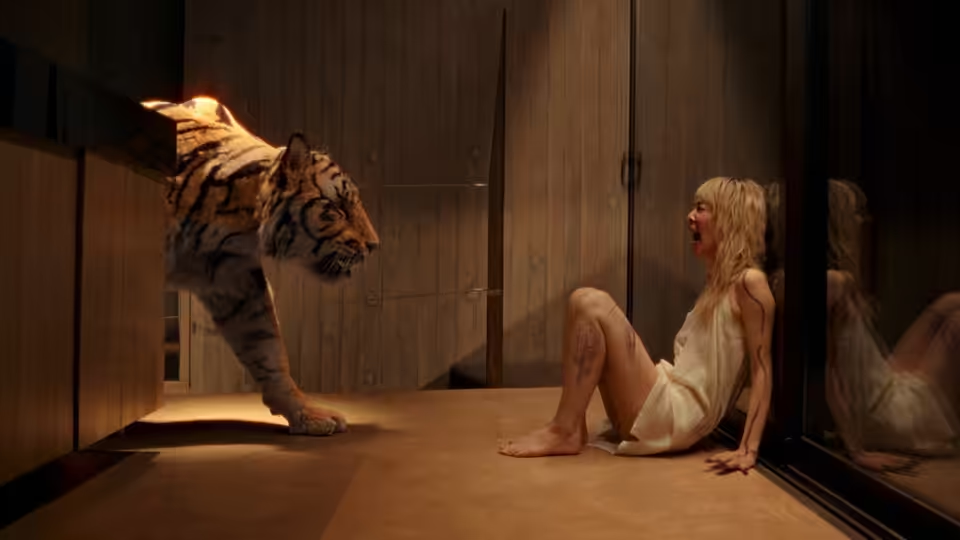
The looking is the reason to come. Jakub Kijowski lights nearly everything in red and blue, two colours that rarely share a frame in nature and here share almost every one, so that faces come out half warm and half cold and the smoke between them turns purple. The concert is where it all pays off. Marcin Macuk and Zuzanna Wrońska’s music builds from a low hum to a full-throated noise, Kijowski’s lights swing with it, and for ten minutes we forgot that we had no idea who anyone was and were simply glad to watch. That is an honest reaction and we own it. It is also the only stretch of the film in which image, sound and cutting are doing the same thing at the same time.
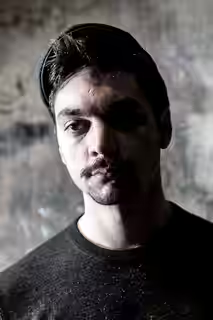
Konopka plays Jan 623 as a man who has been given a number and has not yet worked out whether to resent it, and he is good at the not-yet; a lot of the film is his face waiting for information that never arrives. Rapace plays Rana as someone entirely certain of things the audience cannot see, and it works best in the scene where she announces that we may call her Witch. Kirishima has the quietest part and gives the best account of herself, mostly by refusing to raise her voice when the lighting does. Anna Anosowicz’s production design puts them in corridors and halls that look like a public building nobody has finished paying for, which is the right look for a system that is coming apart.
The trouble is the story, or the editing, since it is hard from the outside to say which failed first. Beata Liszewska cuts the film as a series of arrivals: Jan is on the train, then he is at the concert, then he is somewhere else, and the scenes do not tell us how one led to the next. By the halfway mark we were lost, and by the final third we were cross about being lost, because a film this deliberately strange has to earn its strangeness with some logic underneath, and Bolesto’s script keeps that logic in its pocket. The second half takes turns we will not describe, partly on principle and partly because we are not confident we could.
Smoczyńska and Bolesto made The Lure in 2015, a mermaid musical set in a Warsaw nightclub that was every bit as odd as this and twice as clear, because it had a story about two sisters and never lost sight of it. Her later The Silent Twins kept the same grip. Here the grip is gone. The images are hers and the appetite for the lurid is hers, but the sisters, or anything else to hold on to, have been replaced by a man with a number and a system that is unstable.
The few critics who have written so far are split between mixed and hostile, and we land between them. See it if the red-and-blue lighting and a good loud concert sound like an evening, and go in expecting to be baffled rather than told. At home you can rewind, which will not help.