Sophie Nélisse gives this restrained wartime drama its urgency. Irena’s courage is affecting, but Louise Archambault’s film simplifies too much around her to make the history as troubling as it should be.
Irena’s Vow is worth considering for Sophie Nélisse, whose performance makes courage look difficult enough to matter. Louise Archambault directs a restrained wartime drama that keeps its attention on Irena Gut Opdyke rather than attempting a comprehensive account of Nazism. That is a sensible choice of scale, and sometimes a moving one. But the film’s straightforward treatment becomes a limitation: it gives us ample reason to respect Irena without making the people around her equally convincing. We recommend it cautiously, for the performance rather than the breadth of its understanding.
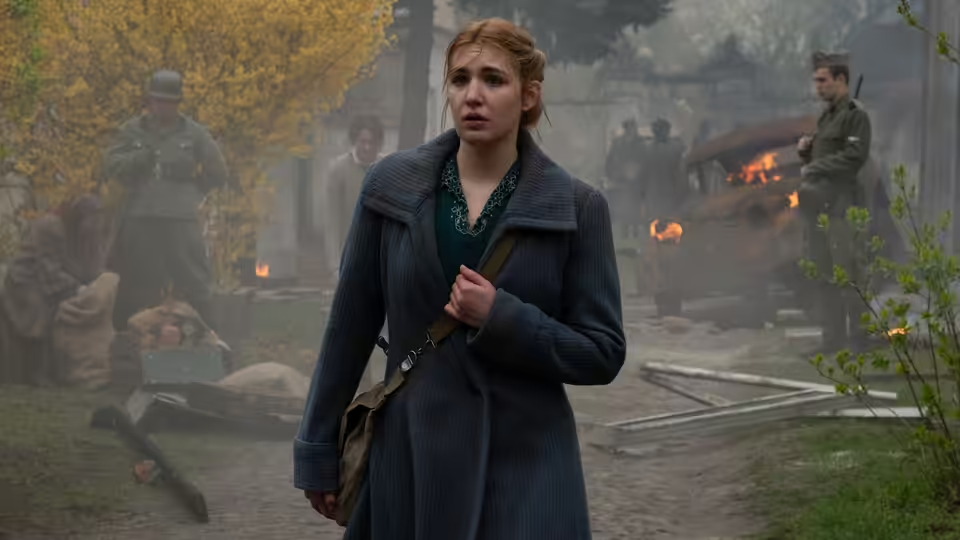
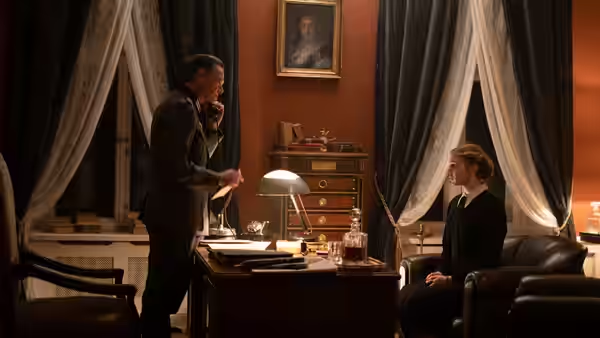
Nélisse supplies the tension that the telling sometimes lacks. Her Irena never seems comfortably assured of her own bravery, and that uncertainty keeps the character from becoming merely an example held up for approval. We were moved by the strain in her performance, because helping others feels frightening rather than simply admirable. The distinction matters in a film whose central courage could otherwise be presented as something settled before the drama even begins. Nélisse gives us reason to keep watching the person making the decisions.
Archambault’s restraint has value, too. There is no obligation for a historical drama to prove its seriousness by making suffering unbearable to watch, and a quieter approach can give an actor more room. The difficulty here is that the film’s tact too often softens what needs closer examination. Dan Gordon’s writing makes the moral stakes accessible, but the simplification leaves too little for us to discover about the people involved. Once their place in the story is clear, our understanding of them does not deepen enough.
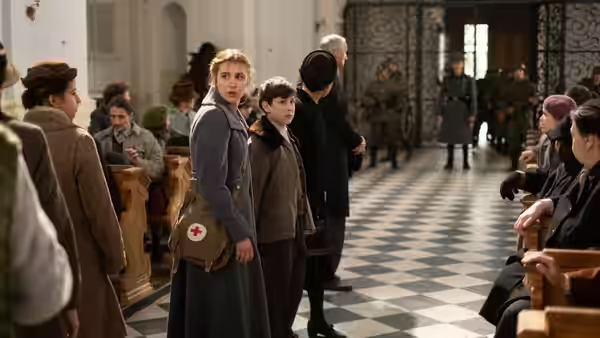
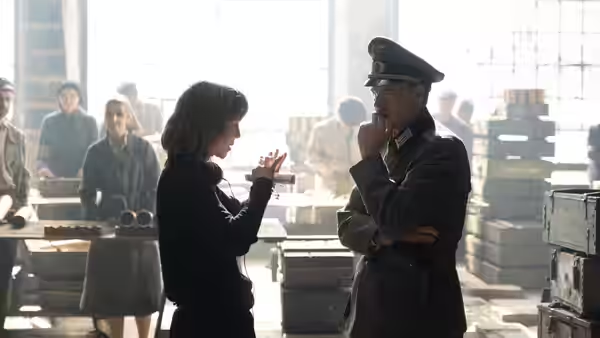
The supporting cast includes Dougray Scott as Rugmer, Andrzej Seweryn as Schultz and Maciej Nawrocki as Rokita. Yet the film remains so dependent on Nélisse that its broader human picture feels thin beside her. We do not need equal attention paid to every character; we need enough individuality to believe that their lives continue beyond their usefulness to Irena’s story. The same straightforwardness that keeps the drama legible also makes some of its encounters feel too readily understood. More uncertainty would have helped.
Paul Sarossy’s cinematography and Arthur Tarnowski’s editing serve that restrained approach, though neither provides a compelling reason to reconsider the film’s tidy storytelling. Alexandra Stréliski’s music belongs to a production that is more persuasive when it allows feeling to emerge without pressing the point. The craft is competent, and the film is seldom difficult to follow. But clarity alone cannot supply the complications that Gordon’s writing leaves underexplored, particularly across a running time of 121 minutes.
War dramas about individual courage have a difficult responsibility: they must make the individual matter without suggesting that bravery makes the surrounding history easier to comprehend. Irena’s Vow succeeds often enough at the first task to deserve a qualified recommendation. Its shortcomings are substantial, but they do not cancel the feeling Nélisse brings to Irena’s predicament. Choose it for that sustained attention to a frightened, courageous person, with the caveat that the historical drama around her is considerably less searching.