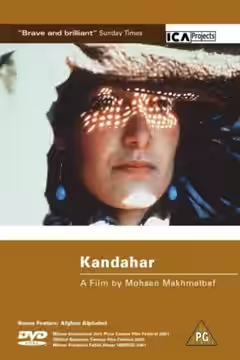
Mohsen Makhmalbaf’s Kandahar is worth seeing for the images that make distant suffering horribly specific. Its journey is uneven and its message sometimes over-insistent, but the people on screen matter more than the awkward storytelling.
Kandahar is a good, uneven film whose most troubling images are hard to dismiss. Mohsen Makhmalbaf uses Nafas’s journey towards the city to look at life in Afghanistan under Taliban rule, particularly the restrictions placed on women. That gives the film a clear purpose, though it can also make the travelling feel arranged to show us one misery after another. At 85 minutes, it asks for little time and a fair amount of patience with its way of telling a story.
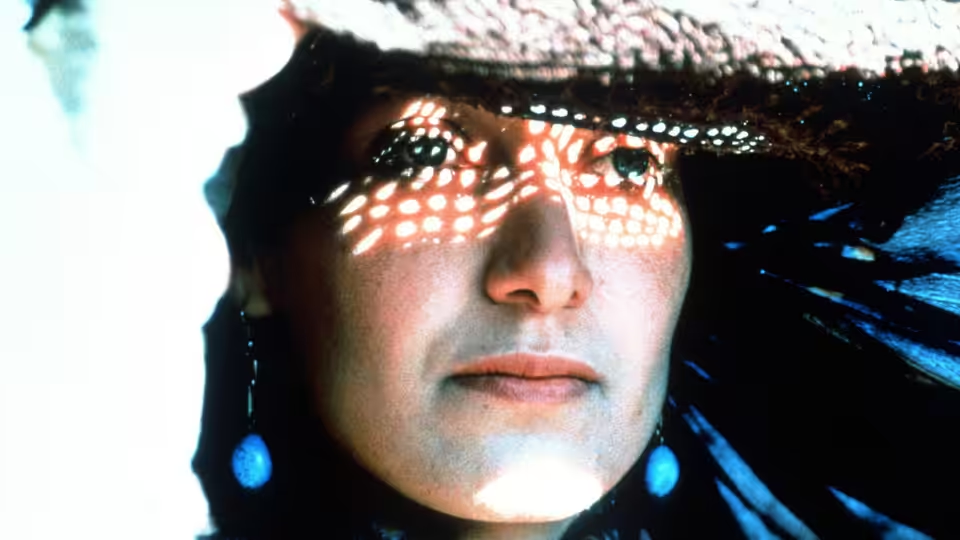
Nelofer Pazira plays Nafas, and the film depends on our willingness to follow her attention as much as her progress. It is strongest when the people encountered along the way take precedence over the destination. We begin by looking for the next step in the journey, then find ourselves caught by lives that will continue after she has passed through. The difficulty is that the director sometimes presses their significance too firmly, leaving less space for a person to be anything other than evidence of suffering.
The sight of amputees racing for prosthetic legs dropped by parachute horrified us. There is something almost absurd about the movement of limbs through the air, until the scramble below makes clear what getting one means. The cinematography, credited to Hashem Gerami, Hossein Amiri and Ebrahim Ghafori, gives the scene a beauty that makes it more difficult to watch. We understand the objection to making an arresting picture out of such desperation, but the desperation is what we remember.
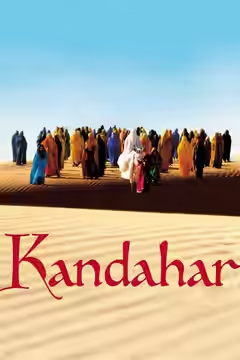
The wedding procession across sand dunes offers a different reason to keep looking: the pleasure of people moving through a landscape. It would be easy for a film with this subject to treat any such pleasure as a distraction from the suffering it wants to expose. Here, the image gives the people on screen something to do beyond demonstrating how badly they have been treated. These passages are welcome because the film can otherwise be so determined to instruct us.
Mastaneh Mohajer’s editing leaves the journey feeling episodic, with pauses that give individual encounters room but weaken the sense of progress. Some of that looseness suits a film interested in what its traveller might otherwise pass by. Elsewhere, we are ready to move on before the film is, and the emphasis starts to feel laboured. Mohammad Reza Darvishi’s music is less memorable than the images; the sight of people competing for the limbs they need is already forceful enough.
By the standards of the travelling-witness drama, Kandahar is unusually willing to let a single sight interrupt the business of getting somewhere. That can be frustrating, and its bluntness occasionally makes the people seem less complicated than the circumstances they inhabit. Yet the parachutes and the race beneath them give us a precise, distressing picture that a smoother film might have hurried past. We recommend it, but not for an evening when a tightly plotted story is the requirement.