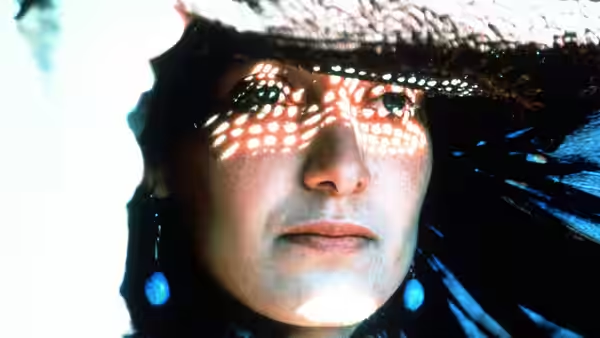
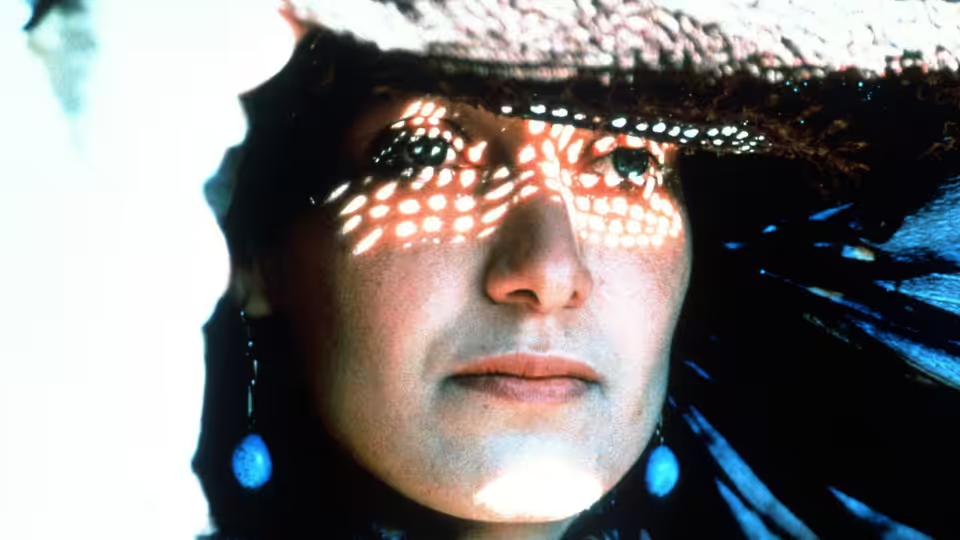
Nafas (Nelofer Pazira) looks out from beneath a perforated veil, sunlight dappling her face
Film review

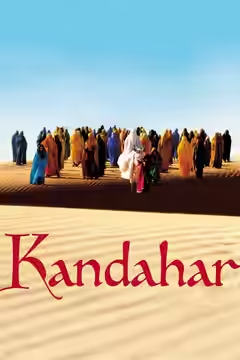
Kandahar

2001 · Directed by Mohsen Makhmalbaf · 1h 25m

In a sentenceArtificial legs fall by parachute, and we forget to ask how much further it is to Kandahar

Nafas (Nelofer Pazira) travels towards Kandahar in Afghanistan under Taliban rule. Her route takes her through a country where restrictions on women shape ordinary life, and where suffering is visible in the people she encounters. Khak (Sadou Teymouri), Tabib Sahid (Hassan Tantai) and Naghadar (Ike Ogut) are among the figures in this account of the journey. As she makes her way towards the city, the film follows the lives affected by the regime, keeping the treatment of women at the centre of its attention.

Fi1m review

Mohsen Makhmalbaf’s Kandahar is worth seeing for the images that make distant suffering horribly specific. Its journey is uneven and its message sometimes over-insistent, but the people on screen matter more than the awkward storytelling.

Kandahar is a good, uneven film whose most troubling images are hard to dismiss. Mohsen Makhmalbaf uses Nafas’s journey towards the city to look at life in Afghanistan under Taliban rule, particularly the restrictions placed on women. That gives the film a clear purpose, though it can also make the travelling feel arranged to show us one misery after another. At 85 minutes, it asks for little time and a fair amount of patience with its way of telling a story.

Nelofer Pazira plays Nafas, and the film depends on our willingness to follow her attention as much as her progress. It is strongest when the people encountered along the way take precedence over the destination. We begin by looking for the next step in the journey, then find ourselves caught by lives that will continue after she has passed through. The difficulty is that the director sometimes presses their significance too firmly, leaving less space for a person to be anything other than evidence of suffering.

The sight of amputees racing for prosthetic legs dropped by parachute horrified us. There is something almost absurd about the movement of limbs through the air, until the scramble below makes clear what getting one means. The cinematography, credited to Hashem Gerami, Hossein Amiri and Ebrahim Ghafori, gives the scene a beauty that makes it more difficult to watch. We understand the objection to making an arresting picture out of such desperation, but the desperation is what we remember.

The wedding procession across sand dunes offers a different reason to keep looking: the pleasure of people moving through a landscape. It would be easy for a film with this subject to treat any such pleasure as a distraction from the suffering it wants to expose. Here, the image gives the people on screen something to do beyond demonstrating how badly they have been treated. These passages are welcome because the film can otherwise be so determined to instruct us.

Mastaneh Mohajer’s editing leaves the journey feeling episodic, with pauses that give individual encounters room but weaken the sense of progress. Some of that looseness suits a film interested in what its traveller might otherwise pass by. Elsewhere, we are ready to move on before the film is, and the emphasis starts to feel laboured. Mohammad Reza Darvishi’s music is less memorable than the images; the sight of people competing for the limbs they need is already forceful enough.

By the standards of the travelling-witness drama, Kandahar is unusually willing to let a single sight interrupt the business of getting somewhere. That can be frustrating, and its bluntness occasionally makes the people seem less complicated than the circumstances they inhabit. Yet the parachutes and the race beneath them give us a precise, distressing picture that a smoother film might have hurried past. We recommend it, but not for an evening when a tightly plotted story is the requirement.
Critical consensus AI synthesised

74
Positive
5
Mixed
4
Negative
0

The available reviews lean positive on Kandahar, with praise clustering around its images and its account of suffering under the Taliban. Critics describe a humanitarian appeal that is moving, disturbing and accessible, particularly in its attention to the treatment of women. The journey gives that suffering concrete form through the people encountered along the way. Images of amputees seeking prosthetic limbs and a wedding procession crossing sand dunes receive particular praise for making the film’s concerns memorable.

The reservations that can be verified concern the storytelling. Slant Magazine finds stretches heavy-handed and scattered, though still evocative; Eye for Film notes an unconventional, open-ended structure without losing confidence in the film. The recorded scores range from mixed to enthusiastic, with none negative, but four entries lack accessible verdicts. That limits how firmly their reservations can be described: the available material establishes shared praise more clearly than substantive disagreement.

Radio Times
★★★★★ · David Parkinson
100

Parkinson calls the film a must-see, moving and angering account of life under the Taliban. He particularly praises the realities witnessed by Nelofer Pazira’s character on her journey.

Read the full review →
Empire
1 January 2000 · Alan Morrison
82*

Morrison praises the film as a courageous and accessible challenge to the Taliban’s treatment of women. He singles out its beautiful imagery and passionate intelligence for making its message memorable.

Read the full review →
Variety
11 May 2001 · festival review · Deborah Young
78*

Young finds the film visually exalting and emotionally horrifying, an urgent humanitarian appeal that makes Afghanistan’s suffering difficult to ignore. She especially praises Makhmalbaf’s arresting metaphorical images, including the amputees racing for prosthetic legs dropped by parachute.

Read the full review →
Slant Magazine
26 November 2001 · ★★★/4 · Ed Gonzalez
75

The critic finds the film evocative despite its heavy-handedness and scatterbrained stretches. He praises its breathtaking visuals, especially the finale’s blend of humor and sadness.

Read the full review →
Screen Daily
31 May 2001 · festival review · Sheila Johnston
64*

The accessible page identifies this as a review but does not show the critic’s verdict. The full text is behind a registration prompt, so no specific praise or complaint is available.

Read the full review →
The New Yorker
10 December 2001 · David Denby
64*

The issue listing identifies this as David Denby’s review, but the article text is unavailable here. Its standfirst mentions a journey to Kandahar without revealing his verdict or what he singled out.

Read the full review →

Straight answers AI written, from our review

Is Kandahar worth watching?
Kandahar is worth watching for its distressing, specific images of life under Taliban rule, and we score it 75 out of 100. We recommend it for viewers willing to follow an episodic journey: the encounters matter more than the destination, though the storytelling is uneven and the insistence on suffering can feel laboured.
How long is Kandahar, and what is it rated?
Kandahar runs 1h 25m. It is a drama film.
Where can I watch Kandahar in Slovenia?
Kandahar is not on any streaming or rental service in Slovenia at the moment. Availability is checked daily.
How does Kandahar compare to Timbuktu?
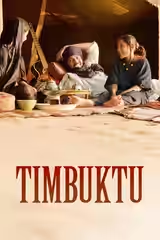
Kandahar is more insistent about suffering than Timbuktu, which we favour for its fuller attention to individual lives and its room for humour under religious coercion. Both have scattered storytelling, but Kandahar suits viewers drawn to forceful individual images, while Timbuktu gives ordinary people more space without softening the violence around them.

Cast

Awards

European Film Award for Best Non-European Film, 2001

Nominated
European Film Award for Best Non-European Film

If you liked this, try…

  1. Osama (2003) · not on Fi1m yetTaliban rule seen through a child’s predicament, with tighter, more punishing storytelling.

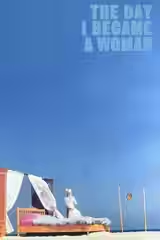
  2. The Day I Became a Woman (2000) · not on Fi1m yetThree episodes about women’s freedom, told with humour and arresting physical images.

  3. Timbuktu (2014, Fi1m 88)Daily life under religious coercion, with more room for humour and individual lives.

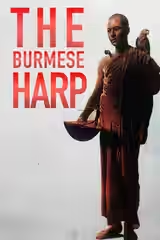
  4. The Burmese Harp (1956) · not on Fi1m yetA soldier’s journey through war’s aftermath, patient about grief and moral responsibility.

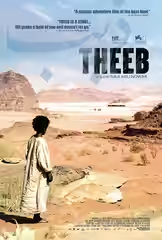
  5. Theeb (2014) · not on Fi1m yetA desert journey that keeps its dangers concrete and its storytelling unusually clear.

Kandahar (2001) review: uneven drama with images that stay (Slovenia) | Fi1m