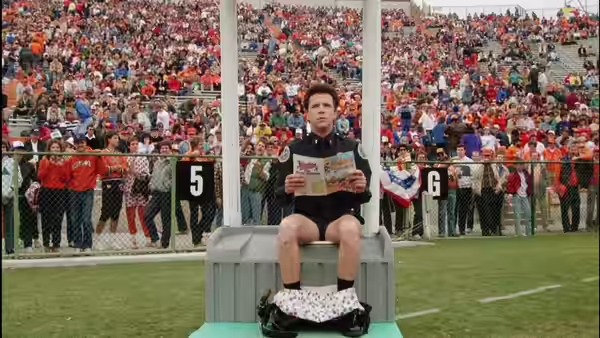
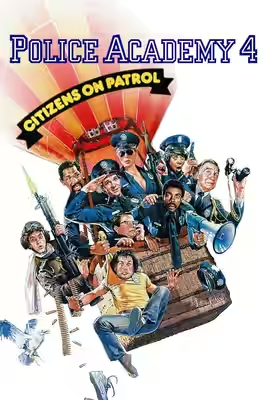
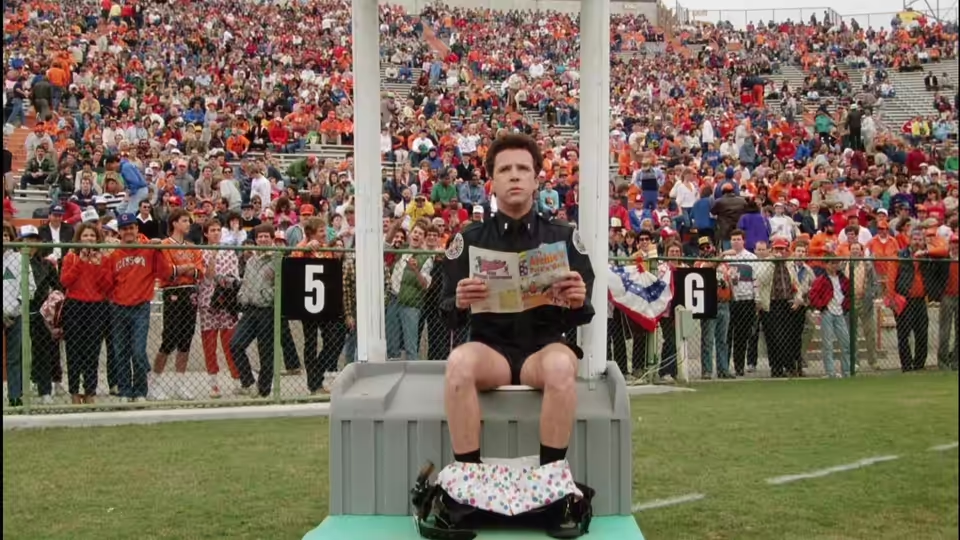
Mahoney (Steve Guttenberg) reads a newspaper while seated on a portable toilet at a stadium
Film review

Police Academy 4: Citizens on Patrol

1987 · Directed by Jim Drake · 1h 28m · Medierådet A

In a sentenceGeorge Gaynes gets a laugh, and then we wait for George Gaynes to come back

Commandant Lassard (George Gaynes) recruits civilian helpers for the police, hoping to involve the public in the force’s work. The scheme brings new arrivals into the company of Mahoney (Steve Guttenberg), Captain Harris (G. W. Bailey), Zed (Bobcat Goldthwait) and Sweetchuck (Tim Kazurinsky). Lassard wants assistance from outside the regular ranks; first, the civilians have to fit in with the officers already there. As the citizen patrol programme gets under way, the police have another group of people to work with and account for.

Fi1m review

Jim Drake’s poor sequel remains amiable even as Gene Quintano’s script runs short of jokes. George Gaynes and G. W. Bailey offer some relief, but the civilian recruits do little to justify another outing.

The idea behind Police Academy 4: Citizens on Patrol is simple enough: Commandant Lassard recruits civilians to help the police, giving the regular cast new people to bounce off. Jim Drake approaches the business cheerfully, and there is something welcome about a comedy that asks for so little solemnity. The trouble is that it asks for equally little invention. This is a poor sequel, full of routines that do not become funnier through familiarity.

Gene Quintano’s screenplay never makes much of the recruits’ arrival. It keeps presenting opportunities for slapstick without developing much interest in what happens between them. The volunteers ought to make the established officers behave differently, but the film remains content to let familiar personalities take their turns. When a gag misses, the next one has to start again from nothing. At 88 minutes this should be light work; instead, the shortage of a story makes even the brisk passages feel longer than they are.

G. W. Bailey gives Captain Harris’s exasperation enough energy to suggest that at least somebody here has something at stake. We laughed at his irritation, because he makes the indignity matter even when the gag itself hardly does. Bobcat Goldthwait as Zed and Tim Kazurinsky as Sweetchuck provide some welcome silliness, helped by a willingness to look foolish without asking to be liked for it. These are modest pleasures, but in this company we start to value them.

George Gaynes fares better still as Commandant Lassard, making the thin material feel briefly worth attending to. His scenes benefit from the simple sense that somebody has found a joke worth telling. Steve Guttenberg’s Mahoney is less persuasive: the relaxed manner becomes disengagement, leaving stretches without much of a comic lead. The ensemble is willing enough, but willingness cannot supply a reason for everybody to be here.

Robert Saad’s cinematography keeps the performers clearly readable, which is useful when so much depends on a reaction. Yet the staging seldom gives a joke an extra beat of discovery or makes the relationship between bodies in the frame amusing. Trevor Williams’s production design likewise provides serviceable surroundings without contributing much to the humour. The cast remain responsible for almost all the amusement, including the stretches when the material gives them little chance of providing it.

David Rawlins’s editing keeps the separate routines moving, but moving on is about the only remedy the film has for a failed joke. There is little accumulation of comic trouble and little satisfaction in seeing one mishap lead to another. Robert Folk’s score supplies a buoyancy the scenes struggle to maintain unaided. Jim Drake keeps the tone good-natured, which stops the experience becoming unpleasant without making it particularly rewarding.

A broad police comedy need not have an intricate plot, and a taste for daft slapstick is no disqualification. It does need jokes that are shaped, timed and allowed to build, particularly when it offers so little else to hold our interest. There are enough flickers of that here to spare the cast a blanket dismissal, though nowhere near enough to recommend the film. Come for George Gaynes only if waiting between his appearances sounds like an acceptable evening.
Critical consensus AI synthesised

32
Positive
0
Mixed
1
Negative
5

The reviews lean heavily negative, finding Police Academy 4: Citizens on Patrol short of fresh ideas and reliable laughs. Praise is scattered rather than shared: the brisk, amiable direction and good-natured tone earn some credit, while George Gaynes’s gags, Capt. Harris’s exasperation and Goldthwait and Kazurinsky’s silliness provide occasional relief. These are small consolations in assessments that largely describe a tired sequel repeating familiar routines.

The differences concern how much those consolations count. Radio Times calls it the only worthwhile sequel while still judging it poor, and faults Steve Guttenberg for going through the motions. Variety is harsher, objecting to tasteless humour and a script that barely connects its gags with a story. The spread is mostly between disappointment and outright dismissal. The apparently more favourable New York Times rating cannot establish a contrary view: its review text is unavailable, so its verdict remains unverified.

The New York Times
4 April 1987
64*

The page content is unavailable, so the critic’s verdict cannot be verified. No specific praise or complaint can be identified from the accessible text.

Read the full review →
Time Out
· NF
40*

The review characterizes the film as more of the same from the franchise. It singles out Lassard’s newly recruited civilian helpers as a central feature.

Read the full review →
Los Angeles Times
6 April 1987 · KEVIN THOMAS
35*

Thomas finds the sequel only marginally better than its predecessors and says it never takes flight. He gives the brisk, amiable direction and good-natured tone faint praise, while faulting the hit-and-miss slapstick.

Read the full review →
Empire
22 September 2006 · Ian Freer
20*

Freer sees the film as a stale, badly conceived entry that signals the franchise has run out of steam. He singles out Capt. Harris’s comic exasperation and Goldthwait and Kazurinsky’s silliness as rare bright spots.

Read the full review →
Radio Times
★ · John Ferguson
20

Ferguson says this is the only sequel in the series worth watching, though not because it is any good. He singles out George Gaynes as getting the best gags, while criticizing Steve Guttenberg for going through the motions.

Read the full review →
Variety
31 December 1986 · Variety Staff
10*

The review is strongly negative, calling the humor tasteless and the film insipid. It faults the script for stringing gags together with barely a hint of a story.

Read the full review →

Straight answers AI written, from our review

Is Police Academy 4: Citizens on Patrol worth watching?
Police Academy 4: Citizens on Patrol is a poor sequel we score 36/100, with too few successful jokes to recommend beyond devoted admirers of the cast. George Gaynes and G. W. Bailey provide welcome laughs, but even viewers fond of daft slapstick may find the thin story and disconnected routines make 88 minutes feel long.
How long is Police Academy 4: Citizens on Patrol, and what is it rated?
Police Academy 4: Citizens on Patrol runs 1h 28m and is rated A by the Medierådet in Denmark. It is a comedy and crime film.
Where can I watch Police Academy 4: Citizens on Patrol in Denmark?
Police Academy 4: Citizens on Patrol is available to rent from Amazon Prime Video from kr 39.00. Availability is checked daily; the links above go straight to each service.
How violent or frightening is Police Academy 4: Citizens on Patrol, and is it suitable for children?
Police Academy 4: Citizens on Patrol carries a UK 12 certificate, so it is not classified as suitable for children under 12. We describe broad slapstick rather than frightening material, but cannot give a detailed assurance about violence or other adult content; the UK rating is the clearest guide for families.
How does Police Academy 4: Citizens on Patrol compare to The Lavender Hill Mob?
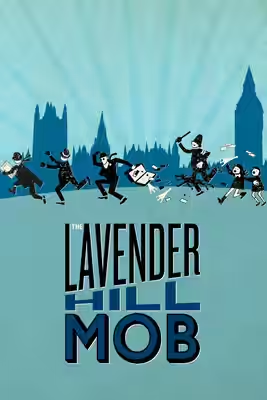
Police Academy 4: Citizens on Patrol is the weaker comedy beside The Lavender Hill Mob, which we recommend for its patient timing and Alec Guinness’s quiet comic precision. The police sequel offers broad slapstick and scattered cast pleasures, while the nervous amateurs in The Lavender Hill Mob give its criminal scheme the momentum the sequel’s disconnected routines lack.
What should I watch after Police Academy 4: Citizens on Patrol?
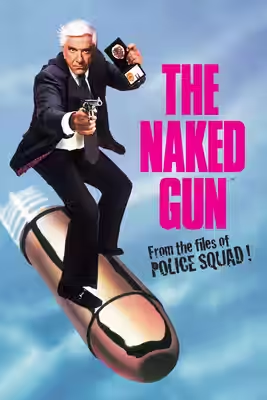
After Police Academy 4: Citizens on Patrol, try The Lavender Hill Mob (1951, Fi1m 82): Nervous amateurs and patient comic timing give this criminal scheme proper momentum. Then The Naked Gun: From the Files of Police Squad! (1988, Fi1m 88): Police incompetence becomes considerably funnier when delivered with such a straight face.

Cast

Awards

Golden Raspberry Award for Worst Original Song, 1988

Nominated
Golden Raspberry Award for Worst Original Song

If you liked this, try…

  1. The Lavender Hill Mob (1951, Fi1m 82)Nervous amateurs and patient comic timing give this criminal scheme proper momentum.

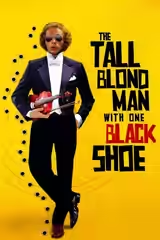
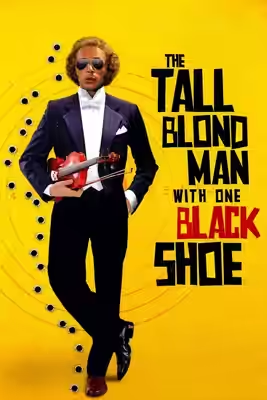
  2. The Tall Blond Man with One Black Shoe (1972) · not reviewed yetA bewildered innocent brings a welcome lightness to a daft espionage plot.

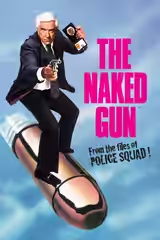
  3. The Naked Gun: From the Files of Police Squad! (1988, Fi1m 88)Police incompetence becomes considerably funnier when delivered with such a straight face.

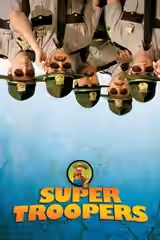
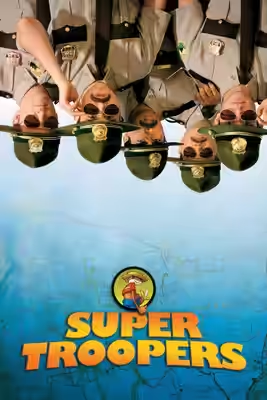
  4. Super Troopers (2001) · not reviewed yetMore juvenile police misbehaviour, with a stronger sense of a working comic team.

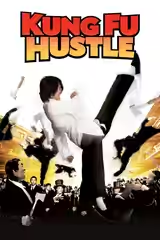
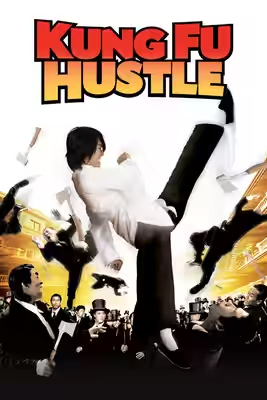
  5. Kung Fu Hustle (2004) · not reviewed yetBroad character comedy and elaborate physical gags, staged with considerably more care.

Free account

Know what to watch tonight

Two lists that know where things are streaming, collections you can share, your own score beside ours, and Discover that remembers what you have seen.

  • Want to see, sorted by what is streaming now
  • Seen, with your score out of ten
  • No adverts, ever