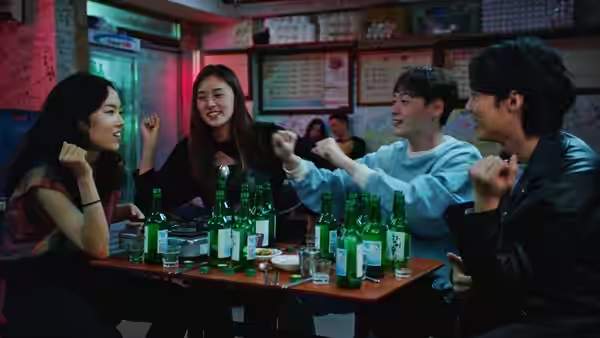
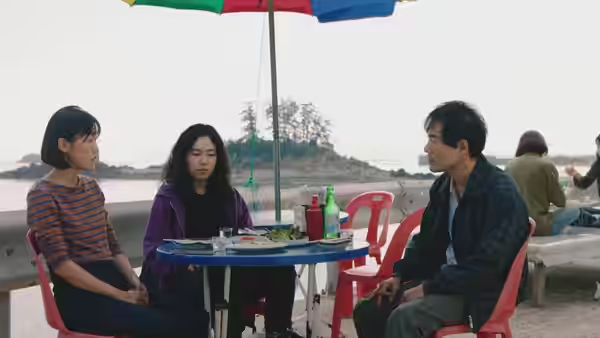
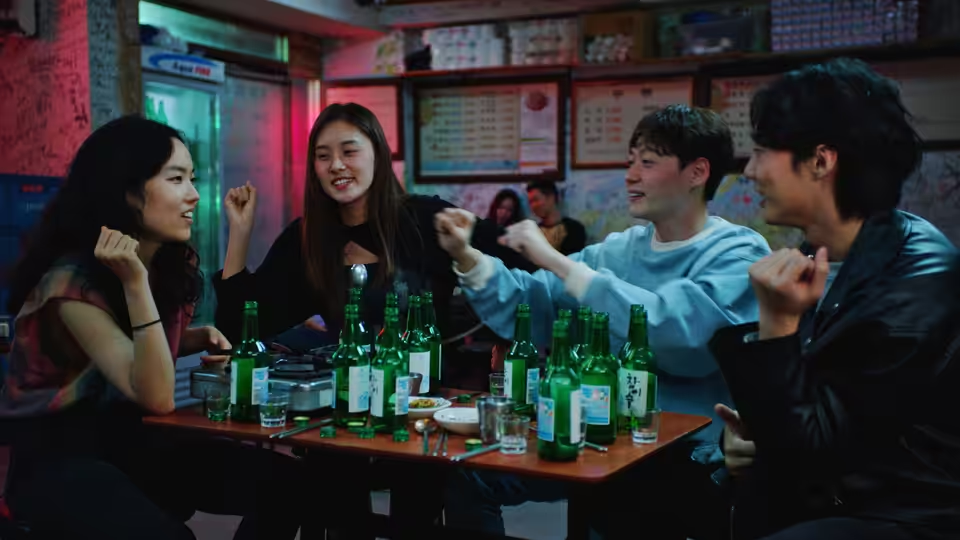
Freddie (Ji-min Park) and three friends laugh and gesture around a table of green bottles
Film review

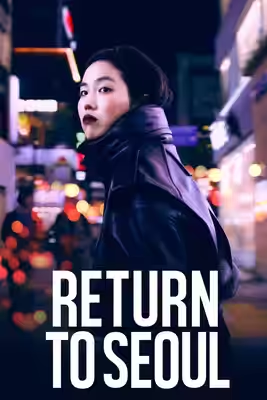
Return to Seoul

2022 · Directed by Davy Chou · 1h 59m

In a sentenceEight years, one city, and a woman who treats everyone who loves her as a hostile witness

Freddie (Park Ji-min) is French, in her mid-twenties, and in Seoul more or less by accident. She was born in Korea and adopted as a baby, she does not speak the language, and she tells Tena (Guka Han), the young woman on the desk at her guesthouse, that she has no plans to look for anyone. Within days she is at the Hammond adoption agency asking them to write to her birth parents. Her father (Oh Kwang-rok) answers. Her mother does not. Davy Chou’s film follows Freddie across several years and several visits, through drink, lovers and sudden decisions, as she tries to work out what she came for.

Plays from YouTube when you press play; nothing loads from them until then.

Fi1m review

Davy Chou’s second feature sends a French adoptee back to Korea and then refuses to give her, or us, the reunion the setup promises. Park Ji-min, acting for the first time, is the reason to see it; the later chapters are thinner than the first.

Freddie (Park Ji-min) arrives in Seoul with a rucksack and no plan, and on her first night out she takes over a restaurant. She pushes tables together, pours soju for strangers, tells Tena (Guka Han), the guesthouse receptionist who has made the mistake of befriending her, that in France you look people in the eye when you drink. She is French, she insists, and she is not here to find anyone. A few scenes later she is sitting in the Hammond adoption agency asking them to send a telegram. Davy Chou, who wrote and directed, spends the rest of his 119 minutes on the gap between what Freddie says she wants and what she does, and he never once closes it for us.

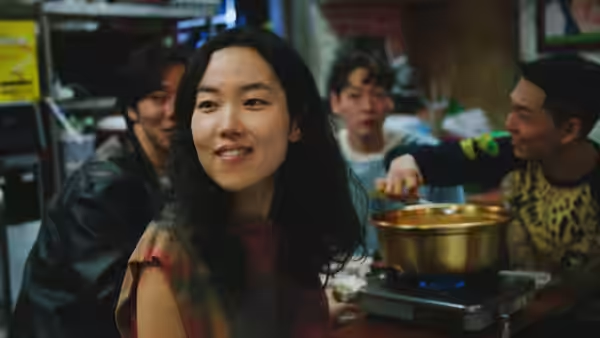
The father (Oh Kwang-rok) replies, and Freddie goes to meet him with Tena along to translate. He is a soft, wrecked man who drinks too much and apologises in a way that asks to be forgiven on the spot. Freddie’s aunt (Kim Sun-young) does most of the talking. Freddie’s grandmother (Heo Jin) takes her face in her hands and weeps. Freddie sits through all of it like someone waiting for a bus. Afterwards the father starts sending her text messages late at night, and she answers with the word for no.

We disliked her for the best part of an hour, and we think we were meant to. Then, in that flat, with the grandmother crying over her, we found we were crying too and Freddie was not, and the film had us. It is Park Ji-min’s first screen performance, and she plays Freddie as a person who has decided in advance not to feel anything and is furious every time she fails. Watch her face when she is being loved. It goes still, then hard, then somewhere else entirely, and none of it looks worked out in advance.

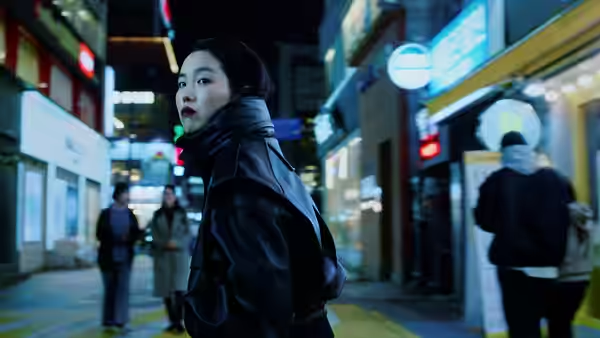
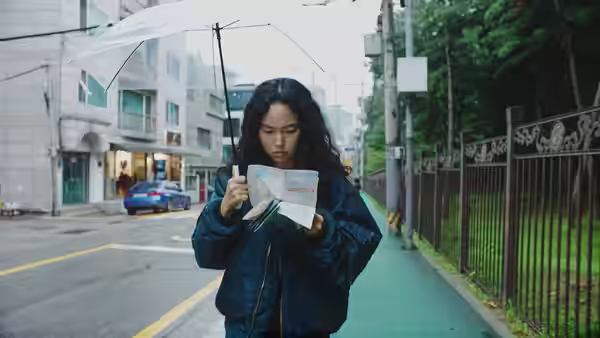
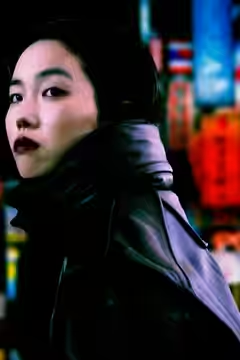
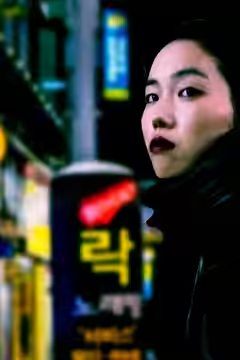
Thomas Favel shoots her close and often from slightly below, so that the bars and side streets of Seoul are a smear of pink and green neon behind her head and she is the only thing in focus. Bo Koung Shin and Choi Chi-youl give the father’s home the look of a place where nothing has been thrown away in thirty years, and the agency office the look of a place where everything has. Claire Dubien changes Freddie’s clothes as the years change, and each new wardrobe tells us something about her before she has opened her mouth. Jérémie Arcache and Christophe Musset keep their own score sparse and let old Korean records do the emotional work, mostly when Freddie is drinking.

The structure is the bold thing, and the risky one. Dounia Sichov cuts across gaps of years with almost nothing to soften the jump, and each time we land Freddie has a new haircut, new company and a new version of what she is doing in Korea. The first of these leaps is thrilling. We had settled into a film about a search and were suddenly in a film about a woman who had stopped searching and was daring anyone to mention it. The second and third leaps are less sure. The sections get shorter, the new people around Freddie, among them Maxime (Yoann Zimmer) and Andre (Louis-Do de Lencquesaing), are drawn quickly, and one late stretch reads as a diagram of what Freddie has become rather than as scenes from her life. We will not say what that is.

Most critics have been warmer than this about the whole, and we understand why, because when the film is working it is doing something almost nobody attempts. It puts an adoptee at the centre of an adoption story and lets her be cold, rude, drunk, promiscuous and wrong, and it does not punish her or explain her. Chou never gives us the mother. He never gives Freddie the scene where she says the thing she has been holding back. Every conventional release is refused, and the refusals cost the film some of its second half, and we would still rather have it this way than the other.

It is a 15 certificate and a slow film that moves in jerks. It will frustrate anyone who wants to like the person they are watching. Freddie dances alone twice in it, to music nobody else has chosen, and both times people clear a little space around her. We suspect that is the film’s whole argument, and that it is right.
Critical consensus AI synthesised

81
Positive
13
Mixed
0
Negative
0

The reviews are uniformly positive, with no critic dissenting from the view that this is a serious and unusual film. Praise clusters overwhelmingly on Park Ji-min, a first-time actor, whose performance as the adoptee Freddie is described again and again as the film’s centre: changeable, blunt and hard to look away from. Davy Chou’s direction draws steady admiration for its intimacy and for a structure that follows Freddie across several years and several visits to Seoul, refusing to settle into a conventional adoption drama.

The reservations are mild and few. /Film notes some sluggish stretches, and The Hollywood Reporter finds Freddie exasperating company even while calling the film a trip worth taking. A handful of festival reviews, Screen Daily among them, are warm rather than rapturous, describing the film as intriguing and unpredictable rather than remarkable. The spread is narrow: nobody dislikes it, and the only argument is over how far to go in praising it.

The Independent
4 May 2023
90*

The critic finds the film daring and mesmeric as it follows an adoptee's search for her birth parents that yields no easy resolution or meaning. Park Ji-min's phenomenal debut performance stands out for its portrayal of manufactured indifference and inner turmoil.

Read the full review →
The Guardian
7 May 2023 · Peter Bradshaw
85*

The film is a remarkably intimate and very affecting drama about an adoptee searching for her roots in South Korea. The critic singles out the lead performance by first-time actor Park Ji-min as mesmerising and transformative.

Read the full review →
Empire
9 May 2023 · John Nugent
80*

The elliptical film dramatises an adoptee's chaotic grappling with identity over several years through heavy drinking, sexual openness and impulsive decisions. Ji-min Park's staggering debut performance is the standout, leaving viewers wistful and heartbroken.

Read the full review →
Little White Lies
2 May 2023 · 3/4/3 · Ella Kemp
80

Davy Chou’s bittersweet comedy of a Korean adoptee searching for her biological parents is powered by a dazzling lead performance. The mercurial structure and vivid colours make the film remarkable and likely to stand the test of time.

Read the full review →
Time Out
25 April 2023 · ★★★★ · Kambole Campbell
80

Director Davy Chou charts Freddie’s attempts to come to terms with her tumultuous feelings towards her background in this naturalist drama. Heartbreaking performances and close-up camerawork single out the emotional challenge of reconnecting with an estranged birthplace.

Read the full review →
Total Film
25 April 2023 · Kevin Harley
80*

Chou anchors a captivating portrait of choppy selfhood in the lead's febrile nuances between partying, clashes and hedonistic excesses. Park Ji-min brings near-musical virtuosity to the questing character piece as a woman mapping her own life routes.

Read the full review →

Straight answers AI written, from our review

Is Return to Seoul worth watching?
Return to Seoul is worth watching for anyone who can sit with a lead character who refuses to be liked, and we scored it 83. Park Ji-min, in her first screen role, plays a French adoptee who treats every offer of love as an insult, and she is the reason to see it. The later chapters are thinner than the first, and the structure jumps years at a time.
How long is Return to Seoul, and what is it rated?
Return to Seoul runs 1h 59m. It is a drama film.
Where can I watch Return to Seoul in Belgium?
Return to Seoul is not on any streaming or rental service in Belgium at the moment. It is available in 1 other country; change your country at the top of the page to see where. Availability is checked daily.
How violent or frightening is Return to Seoul, and is it suitable for children?
Return to Seoul is a 15 certificate in the UK and an R in the US, and it is not a film for children. There is no violence or horror to speak of; the certificate reflects heavy drinking, casual sex and a good deal of emotional cruelty across 119 slow minutes. Older teenagers with patience for a difficult heroine will manage it; younger viewers will simply be bored.
How does Return to Seoul compare to Secrets & Lies?
Return to Seoul and Secrets & Lies both follow an adopted woman seeking her birth family, and they could hardly be less alike in temper. Mike Leigh's film gives Brenda Blethyn and Marianne Jean-Baptiste long, funny, painful conversations that arrive somewhere; Davy Chou's refuses every reunion the setup promises and keeps its heroine cold. Leigh's is the warmer and more complete film, Chou's the stranger and braver one.
What should I watch after Return to Seoul?
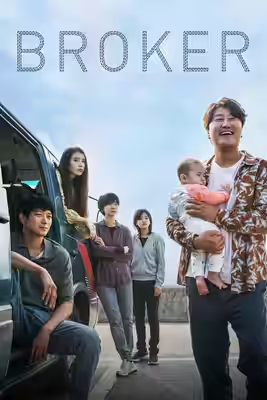
After Return to Seoul, try Secrets & Lies (1996, Fi1m 88): Mike Leigh’s adopted daughter finds her birth mother; the café scene alone is worth it. Then Lion (2016, Fi1m 84): The same search told the warm way, with a map and a satellite instead of a telegram; and Broker (2022, Fi1m 76): Kore-eda in Korea, following a baby the other way through the same system.

Cast

Awards

International Submission to the Academy Awards, 2023

Nominated
International Submission to the Academy Awards

If you liked this, try…

  1. Secrets & Lies (1996, Fi1m 88)Mike Leigh’s adopted daughter finds her birth mother; the café scene alone is worth it.

  2. Lion (2016, Fi1m 84)The same search told the warm way, with a map and a satellite instead of a telegram.

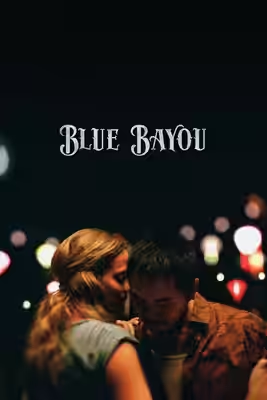
  3. Blue Bayou (2021) · not reviewed yetA Korean-born adoptee in Louisiana, and what a country does to someone it raised.

  4. Broker (2022, Fi1m 76)Kore-eda in Korea, following a baby the other way through the same system.

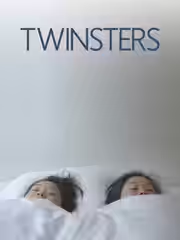
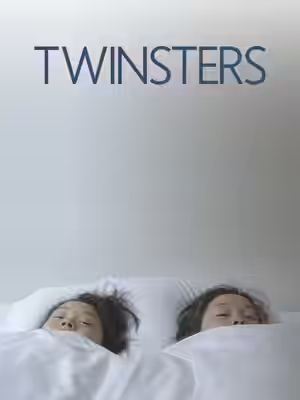
  5. Twinsters (2015) · not reviewed yetTwo Korean adoptees find each other online; a documentary that earns its tears.

Free account

Know what to watch tonight

Two lists that know where things are streaming, collections you can share, your own score beside ours, and Discover that remembers what you have seen.

  • Want to see, sorted by what is streaming now
  • Seen, with your score out of ten
  • No adverts, ever