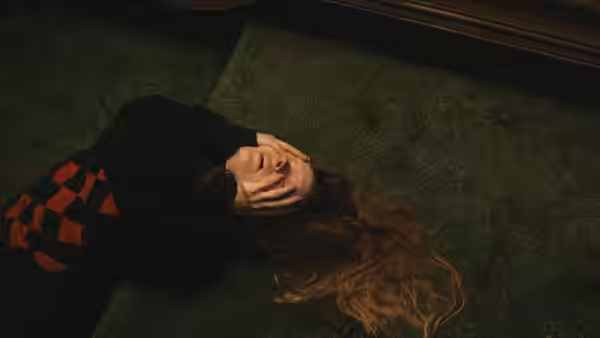
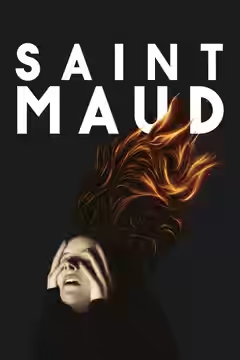
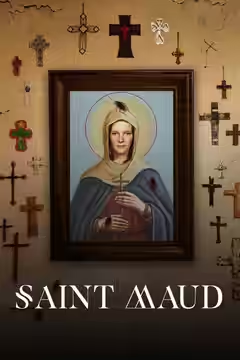
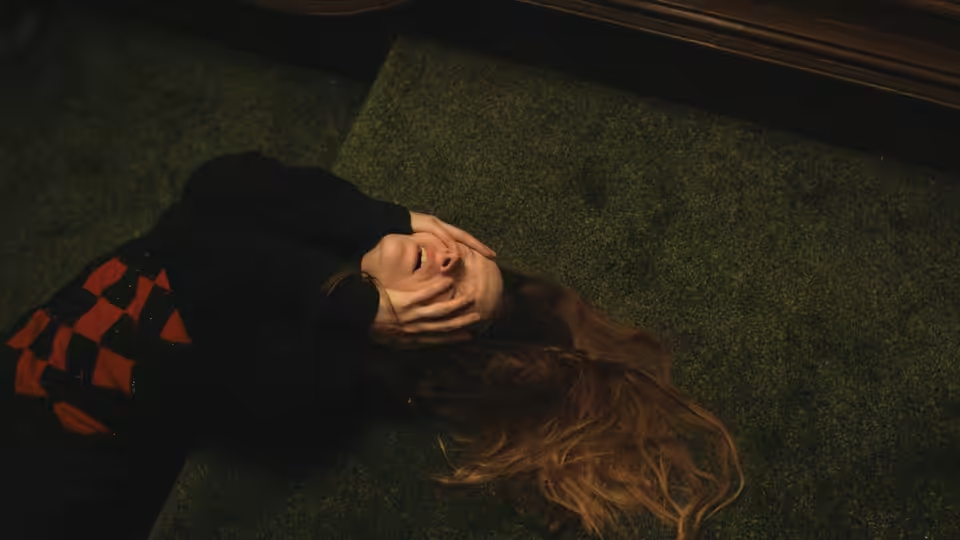
Maud (Morfydd Clark) lies on the floor with her hands covering her face
Film review

Saint Maud

2020 · Directed by Rose Glass · 1h 25m

In a sentenceA nurse who prays the way other people drink, in a seaside town that stopped expecting visitors

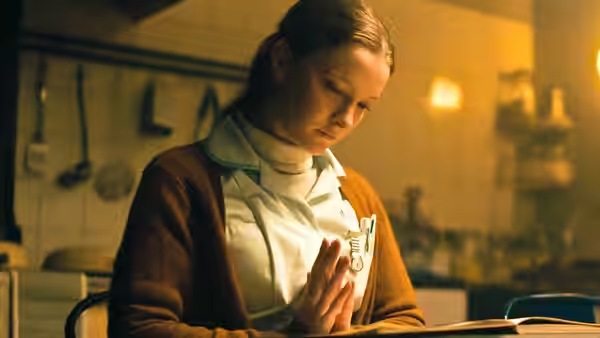
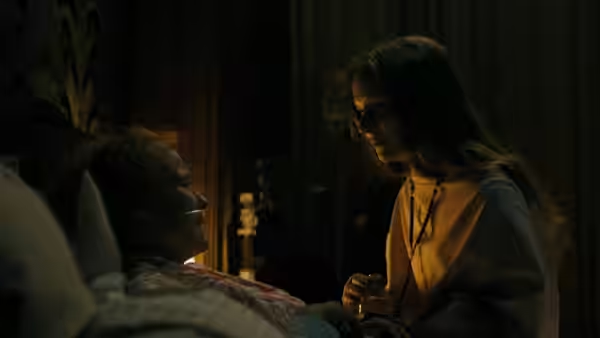
Maud (Morfydd Clark) is a private palliative care nurse in a faded English seaside town, sent by an agency to a large house on the hill where Amanda (Jennifer Ehle), a dancer and choreographer, is dying of cancer. Maud has recently found God. She prays over her tinned soup in a bare bedsit above the seafront, talks to Him in her head with the politeness of someone who expects an answer, and has not been the same since something happened at the hospital where she used to work. Amanda drinks, smokes, mocks the faith and is bored and frightened in equal measure. She calls Maud her little saviour. Maud decides that saving Amanda’s soul is the job she has been sent to do, and Amanda’s visiting lover Carol (Lily Frazer) is not part of the plan.

Plays from YouTube when you press play; nothing loads from them until then.

Fi1m review

Rose Glass’s first film is short, exact and frightening, and Morfydd Clark makes a saint of a woman you would cross the road to avoid. It loses its footing for a stretch in the middle, and it does not matter much. We recommend it.

Maud (Morfydd Clark) looks after people who are dying, and she has recently started to believe that God has a particular use for her. Sent by an agency to nurse Amanda (Jennifer Ehle), a dancer and choreographer with cancer and a large dark house on a hill, she sees a soul that needs saving and a deadline. Rose Glass, writing and directing her first feature, has made a horror film about faith that takes the faith seriously, and that is rarer than it should be. It is 85 minutes long, it is very good, and its one real weakness is a stretch in the middle where it loses the second of its two women.

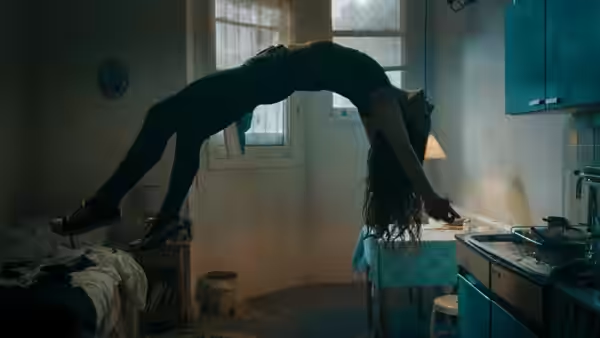
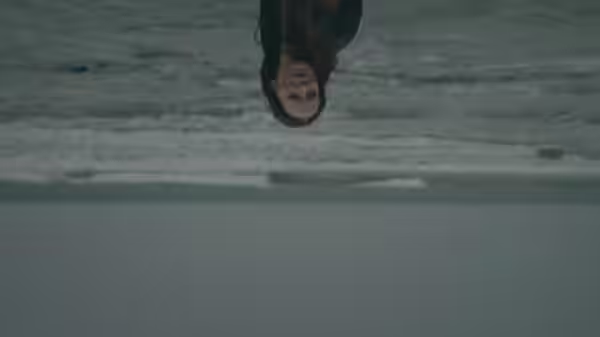
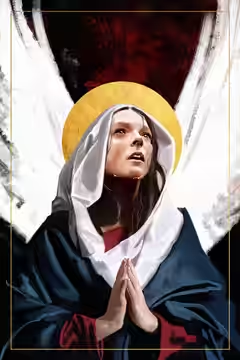
Clark is the film. She plays Maud as someone who has organised her whole life around one idea and is slightly put out when the world does not co-operate. She narrates to God in voiceover, apologising for small lapses, asking for signs, mildly hurt by the silences. The first time she feels Him arrive, alone on the lino of her bedsit, the sound drops away and her body bends back as if pulled by the spine, mouth open, eyes wet. We were frightened by it and a little ashamed to be watching, because Glass films faith the way other films film sex, and Clark does not spare us a second of it.

Ehle is the reason the first half works as drama and not just as a study. Amanda has spent her life being looked at, and Ehle plays the vanity of that, and the terror underneath it, without asking for sympathy. She drinks through the afternoon in a silk dressing gown, lights a cigarette when Maud is not looking, and needles her nurse’s God because it is the only game left in the house. Lily Frazer’s Carol, who visits with a bottle and stays the night, is everything Maud wants Amanda to give up. The scenes where the three of them share a room are the sharpest in the film.

The craft is small-scale and precise. Ben Fordesman shoots the town at night in the greens and pinks of the amusement arcades, and Maud’s face lit from below by whatever she happens to be kneeling in front of. Paulina Rzeszowska gives Amanda’s house heavy curtains, dark wood and framed photographs of her dancing, so that the whole place is a shrine to a body that is failing, and gives Maud a bedsit with one ring, one bed and one picture. Tina Kalivas keeps Maud in a nurse’s tunic and shapeless cardigans and puts Amanda in turbans and silk. Adam Janota Bzowski’s score is mostly a low drone and something like breathing, and it knows when to stop. Mark Towns cuts it tight; there is not a slack scene in the first forty minutes.

The problem arrives when Maud and Amanda are separated, for reasons we will leave alone. Maud on her own in the town, drifting past the pubs and the seafront, is less interesting than Maud with someone to convert, and Glass fills the gap with a couple of scenes that show us what we had already understood. Some critics have complained that Maud is thin as a character, that we never learn enough about her to feel the fall. We disagree. Glass gives us the hospital in a few frames and the rest in Clark’s face, and that is enough; it is the town, not the woman, that runs out of things to say. The last few minutes ask more of the budget than the budget can quite give, and you can see it straining. The final image is another matter. We have not managed to shake it.

Religious horror usually picks a side, the priest’s or the devil’s, and lets the audience watch from the pews. Glass puts us inside Maud’s head and leaves us there, and the film is at its best when it will not tell us whether what she hears is God or an illness, because Maud herself has no doubt. It owes something to Repulsion, another film about a young woman alone in a flat with her own mind, and it earns the comparison.

Watch it in the dark, alone if you can bear to, and do not plan anything for afterwards. It is over quickly and it does not leave quickly.
Critical consensus AI synthesised

80
Positive
23
Mixed
2
Negative
3

Most critics rate Saint Maud highly, and the praise is unusually consistent. Twenty-three of the twenty-eight reviews are positive, and nearly all of them name Morfydd Clark first: her Maud is called measured, vulnerable and unnerving in the same breath. Jennifer Ehle is the second most-mentioned name. Rose Glass, on her first feature, is credited with a confident, tightly controlled film, and several reviewers single out the close framing and sound design that keep the viewer inside Maud’s head, along with the bleak seaside setting.

The reservations gather at the end. Empire finds the final stretch too poetic for the film around it, and Total Film thinks the budget shows in the coda. The outright dissenters are few and mostly American, writing after the 2021 release there: Slant calls the portrait of fanaticism shallow, The New Yorker thinks Glass skims the details that would give Maud an inner life, and Polygon finds it too familiar to last. The spread is narrow at the top and wide at the bottom, but the bottom is thin.

Evening Standard
9 October 2020 · ★★★★★ · Charlotte O'Sullivan
100

O'Sullivan gives the film an emphatically positive verdict, calling it hauntingly perfect and worthy of success. She singles out Morfydd Clark’s performance for conveying Maud’s inner softness and pain.

Read the full review →
The Guardian
11 October 2020 · ★★★★★ · Mark Kermode
100

Kermode praises the film as an electrifying, shape-shifting psychological horror and a striking debut. He singles out Morfydd Clark and Jennifer Ehle’s performances, along with the film’s fluid visual style and carefully orchestrated scares.

Read the full review →
Time Out
4 October 2020 · ★★★★★ · Phil de Semlyen
100

The review calls the film the best British horror film since Under the Skin. It praises its startling seaside atmosphere.

Read the full review →
Variety
9 September 2019 · festival review · Guy Lodge
90*

Lodge calls the film a formidable, compassionate debut that balances horror with a searching character study. He especially praises Morfydd Clark’s blood-freezing performance as Maud.

Read the full review →
The i Paper
8 October 2020 · Geoffrey Macnab
88*

Macnab calls the film an exceptional, stylish and bone-chilling debut. He particularly praises Rose Glass’s blend of traditional horror with mordant social observation, and Morfydd Clark’s measured performance.

Read the full review →
Empire
5 October 2020 · Ian Freer
85*

Freer finds the film original, unsettling and surprisingly moving, praising Rose Glass’s ambitious, compassionate portrait of a troubled soul. He especially singles out Morfydd Clark’s vulnerable, powerful lead performance, while noting that the more poetic ending feels out of place.

Read the full review →

Straight answers AI written, from our review

Is Saint Maud worth watching?
Saint Maud is worth watching for anyone who can take a frightening, serious horror film about faith, and we scored it 82. Morfydd Clark carries it as a palliative nurse who believes God has a job for her, and Rose Glass takes the belief seriously. It sags in the middle when the two women are separated, but at 85 minutes it does not sag for long.
How long is Saint Maud, and what is it rated?
Saint Maud runs 1h 25m. It is a horror and mystery film.
Where can I watch Saint Maud in Ukraine?
Saint Maud is available to rent from Apple TV from ₴3.99. Availability is checked daily; the links above go straight to each service.
How violent or frightening is Saint Maud, and is it suitable for children?
Saint Maud is a 15 in the UK and an R in the US, and it is not for children. The fear is mostly in the mind of its heroine rather than on the walls, but it builds to a final stretch and a last image we have not managed to shake. Adults who dislike sustained dread should watch it with someone else.
How does Saint Maud compare to Repulsion?
Saint Maud owes a clear debt to Repulsion: both shut a young woman alone in a flat with her own mind and refuse to say whether what she perceives is real. Polanski's film is the tighter and the stranger, and Deneuve barely speaks; Glass's is warmer and talks to God in voiceover. Start with Repulsion if you want the original, with Saint Maud if you want the faith taken seriously.
What should I watch after Saint Maud?
After Saint Maud, try Repulsion (1965, Fi1m 88): Polanski’s young woman alone in a London flat; the walls start listening back. Then Breaking the Waves (1996, Fi1m 82): Faith taken to its end by a woman nobody will believe; von Trier at his most tender; and First Reformed (2017, Fi1m 86): A priest’s diary, a dying congregation and a conviction that turns to something worse.

Cast

If you liked this, try…

  1. Repulsion (1965, Fi1m 88)Polanski’s young woman alone in a London flat; the walls start listening back.

  2. Breaking the Waves (1996, Fi1m 82)Faith taken to its end by a woman nobody will believe; von Trier at his most tender.

  3. First Reformed (2017, Fi1m 86)A priest’s diary, a dying congregation and a conviction that turns to something worse.

  4. Possession (1981) · not on Fi1m yetA marriage in Cold War Berlin comes apart, and Isabelle Adjani does the unthinkable in a subway.

  5. Lourdes (2009) · not on Fi1m yetA pilgrimage, a possible miracle and the quiet cruelty of everyone else’s envy.