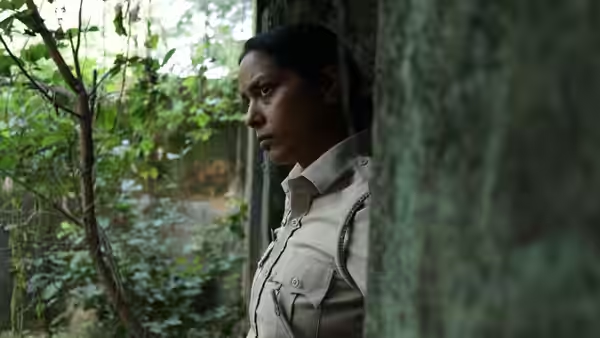
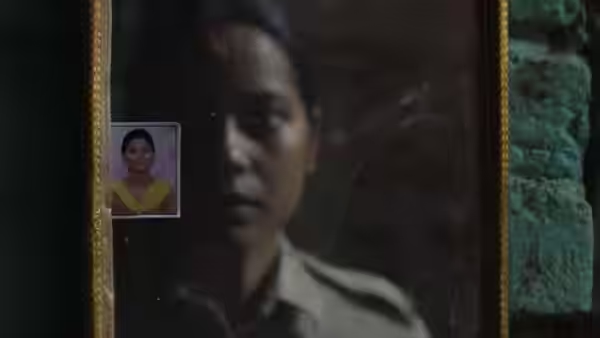
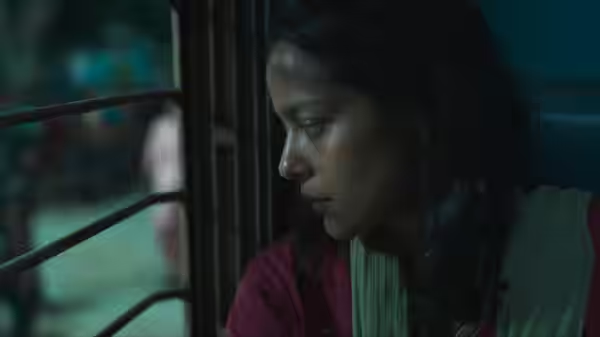
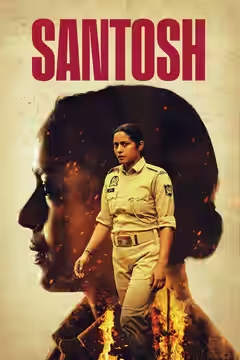
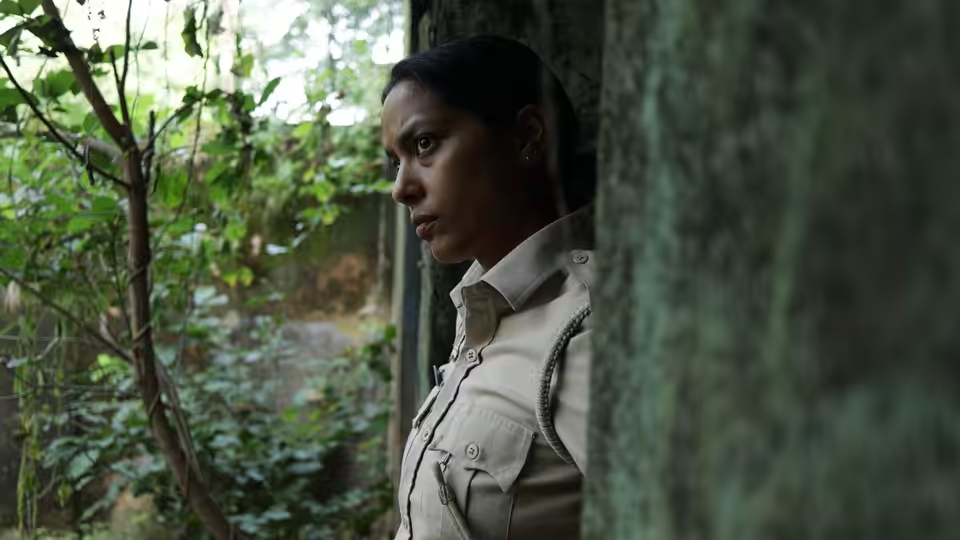
Constable Santosh Saini (Shahana Goswami) peers through foliage beside a window
Film review

Santosh

2024 · Directed by Sandhya Suri · 2h 08m

In a sentenceTwo policewomen make a corrupt institution look almost welcoming, and that is what gets under our skin

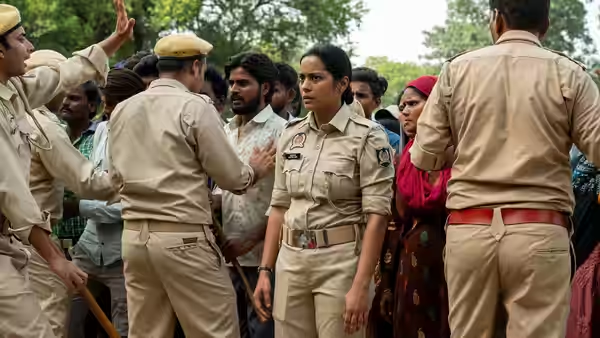
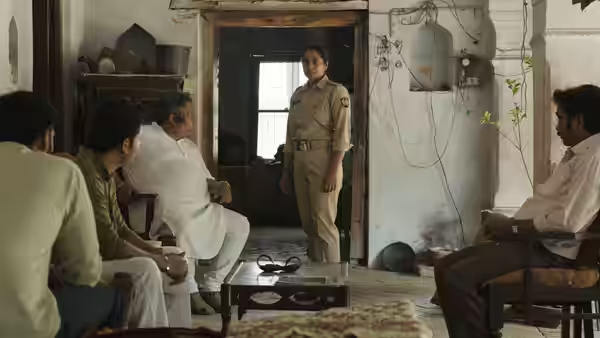
In rural India, Constable Santosh Saini (Shahana Goswami) works within a police system shaped by caste, religion and male authority. A murder investigation brings her into an uneasy partnership with Inspector Sharma (Sunita Rajwar), whose support offers some comfort amid the force’s hostility towards women. Their colleagues include Inspector Thakur (Naval Shukla). As Santosh pursues the case, the officers’ prejudices complicate the work of finding answers. She has to navigate the police hierarchy as well as the inquiry, with the possibility of acceptance by her colleagues making it harder to keep her distance from their methods.

Plays from YouTube when you press play; nothing loads from them until then.

Fi1m review

Sandhya Suri makes an absorbing police drama about two women working inside an institution that rewards prejudice. Shahana Goswami and Sunita Rajwar give it human weight, though the writing grows too eager to explain what their performances already show.

Santosh is an absorbing crime drama with two performances strong enough to carry it through some over-explaining. Sandhya Suri uses a murder investigation to examine how women find a place inside a police force organised around male authority and social prejudice. We keep watching for the investigators as much as for the investigation. The director is particularly good at making the job’s appeal understandable even when its practices are appalling.

Shahana Goswami plays Constable Santosh Saini with a restraint that asks us to pay attention without making her unreadable. She makes the officer’s vulnerability apparent without asking for sympathy at every opportunity. Santosh’s grief, however, receives less attention than it needs, leaving us to supply some of the connection between her private life and her conduct at work. The performance holds our interest even when the screenplay offers too little of that life.

Sunita Rajwar’s Inspector Sharma gives Santosh someone to feel close to in a force defined by its hostility towards women. The affection between them matters because the film lets it feel welcome without making either woman harmless. We were unsettled by their warmth: it made belonging to this police force seem attractive, despite everything wrong with it. Their exchanges help us understand why Santosh might respond to the person offering support rather than question the institution around her.

The screenplay is sharpest about the way caste, religion and rank affect the exercise of police power. These pressures bear on the investigation without requiring each character to stop and deliver a position on them. It helps that the women are allowed to be compromised, and that the actors give them more to do than demonstrate the film’s objections to policing. There is enough detail in the police work to hold our attention even when the direction of the case becomes easier to anticipate.

Lennert Hillege’s cinematography observes the officers coolly, an effective choice that also contributes to the film’s occasional emotional distance. Devika Dave’s production design helps the police setting feel like a workplace, though the people remain more distinctive than their surroundings. Maxime Pozzi-Garcia’s editing sustains our interest in the procedural detail, but the 128 minutes leave room for the same point to register more than once. Luisa Gerstein’s music makes less of an impression than the tension the two leads create together.

The weakness is a growing determination to make sure we have understood. As the film proceeds, Sandhya Suri’s writing becomes more explicit about ideas the performances have already made clear, and some of the uncertainty drains away. The crime story is also easier to predict than its patient attention to the inquiry initially promises. None of that undoes the force of the partnership, but it does make the film feel longer and more instructional than it needs to be.

Anyone coming for an ingenious mystery should adjust their expectations. The interest lies in spending time with people whose judgement we cannot comfortably trust, and whose company has begun to appeal to us. It is worth an evening for the two leads, provided a crime drama does not have to keep its deductions ahead of yours.

Critical consensus AI synthesised

72
Positive
9
Mixed
5
Negative
0

Most critics find Santosh a compelling police procedural, with praise centred on Shahana Goswami and Sunita Rajwar’s performances and the uneasy relationship between their characters. The reviews repeatedly credit the film with showing how caste, sexism and institutional loyalty shape police power. Its attention to everyday procedure gives that scrutiny force, while several critics admire how the social criticism emerges through character and incident rather than speeches. The lean is positive, with reservations rather than outright dismissals.

The disagreement concerns how far the film trusts its audience and how close it lets them get to Santosh. Some reviews find its restraint revealing; others see an emotional distance that limits the human drama, particularly her grief. The AV Club and Little White Lies argue that the film overstates its conclusions, weakening its ambiguity. Predictable crime plotting is another reservation, though even the more qualified responses generally find the investigation engrossing.

The Guardian
21 March 2025 · Peter Bradshaw
90*

Bradshaw finds the film tense, politically astute and satisfying, praising its lead performances by Shahana Goswami and Sunita Rajwar. He especially singles out how their uneasy partnership exposes sexism, caste prejudice and abuses of police power.

Read the full review →
Time Out
24 March 2025 · ★★★★ · Phil de Semlyen
80

The review presents the film as gripping and powerfully feminist. It praises its crime-procedural approach to murder and corruption.

Read the full review →
The Hollywood Reporter
24 May 2024 · festival review · Lovia Gyarkye
78*

Gyarkye finds the film smart, compelling, and immersive, while noting that more detail about Santosh’s grief would help. She particularly praises the performances of Shahana Goswami and Sunita Rajwar, and the screenplay’s subtle portrayal of India’s political realities.

Read the full review →
IndieWire
20 May 2024 · B · Proma Khosla
77

Khosla finds the film subtle and thought-provoking, letting its social critique emerge through story rather than speeches. She praises the naturalistic non-actors and lead performances, especially their grounded portrayal of life in rural India.

Read the full review →
Slant Magazine
18 December 2024 · ★★★/4 · Ross McIndoe
75

The critic finds the film extremely effective as a depiction of bleak systemic realities, though its crime-mystery turns are seldom surprising. They praise Shahana Goswami’s restrained performance and the film’s portrayal of how power can recruit the vulnerable into oppression.

Read the full review →
Sight and Sound
19 March 2025 · BFI
70*

The critic finds that Suri largely succeeds in exposing corruption and prejudice within the police system, though the film leaves some of its ideas underdeveloped. They praise the bond between Santosh and Geeta as a rare source of affection amid the violence and misogyny.

Read the full review →

Straight answers AI written, from our review

Is Santosh worth watching?
Santosh is worth watching for its two lead performances and its unsettling account of police prejudice; we score it 76 out of 100. We recommend it to anyone who values compromised characters over ingenious deductions, though the writing over-explains what the actors convey and the murder inquiry becomes easier to predict.
How long is Santosh, and what is it rated?
Santosh runs 2h 08m. It is a thriller and crime film.
Where can I watch Santosh in Lithuania?
Santosh is not on any streaming or rental service in Lithuania at the moment. It is available in 3 other countries; change your country at the top of the page to see where. Availability is checked daily.
How violent or frightening is Santosh, and is it suitable for children?
Santosh carries a UK 15 certificate, so it is not suitable for children under 15. Its murder investigation and prejudiced police force make it an unsettling choice, but we cannot give a precise account of graphic violence or scares from the available detail; the certificate is the clearest guide for younger teenagers and sensitive viewers.
How does Santosh compare to Memories of Murder?
Santosh shares its scrutiny of police behaviour with Memories of Murder, but we recommend the latter as the stronger procedural. Santosh is particularly absorbing in its relationship between two policewomen navigating prejudice and male authority; Memories of Murder offers greater tonal range, moving from comedy into discomfort, though its long middle stretch drags.
What should I watch after Santosh?
After Santosh, try Memories of Murder (2003, Fi1m 91): Another murder inquiry where police habits deserve as much scrutiny as suspects. Then A Separation (2011, Fi1m 93): Carefully observed loyalties and social divisions make every accusation harder to judge.

Cast

If you liked this, try…

  1. Memories of Murder (2003, Fi1m 91)Another murder inquiry where police habits deserve as much scrutiny as suspects.

  2. The Headless Woman (2008) · not reviewed yetFor another unsettling account of privilege making responsibility easier to evade.

  3. The Offence (1973) · not reviewed yetA harsher, claustrophobic encounter with police violence and the people excusing it.

  4. A Separation (2011, Fi1m 93)Carefully observed loyalties and social divisions make every accusation harder to judge.

  5. Black Coal, Thin Ice (2014) · not reviewed yetA chilly investigation where damaged investigators cannot keep their own desires outside.