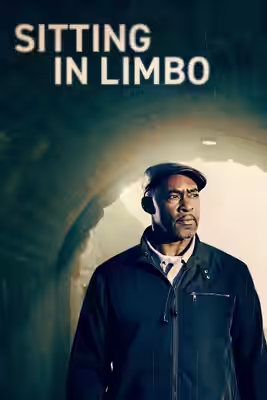
A family huddles together as a woman leans against an older man wearing a cap
Film review

Sitting in Limbo

2020 · Directed by Stella Corradi · 1h 29m

In a sentencePatrick Robinson makes staying calm look like work nobody should have to do

Anthony (Patrick Robinson) finds his sense of home and identity threatened by bureaucracy. His story unfolds within the Windrush scandal, with Janet (Nadine Marshall) and Eileen (Pippa Bennett-Warner) among the people around him. He wants to preserve the life he regards as his own, but official decisions place that belonging in doubt. As he tries to contain his fear and anger, dealing with the authorities becomes a struggle to hold on to his sense of himself. The drama follows the personal consequences of those decisions for Anthony and the people in his life.

Plays from YouTube when you press play; nothing loads from them until then.

Fi1m review

Stella Corradi’s restrained Windrush drama is moving and worth the attention it asks for. The supporting characters deserve more space, but Patrick Robinson makes Anthony’s fear, anger and effort to remain composed painfully clear.

Stella Corradi’s Sitting in Limbo is a moving drama that puts its faith in Patrick Robinson, and is right to do so. Its subject is the Windrush scandal, approached through Anthony’s experience of bureaucracy and the damage it does to his sense of belonging. Stephen S. Thompson’s writing keeps the emphasis on what this treatment costs a person. The narrow focus has its drawbacks, but Robinson gives us enough to sustain our interest in Anthony without turning his distress into a performance of suffering.

Robinson makes Anthony’s composure feel difficult to maintain. Fear and anger are present together, though neither becomes an invitation to admire the actor for displaying them. We found his effort to stay composed distressing, because Robinson makes clear how much Anthony has to suppress while trying to deal with what is happening to him. The weariness matters, too: staying reasonable takes something out of him, and Robinson allows us to register the effort without overstating it.

Social dramas can become too pleased with the dignity of the people they depict. Anthony should not have to be patient or sympathetic for his treatment to matter; a less agreeable person would deserve the same concern. Robinson’s anger helps here, giving Anthony feelings that cannot be contained by the description of a decent man in difficulty. Thompson and Corradi are strongest when they trust that anger to be understood without explaining it, keeping our attention on the person subjected to official decisions.

Rina Yang’s cinematography and Stephen Campbell’s production design support the intimacy of Corradi’s approach, without competing with the actors for attention. The editing by Kristina Hetherington and Lee Mckarkiel gives the telling a useful clarity: bureaucratic confusion does not become confusion for us. Neil Davidge’s music makes less of an impression than the performances, which is no great fault in a drama so dependent on Robinson. The unobtrusiveness works, although the film can feel a little too visually discreet for the strength of feeling it generates.

Nadine Marshall as Janet and Pippa Bennett-Warner as Eileen are welcome presences, though neither character feels as fully considered as Anthony. The supporting performances deserve more space, and this is where the close attention to him becomes a limitation. We get less opportunity to consider the other characters in their own right. It is a worthwhile reservation about a film whose lead performance is so persuasive that it can take a while to notice how much of our interest depends on him.

At 89 minutes, Sitting in Limbo is compact, but Robinson’s weariness asks for sustained attention. Corradi’s restraint suits a story about the damage bureaucracy does to someone’s understanding of home, and she avoids making anger feel like an easy response that settles anything. The film is strongest when it leaves us considering how Anthony manages to contain his feelings at all. Watch it for Robinson, accepting that the people around Anthony remain less clearly drawn.


Critical consensus AI synthesised

80
Positive
4
Mixed
0
Negative
0
The Guardian
14 June 2020 · Euan Ferguson
80*

Ferguson calls the drama absorbing and rewatchable, saying it quietly tells loud truths about the Windrush scandal. He particularly praises its restrained anger and Patrick Robinson’s weary, dignified performance.

Read the full review →
The i Paper
8 June 2020 · ★★★★ · Sarah Hughes
80

The review finds the drama moving and powerful in showing how bureaucracy devastates people’s lives. It particularly praises the way it unpicks the characters’ sense of home and self.

Read the full review →
Radio Times
9 June 2020 · Eleanor Bley Griffiths
75*

The review presents the drama as especially timely. It praises the clarity and intimacy of its telling of Anthony Bryan’s story.

Read the full review →
Den of Geek
8 June 2020 · Louisa Mellor
85*

The review calls the drama vital viewing, praising its restrained approach to exposing the Windrush scandal. It singles out Patrick Robinson’s nuanced, understated performance for conveying Bryan’s fear and anger through self-control.

Read the full review →

Straight answers AI written, from our review

Is Sitting in Limbo worth watching?
Sitting in Limbo is worth watching for Patrick Robinson’s quietly distressing performance, and we score it 80 out of 100. We recommend it to viewers who value restrained, performance-led drama: Anthony’s effort to contain his fear and anger makes the personal cost of the Windrush scandal painfully clear, though the people around him deserve more space.
How long is Sitting in Limbo, and what is it rated?
Sitting in Limbo runs 1h 29m. It is a drama film.
Where can I watch Sitting in Limbo in Chile?
Sitting in Limbo is not on any streaming or rental service in Chile at the moment. It is available in 1 other country; change your country at the top of the page to see where. Availability is checked daily.
How does Sitting in Limbo compare to I, Daniel Blake?
Sitting in Limbo is the more restrained choice beside I, Daniel Blake, with both dramas following people worn down by official decisions. We favour its restraint over the way Ken Loach’s film sometimes presses its case, though I, Daniel Blake offers warmth and stubborn humour through Dave Johns and Hayley Squires; Sitting in Limbo depends more heavily on its lead.
What should I watch after Sitting in Limbo?
After Sitting in Limbo, try I, Daniel Blake (2016, Fi1m 82): Another patient account of ordinary people worn down by official decisions. Then His House (2020, Fi1m 79): Displacement and the search for safety become horror, with the human cost intact; and The Emigrants (1971, Fi1m 85): For a longer view of migration, family and the difficulty of starting again.

Cast

If you liked this, try…

  1. I, Daniel Blake (2016, Fi1m 82)Another patient account of ordinary people worn down by official decisions.

  2. The Visitor (2007) · not reviewed yetA quiet American drama about immigration, friendship and the limits of goodwill.

  3. His House (2020, Fi1m 79)Displacement and the search for safety become horror, with the human cost intact.

  4. The Emigrants (1971, Fi1m 85)For a longer view of migration, family and the difficulty of starting again.

  5. Small Axe (2020, Fi1m 88)British Caribbean lives receive the space and variety a single film cannot offer.

Free account

Know what to watch tonight

Two lists that know where things are streaming, collections you can share, your own score beside ours, and Discover that remembers what you have seen.

  • Want to see, sorted by what is streaming now
  • Seen, with your score out of ten
  • No adverts, ever