Garth Jennings’s comedy about two boys remaking First Blood with a camcorder is funny, fond and well acted, and its first hour gets childhood right. It then reaches for a bigger plot than it needs, and the sentiment arrives on schedule.
Garth Jennings’s film is a small one and better for it. Will Proudfoot (Bill Milner) has grown up in a Brethren household in the 1980s, which means no television, no films and no music that is not sung in church. Lee Carter (Will Poulter) is the boy who gets sent out of every lesson. He shows Will First Blood and signs him up as the stuntman in a home-made sequel. The film that follows is funny and warm and well acted, and for an hour it gets childhood right. Then it reaches for more plot than it can carry.
The first hour belongs to the two boys. Milner plays Will as a child with too much in his head and nowhere to put it; he draws in the margins of his Bible and on the walls of his bedroom, and Jennings animates the drawings so they climb off the page and start fights with each other. Poulter plays Lee as a bully who has worked out that bullying is quicker than asking, and lets us see, a scene at a time, how lonely the house he goes home to is. Lee gives orders and Will carries them out, and neither of them notices for a long while that this is the first friend either has had.
The scene where Will watches First Blood moved us more than a scene of a boy watching a video has any right to. Jennings keeps the camera on Milner rather than on the screen, and Milner does nothing but watch, mouth slightly open, as a man with a knife runs through a forest. Everything the film has to say about imagination is in that face, and it says it without a line of dialogue. We were not expecting to be got at twenty minutes into a comedy about a camcorder.
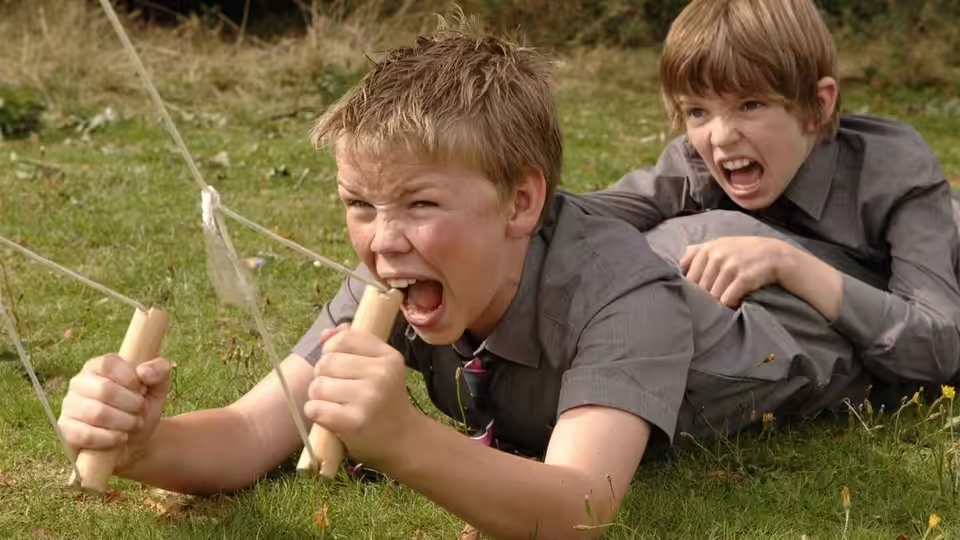
The stunts made us laugh out loud, which is rarer than it should be. Will is launched from a rope swing into a lake, tipped out of a tree and dragged through undergrowth, and Milner plays every landing as a boy who has been told pain is a sin and has just discovered it is also fun. Jess Hall shoots the Proudfoot house in dim brown rooms and the woods in strong, bright summer colour, so that going out to make the film looks like a jailbreak. Joel Collins gives Lee’s house the clutter of a boy left to himself and Harriet Cawley puts Will in grey knitwear and Lee in army surplus. Dominic Leung cuts the boys’ footage into the film at exactly the length a joke needs, and Joby Talbot’s score bounces along underneath without insisting on anything.
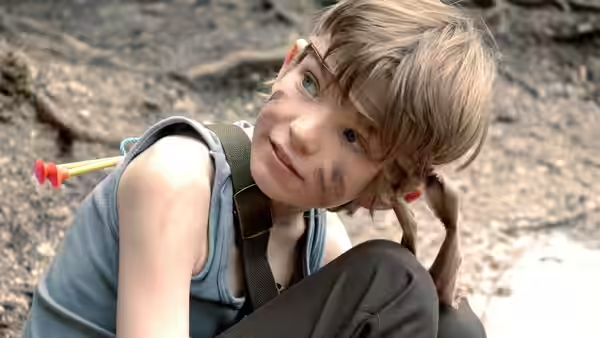
The trouble begins with Didier Revol (Jules Sitruk), a French exchange student with a quiff and a pout who arrives at the school and is worshipped on sight. His coming turns a two-hander into a film about popularity, and the second half spends most of its energy on who is in whose gang. Jennings has written himself a subplot he does not need, and it costs the boys the screen time that was the point. At the same time the Brethren story, with Joshua (Neil Dudgeon) hovering over Mary (Jessica Hynes), is given less room than it earns. Dudgeon plays Joshua softly, as a man who believes himself kind, and Hynes gets one scene that matters and plays it beautifully; both deserved more.
The last half hour takes a turn we will not describe. We can say that we saw it coming from some distance and that it still worked on us a little, and that the credit for this belongs to Milner and Poulter rather than to the writing, which reaches for its lessons in the places you would expect to find them.
It runs 95 minutes and carries a 12A. Watch it with a child of about ten, if you have one to hand, or with whoever you were at that age. Then go and find out what happened to the two boys, because the film’s best argument is their faces.