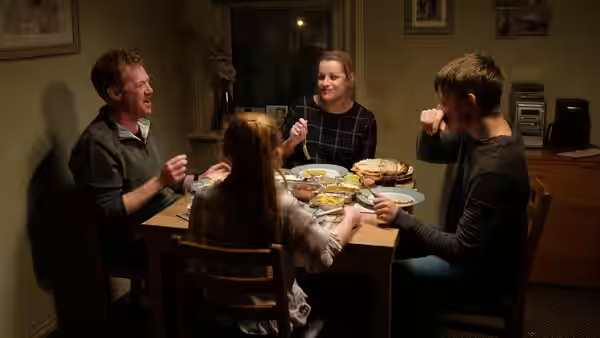
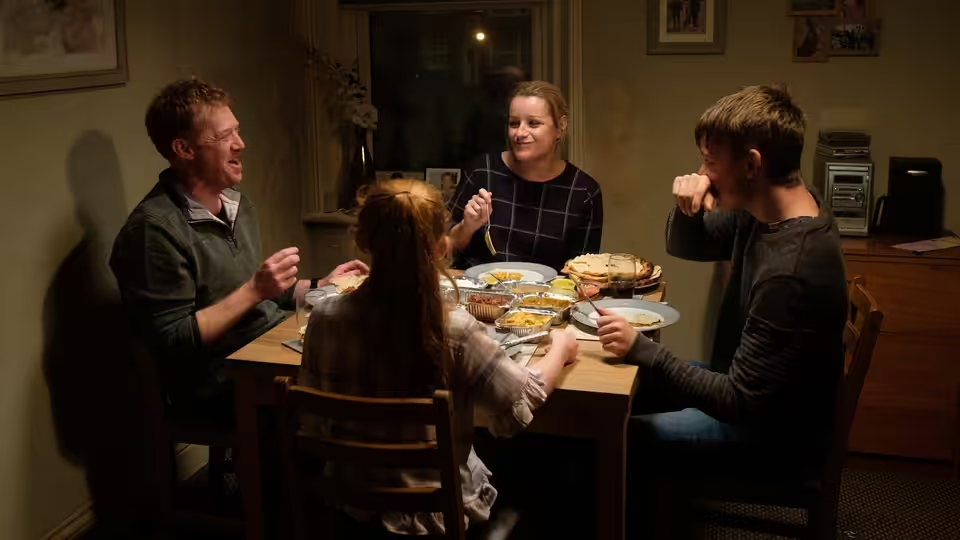
Ricky (Kris Hitchen), Abby (Debbie Honeywood), and their children share a meal around the dining table
Film review

Sorry We Missed You

2019 · Directed by Ken Loach · 1h 41m

In a sentenceA parcel arrives on time, and an entire family pays for it

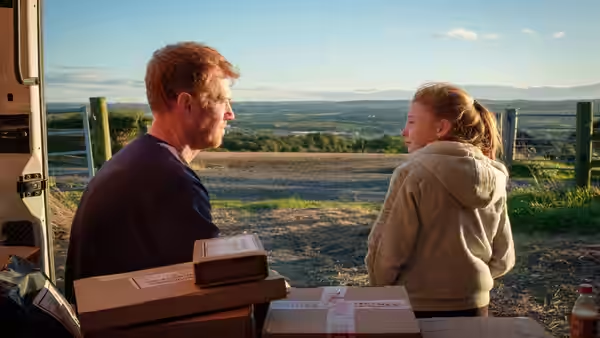
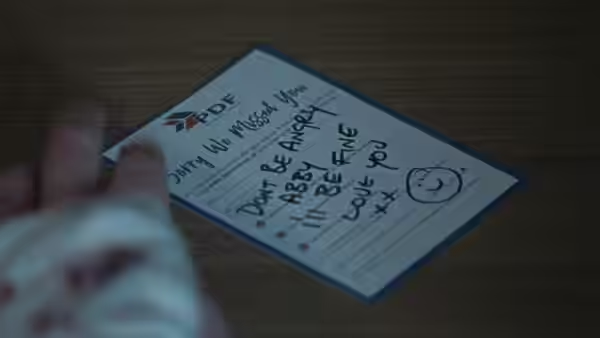
Ricky (Kris Hitchen) is trying to support his family through delivery work, dealing with customers while the job makes demands on his time. At home, Abby (Debbie Honeywood), Seb (Rhys Mcgowan) and Liza Jane (Katie Proctor) share the pressure. Delivery and care work shape the household’s days, leaving the family to fit its needs around those of other people. Maloney (Ross Brewster) spells out what the job expects. Ricky wants his efforts to give the family some security, but making a living increasingly leaves him less time to spend with them.

Plays from YouTube when you press play; nothing loads from them until then.

Fi1m review

Ken Loach makes the damage done by insecure work painfully clear, helped by a cast who make the family worth caring about. The accumulated setbacks can feel arranged, but the anger is earned.

Sorry We Missed You is a forceful, humane drama, with performances that keep it worth watching when the writing becomes too insistent. Ken Loach and writer Paul Laverty follow the pressures of insecure work into family life, where earning a living begins to hurt the people it is meant to support. Delivery and care work give the film its subject, and the ordinary demands of employment supply much of its tension. We recommend it, with a warning that the succession of setbacks can feel arranged.

Kris Hitchen gives Ricky enough humour to keep him from becoming merely a man to feel sorry for. The customer encounters are important for that reason: we get some sense of the person doing the job, beyond the difficulties of getting it done. Such exchanges let the film breathe without pretending the pressure has disappeared. His approachable performance makes the family scenes more involving. We have reasons to care about Ricky before the setbacks accumulate.

Debbie Honeywood’s Abby is the strongest reason to stay with the film when the writing grows forceful. She makes the exhaustion and anger credible without making Abby seem incapable of tenderness. Rhys Mcgowan as Seb and Katie Proctor as Liza Jane help the family scenes feel awkward and affectionate without making them cosy. The affection matters because it gives us something to worry about losing when work begins to crowd everything else out.

Robbie Ryan’s cinematography has a documentary-like plainness, which suits a drama that asks us to pay attention to ordinary work. Fergus Clegg’s production design shares that lack of fuss, helping the family scenes feel lived in without making hardship the only thing to notice. Jonathan Morris’s editing keeps the demands of employment close to their consequences at home, giving the film a firm pace across its 101 minutes. George Fenton’s score is less memorable than the voices, which is no failing in a film so dependent on the credibility of its performances.

The trouble is how determined Paul Laverty is to leave us in no doubt about the damage. As setbacks accumulate, there is less room for the casual family observation that makes the earlier passages persuasive, and Seb’s difficulties are pushed particularly hard. The film sometimes appears to have decided what each person must suffer before letting them get on with living. That matters in social drama: if every difficulty seems prescribed by the writer, we can start resisting events we might otherwise believe.

Ross Brewster’s Maloney shows how well the blunt approach can work when it has a clear target. We were angry at his callous speech about work, because it makes the needs of the worker sound like an imposition. The writing scarcely disguises its purpose there, but the performance makes that attitude credible. See it when there is time to talk afterwards; it is poor preparation for an early night.

Critical consensus AI synthesised

74
Positive
17
Mixed
3
Negative
3

Most critics find Sorry We Missed You an affecting, angry account of how gig-economy work strains family life. Praise centres on the cast’s natural, understated performances and Ken Loach’s attention to the daily pressures of precarious employment. Paul Laverty’s researched script also earns approval for making working conditions concrete. For many reviewers, the domestic detail, humour and compassion make the political case persuasive rather than merely instructive.

The spread is wide, though, and the chief disagreement concerns how heavily the story loads hardship onto its family. Even some favourable reviews find the accumulating setbacks melodramatic or the plotting too calculated. Little White Lies sees a relevant social critique weakened by blunt, soapy storytelling, while The New Yorker goes further, arguing that the characters lack independent voices and fuller lives. The divide is between critics who find the family convincingly observed and those who see people reduced to illustrations of exploitation.

The Hollywood Reporter
16 May 2019 · festival review · David Rooney
94*

Rooney calls the film expertly judged, profoundly humane, and deeply affecting. He singles out its emotionally devastating portrayal of how gig-economy work damages family life.

Read the full review →
Screen Daily
17 May 2019 · festival review · Lee Marshall
90*

Marshall calls it one of Ken Loach’s best films. He singles out Loach’s continued collaboration with writer Paul Laverty.

Read the full review →
The Guardian
16 May 2019 · festival review · Peter Bradshaw
90*

Bradshaw calls the film brilliant, gripping and emotionally devastating, while noting a political qualm about its treatment of Brexit. He praises the performances’ simple dignity and the film’s vivid, researched portrayal of precarious work.

Read the full review →
Variety
16 May 2019 · festival review · Shalini Dore
90*

Dore finds the film a fraught, touching, and galvanizing drama about the gig economy’s damage to working families. She particularly praises Loach’s lived-in depiction of precarious labor and its growing strain on family life.

Read the full review →
Slant Magazine
2 March 2020 · ★★★½/4 · Pat Brown
88

Brown calls the film a powerful, enraged appeal for action against the forces eroding workers’ rights. The review praises its understated, realistic performances and its portrayal of how precarious work damages family life.

Read the full review →
Los Angeles Times
5 March 2020 · Robert Abele
85*

A blisteringly human and emotionally wrenching film, the review says, makes its critique of modern work feel honest rather than schematic. It singles out the central cast’s gritty, humorous and sensitive performances as a source of the family drama’s force.

Read the full review →

Straight answers AI written, from our review

Is Sorry We Missed You worth watching?
Sorry We Missed You is worth watching for its humane performances and forceful account of insecure work damaging family life; we score it 82. We recommend it to viewers who want an involving social drama, with the caveat that its accumulating setbacks sometimes feel arranged to make the point harder to miss.
How long is Sorry We Missed You, and what is it rated?
Sorry We Missed You runs 1h 41m. It is a drama film.
Where can I watch Sorry We Missed You in Malaysia?
Sorry We Missed You is not on any streaming or rental service in Malaysia at the moment. It is available in 24 other countries; change your country at the top of the page to see where. Availability is checked daily.
How violent or frightening is Sorry We Missed You, and is it suitable for children?
Sorry We Missed You has a UK 15 certificate, making it unsuitable for children under 15. Its emotional pressure comes from exhausting work, family strain and anger rather than anything we would describe here as horror; we cannot give a specific violence warning from those details alone. We recommend it for older teenagers and adults prepared for a distressing social drama.
How does Sorry We Missed You compare to Bicycle Thieves?
Sorry We Missed You is a forceful companion to Bicycle Thieves, though we recommend the latter more warmly for its father-son performances. Both show poverty putting pressure on a working father; Sorry We Missed You gives delivery work, care work and the wider household more attention. Its repeated setbacks are our reservation, whereas the music is our caveat with Bicycle Thieves.
What should I watch after Sorry We Missed You?
After Sorry We Missed You, try Bicycle Thieves (1948, Fi1m 93): A working father’s search exposes how quickly poverty makes ordinary decency difficult. Then Two Days, One Night (2014, Fi1m 88): Another worker’s livelihood depends on people who can barely protect their own; and Riff-Raff (1991, Fi1m 77): Building-site humour gives precarious workers the unruly lives a political argument might flatten.

Cast

Awards

Gaudí Award for Best European Film, 2021

Won
Gaudí Award for Best European Film

If you liked this, try…

  1. Bicycle Thieves (1948, Fi1m 93)A working father’s search exposes how quickly poverty makes ordinary decency difficult.

  2. Two Days, One Night (2014, Fi1m 88)Another worker’s livelihood depends on people who can barely protect their own.

  3. Support the Girls (2018) · not reviewed yetService work, unreasonable demands and colleagues finding small ways to look after one another.

  4. Tokyo Sonata (2008) · not reviewed yetUnemployment enters a family home where nobody knows how to discuss it.

  5. Riff-Raff (1991, Fi1m 77)Building-site humour gives precarious workers the unruly lives a political argument might flatten.