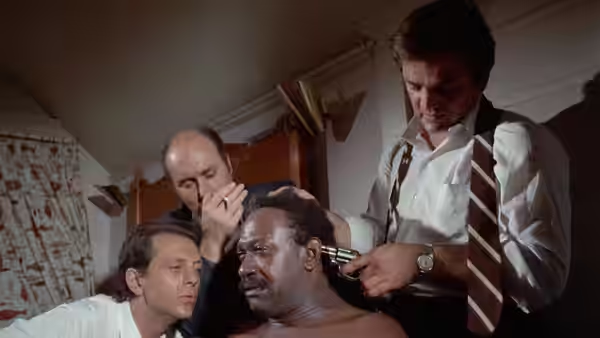
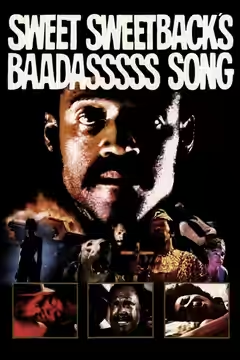
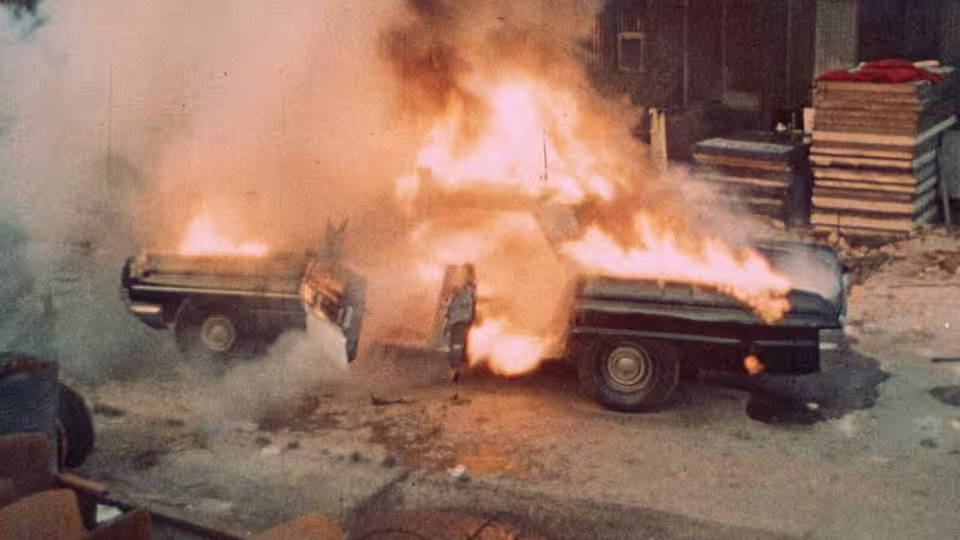
A car burns in the street as flames pour from its windows
Film review

Sweet Sweetback's Baadasssss Song

1971 · Directed by Melvin Van Peebles · 1h 38m

In a sentenceWe would happily watch the montage again; the chases have had their turn

Sweetback (Melvin Van Peebles) is at the centre of a crime story driven by pursuit. The characters include Beetle (Simon Chuckster), the Commissioner (John Dullaghan) and Young Sweetback (Mario Van Peebles), alongside Biker (John Amos) and Old Girlfriend (Rhetta Hughes). The chase provides the action in a film that also draws on drama and thriller elements. This 1971 film runs for 98 minutes and carries an 18 certificate; Melvin Van Peebles writes, directs, edits and supplies the music as well as taking the lead.

Plays from YouTube when you press play; nothing loads from them until then.

Fi1m review

Melvin Van Peebles’s crime film is angry, visually inventive and worth the effort, though its repeated chases wear thin. The montage gives it an excitement the screenplay cannot consistently supply.

Sweet Sweetback’s Baadasssss Song is a good, abrasive crime film, worth the effort if a tidy chase is not the chief attraction. Melvin Van Peebles directs, writes and plays Sweetback, and the film’s political anger gives it a force the plotting cannot always sustain. The pursuit grows repetitive. What keeps us watching is the visual invention, which can make a familiar action-film device feel awkward and unpredictable again.

Robert Maxwell’s cinematography provides the material for the psychedelic montage, with Melvin Van Peebles also taking the editing credit. That combination produces the film’s most absorbing passages, where the treatment of the images becomes more interesting than the business of keeping a chase going. We felt jolted by the montage; its disruptions made us pay attention again when the pursuit had begun to lose us. There is considerable pleasure in watching the images change, even when following the story is less rewarding.

The film works as a fable addressed to people accustomed to being pushed aside, and its bluntness makes sense on those terms. There is little interest in making the anger comfortable. We welcome that, particularly in a genre that can turn conflict into an easy evening’s diversion. But the deliberate overstatement sometimes becomes wearing, and the film is less persuasive when it presses the same point without finding a fresh way to express it.

Melvin Van Peebles’s music helps maintain the sense of agitation, and we count that pressure among the film’s strengths. Sound and cutting keep the action unsettled even when the screenplay has become predictable. Yet sustained intensity needs some variation if it is to keep working. There are passages where the music and editing have already done enough, and the continued insistence makes their effect less powerful.

The screenplay is the weaker part of Melvin Van Peebles’s many contributions. Several of the vignettes are absorbing, but the repeated chase scenes ask movement to supply interest that the writing has not earned. We grew impatient with that repetition, because another stretch of pursuit was too often giving us the same experience. A running time of 98 minutes should suit such direct filmmaking, but the chase occupies more of it than the story can usefully support.

Still, the unevenness should not obscure how much of the filmmaking works. The independently made film risks being abrasive, and its best visual passages justify that risk without requiring us to make allowances for them. The action genre benefits from this willingness to interrupt a chase and make us look differently, even when the resulting film is harder to enjoy. We wish the writing offered as much variety as the montage, but there is plenty here to hold our attention.

We recommend it most readily to viewers interested in confrontational political cinema, who may find its overstatement easier to accept. The visual invention gives us enough pleasure to forgive the slack passages, though patience is required. Anyone chiefly after a tightly plotted thriller should choose something else.

Critical consensus AI synthesised

72
Positive
2
Mixed
3
Negative
0
Slant Magazine
10 June 2018 · ★★★★½ · Clayton Dillard
90

Dillard regards the film as a singular, politically charged work and praises the Blu-ray restoration as a revelation. He singles out its inventive psychedelic montage and visual approach as central to its lasting impact.

Read the full review →
Time Out
· TCh
85*

The review presents the film as arguably the most important Black American film of its era. It singles out its genuinely independent production, while noting that it has remained largely unseen in Britain.

Read the full review →
The New Yorker
11 June 1971 · Penelope Gilliatt
68*

Gilliatt finds the film angry and often unlikable, but admires its force as a fable for a marginalized audience. She singles out its energetic, insurgent popular style, while noting that its deliberate overstatement can grate.

Read the full review →
The New York Times
9 May 1971
65*

The page does not reveal the critic’s verdict. Its assessment and any specific praise or complaint cannot be verified from the accessible text.

Read the full review →
Variety
31 December 1970 · Variety Staff
50*

The review is mixed, crediting Van Peebles’s many contributions while criticizing serious screenplay problems. It praises several absorbing vignettes but finds the repeated chase scenes boring.

Read the full review →

Straight answers AI written, from our review

Is Sweet Sweetback's Baadasssss Song worth watching?
Sweet Sweetback’s Baadasssss Song is worth watching for its abrasive political anger and inventive montage, and we score it 72 out of 100. We recommend it to viewers interested in confrontational political cinema, but the repetitive chases and weaker screenplay make it a poor choice for anyone chiefly after a tightly plotted thriller.
How long is Sweet Sweetback's Baadasssss Song, and what is it rated?
Sweet Sweetback's Baadasssss Song runs 1h 38m. It is an action and crime film.
Where can I watch Sweet Sweetback's Baadasssss Song in South Korea?
Sweet Sweetback's Baadasssss Song is not on any streaming or rental service in South Korea at the moment. It is available in 1 other country; change your country at the top of the page to see where. Availability is checked daily.
How violent or frightening is Sweet Sweetback's Baadasssss Song, and is it suitable for children?
Sweet Sweetback’s Baadasssss Song carries a UK 18 certificate and is not suitable for children. That classification marks it as adult viewing; we find its pursuit-driven action and agitated sound and editing abrasive, but cannot give a specific account of violence or frightening content from the details available.
How does Sweet Sweetback's Baadasssss Song compare to Killer of Sheep?
Sweet Sweetback’s Baadasssss Song is the more confrontational choice beside Killer of Sheep, which we recommend more readily for its humour, tenderness and closely observed family life. Sweetback’s psychedelic montage rewards an appetite for abrasive political cinema despite repetitive chases; Burnett’s quieter film is more affecting, though its episodic storytelling and some hesitant acting take adjustment.
What should I watch after Sweet Sweetback's Baadasssss Song?
After Sweet Sweetback's Baadasssss Song, try Killer of Sheep (1978, Fi1m 90): For Black independent filmmaking that finds its force in quieter, closely observed lives. Then The Battle of Algiers (1966, Fi1m 93): Political anger and pursuit, handled with greater narrative discipline and collective scope.

Cast

If you liked this, try…

  1. The Spook Who Sat by the Door (1973) · not on Fi1m yetAnother abrasive Black political thriller, with a sharper appetite for organised resistance.

  2. Killer of Sheep (1978, Fi1m 90)For Black independent filmmaking that finds its force in quieter, closely observed lives.

  3. The Battle of Algiers (1966, Fi1m 93)Political anger and pursuit, handled with greater narrative discipline and collective scope.

  4. Touki Bouki (1973) · not on Fi1m yetFor restless montage and young outsiders whose ambitions keep colliding with their surroundings.

  5. Born in Flames (1983) · not on Fi1m yetRough, argumentative political filmmaking that makes formal disruption part of its protest.