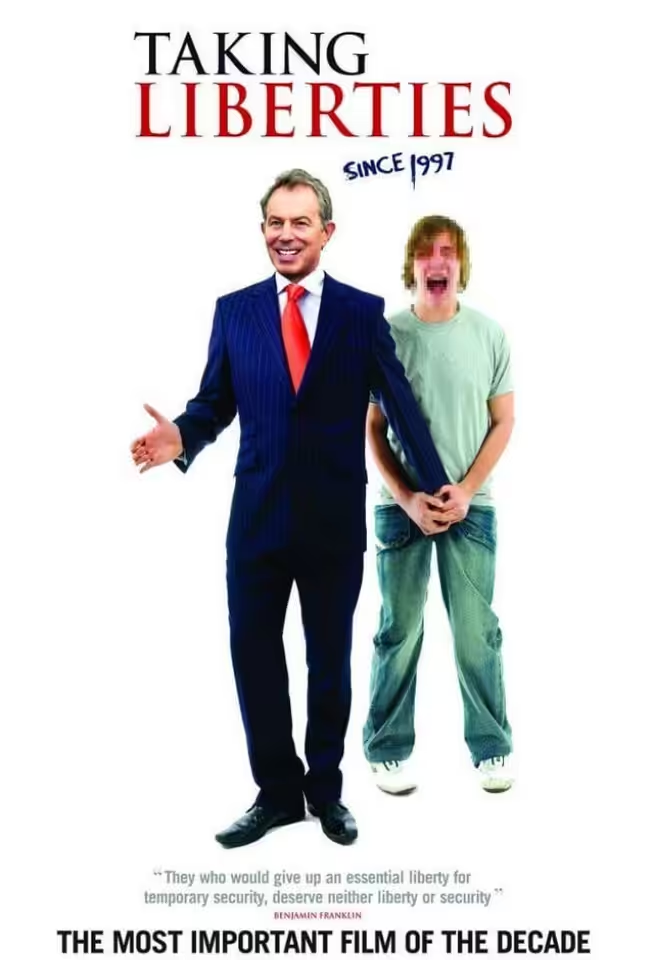
Taking Liberties poster
Film review

Taking Liberties

2007 · Directed by Chris Atkins · 1h 41m

In a sentenceTen years of New Labour explained by two narrators, some cartoons and, for reasons unclear, Boris Johnson

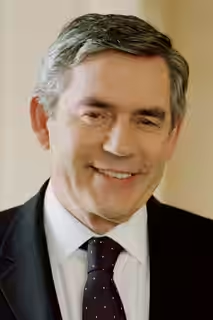
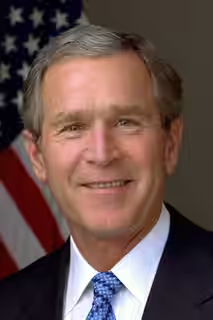
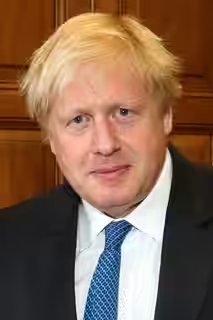
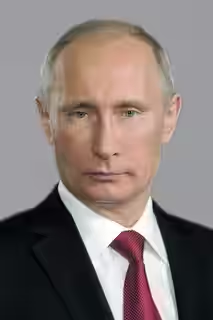
Narrated by David Morrissey and Ashley Jensen, Chris Atkins’s documentary takes 1997 as its starting point and asks what the ten years since have done to the right to say no to the people in power. It sets archive footage of Tony Blair, Gordon Brown and John Prescott against the record, and lines them up beside George W. Bush and Vladimir Putin. Between the politicians come ordinary people, most of them caught on the wrong side of new restrictions on protest, and some of them pushing back. Tony Benn and the civil-liberties campaigner Shami Chakrabarti speak for the defence; Boris Johnson turns up too. Cartoon interludes explain the laws as they arrive.

Fi1m review

Chris Atkins’s cheerful, openly one-sided polemic about civil liberties under Blair is at its best when it stops arguing and simply shows someone being arrested for something that should not be a crime. The jokes and the length get in the way.

Chris Atkins’s documentary takes the ten years from Tony Blair’s arrival in Downing Street and asks what happened to the right to say no to the people inside it. The tagline is Since 1997, and the film means it as a charge sheet. It is a cheerful, scrappy, openly one-sided 101 minutes, built from archive clips, interviews and cartoon interludes, and it is at its best when it stops arguing and simply shows us somebody being arrested for something that should not be a crime. That happens often enough to make it worth an evening. It does not happen often enough to make the case.

The method will be familiar to anyone who has sat through a polemical documentary since the turn of the century. Blair’s early promises are cut against what came after; Gordon Brown and John Prescott turn up in archive to look evasive; George W. Bush and Vladimir Putin appear so that a comparison can be drawn without anyone having to say it aloud. David Morrissey and Ashley Jensen share the narration, he gravely and she with a lift in the voice that warns you a joke is coming. The jokes are the problem, and we will come back to them.

What works are the people. Atkins has found a run of ordinary Britons who did something mild, mostly in the way of protest, and were treated as if they had done something dangerous. He also follows some of them as they push back against the new rules, and win small victories, which is the film’s most cheering stretch. None of them is a radical in any sense you would notice on a bus. That is the film’s strongest point, and it makes it without raising its voice.

We will admit to being got at. The footage of ordinary people being stopped, moved on and arrested for the crime of standing somewhere with an opinion made us laugh, because the gap between the offence and the response is absurd, and then it made us angry, because it is our own country and our own police. Atkins lets the officials explain themselves and then cuts to the people on the receiving end. Those cuts do more work than the twenty minutes of argument that follow them.

The argument is where the trouble is. Atkins has decided the audience needs jollying along, so the serious material keeps being interrupted by an animated sequence, a jaunty cue and a narrator’s quip, as if we might otherwise reach for the remote. The cartoons are neatly made and some are funny. But a passage about detention without charge does not need a gag at the end of it, and the habit of supplying one makes the film look less sure of its material than it is. Tony Benn and Shami Chakrabarti speak for the defence and are given room; Boris Johnson is there to be amusing and is. Almost nobody is brought on to put the government’s side and have it tested, so the film wins every exchange, and the wins are worth less for it.

It also goes on. In 101 minutes it covers identity cards, extradition, surveillance, protest law, detention and the war, and by the last third the cases start to blur into a list. A shorter film with half the subjects and twice the time on each would have been harder to dismiss.

Against the Michael Moore model it is plainly working from, it is gentler, more British and less pleased with itself; Atkins stays off camera, which is a mercy. Against the standard of a documentary that changes a mind, it falls short, because it is speaking to people who have already made theirs up. Watch it at home with someone who voted the other way and see how far you get. We would give it forty minutes.

Critical consensus AI synthesised

66
Positive
3
Mixed
1
Negative
1
The Guardian
8 June 2007 · Peter Bradshaw
85*

Bradshaw finds the documentary thoroughly enjoyable and worthwhile despite its familiar arguments. He praises its cheerful, polemical celebration of dissent and British awkwardness.

Read the full review →
Time Out
5 June 2007 · ★★★★ · Wally Hammond
80

Hammond gives the film four stars, indicating a positive verdict. The available description singles out its cinema-feature documentary approach and gently tongue-in-cheek tagline.

Read the full review →
Radio Times
★★★ · David Parkinson
60

The critic sees the documentary as a damning, combative account of civil-liberties restrictions under Tony Blair. He praises its breadth of subject matter but notes that the narration sometimes takes a misjudged comic tone.

Read the full review →
Empire
18 September 2007 · William Thomas
30*

The review finds the documentary’s case against the erosion of civil liberties sinister but ultimately unconvincing. It criticizes the film’s partisanship and flawed evidence, despite its droll use of archive footage.

Read the full review →
Eye for Film
3 June 2007 · Jennie Kermode
80*

Kermode finds the documentary important, entertaining and emotionally effective, despite saying it could be tighter and feels slightly too long. She particularly praises its impressive animation and the positive examples of people taking action against restrictions on protest.

Read the full review →

Straight answers AI written, from our review

Is Taking Liberties worth watching?
Taking Liberties is worth an evening for anyone already interested in what ten years of Blair's government did to the right to protest, and we scored it 66. Its strongest stretches simply show ordinary Britons arrested for standing somewhere with an opinion; the cartoons, the quips and the 101-minute length keep getting in the way, and it will not change a mind that is made up.
How long is Taking Liberties, and what is it rated?
Taking Liberties runs 1h 41m. It is a documentary film.
Where can I watch Taking Liberties in the US?
Taking Liberties is not on any streaming or rental service in the US at the moment. It is available in 1 other country; change your country at the top of the page to see where. Availability is checked daily.
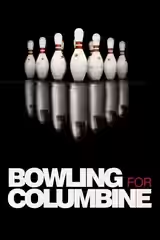
How does Taking Liberties compare to Bowling for Columbine?
Taking Liberties is the gentler, more British and less self-satisfied film, and Chris Atkins stays off camera where Michael Moore never would. Bowling for Columbine is the funnier and more furious of the two, and the more horrifying when it stops talking, though its stunts have aged badly. Pick Moore for force and Atkins for restraint; neither one tests the other side's case.
What should I watch after Taking Liberties?
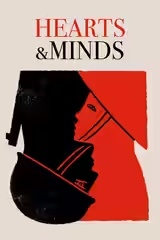
After Taking Liberties, try Bowling for Columbine (2002, Fi1m 72): The template Atkins is working from, with the same cartoons and far more Moore. Then Citizenfour (2014, Fi1m 83): What the surveillance passages here were warning about, filmed in a Hong Kong hotel room; and Hearts and Minds (1974, Fi1m 82): The anti-war documentary that showed how much archive can say when nobody narrates over it.

Cast

If you liked this, try…

  1. Bowling for Columbine (2002, Fi1m 72)The template Atkins is working from, with the same cartoons and far more Moore.

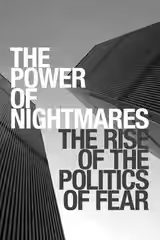
  2. The Power of Nightmares (2004) · not on Fi1m yetAdam Curtis on the politics of fear, slower, stranger and with no jokes at all.

  3. Citizenfour (2014, Fi1m 83)What the surveillance passages here were warning about, filmed in a Hong Kong hotel room.

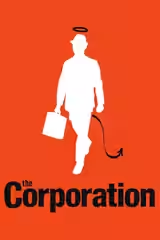
  4. The Corporation (2003) · not on Fi1m yetCanadian polemic that takes its time and lets its opponents hang themselves.

  5. Hearts and Minds (1974, Fi1m 82)The anti-war documentary that showed how much archive can say when nobody narrates over it.