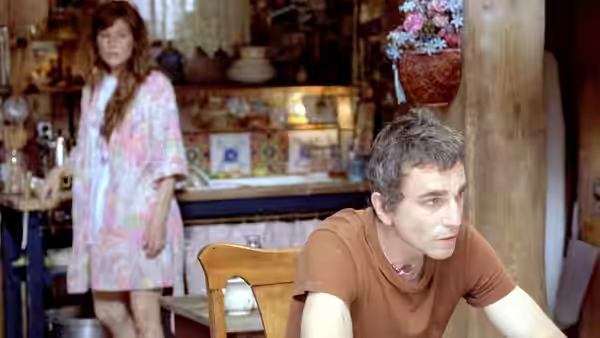
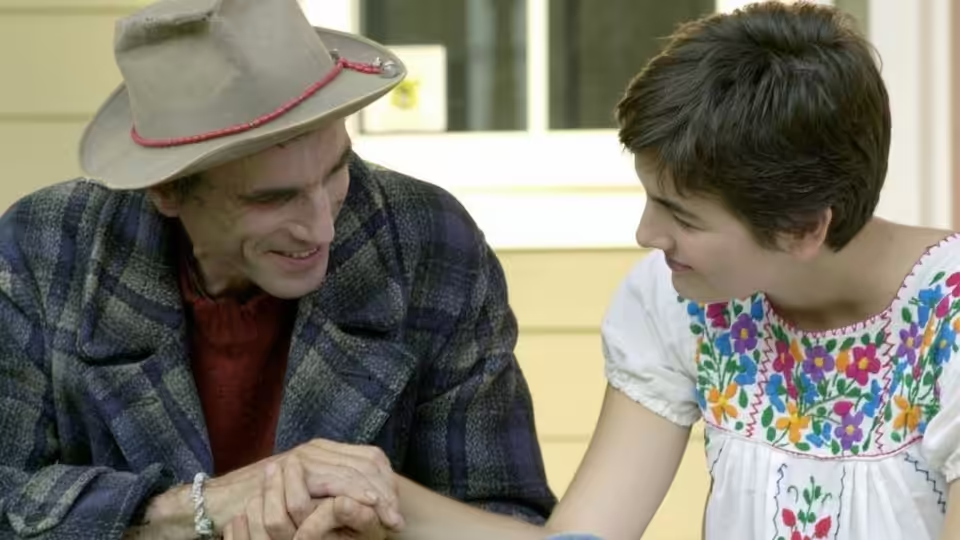
Jack Slavin (Daniel Day-Lewis) and Rose Slavin (Camilla Belle) lean together outside a house
Film review

The Ballad of Jack and Rose

2005 · Directed by Rebecca Miller · 1h 51m · MPA R

In a sentenceDaniel Day-Lewis, a dying idealist, a teenage daughter and more symbolism than the island can hold

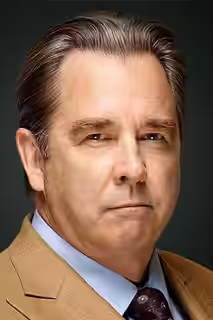
It is 1986. Jack Slavin (Daniel Day-Lewis) founded a commune on an island off the American east coast, and he is the last grown-up left on it, living in the old farmhouse with his sixteen-year-old daughter Rose (Camilla Belle). His heart is failing and his doctor has told him so. Across the wetland, the developer Marty Rance (Beau Bridges) is putting up a row of new houses, and Jack takes a shotgun to them. Worried about what Rose will do once he is gone, he invites his girlfriend Kathleen (Catherine Keener) over from the mainland to move in, bringing her two sons, the gentle Rodney (Ryan McDonald) and the sullen Thaddius (Paul Dano). Rose, who has never had to share her father with anyone, does not take it well.

Fi1m review

Rebecca Miller has a fine subject, a father whose principles have become his property, and the right actor to play him. The film around Daniel Day-Lewis is well shot and well meant, and it cannot stop explaining itself. For the performances, with patience.

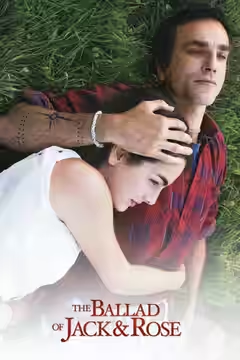
Rebecca Miller writes and directs a 111-minute drama about the last man standing in a commune and the daughter he has raised inside it. Jack Slavin (Daniel Day-Lewis) once believed that a few people on an island could live rightly, and the island now holds him, Rose (Camilla Belle), a wind turbine and a lot of weather. He is dying, and he knows that when he goes she will be alone with his ideas. The tagline on the poster reads “Selfhood begins with a walking away, and love is proved in the letting go”, which is the whole film in one line, and the trouble is that the film keeps saying it.

Day-Lewis is the reason to watch. He plays Jack as a man who has confused his principles with his acreage: courteous to his daughter, savage to anyone with a surveyor’s pole, and quietly aware that the two moods come from the same place. His rage at Marty Rance (Beau Bridges) and the half-built houses is funny and then frightening, because you can see he has nothing left to fight with but temper. Belle has the harder, stiller job and does it with her eyes. We were unsettled, properly, by how she looks at him; it is not quite a daughter’s look, the film knows it, and for a long stretch that knowledge gives the house a charge nothing else here has.

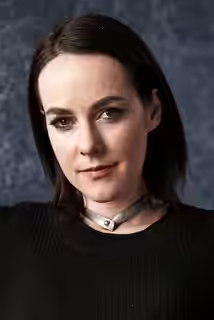
Catherine Keener gets the worst of the writing and does the most with it. Her Kathleen is a woman who has run out of better offers and knows how that sounds, and Keener plays the embarrassment rather than the hope. Paul Dano lounges through Thaddius with a grin that is already looking for the exit, and Ryan McDonald makes Rodney, the soft boy who wants to cut hair, the one person on the island you would trust with scissors. Jena Malone and Jason Lee arrive with parts that are more idea than person and leave the same way.

Ellen Kuras shoots the place in soft, damp light, the grass close enough to count and the farmhouse weathered to grey, and she keeps the camera on shoulders rather than tripods so the house feels lived in and slightly tilted. Mark Ricker has built the commune as a thing already half returned to the ground: the greenhouse, the turbine, the empty cabins of people who left years ago. Michael Rohatyn’s score is sparse and stays out of the quarrels. Sabine Hoffmann cuts the early scenes with patience, holding on faces after the lines are finished, which suits a film about people who do not say what they want.

Then Miller starts underlining. Every object in the second half stands for something, and the film makes sure we have noticed, in ways we will not detail here. Characters begin to speak their themes aloud, and Jack’s speeches about what the island meant turn from character into lecture. The melodrama arrives on schedule, and there is a closing passage that spells out in dialogue what the preceding hour had already shown. We found that passage embarrassing, and we say so as people who had been on the film’s side until then.

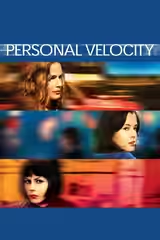
Miller’s previous film, Personal Velocity (2002), was three short stories about women, made cheaply and quickly, and it was good at leaving things alone. This one has a bigger star, a bigger house and less confidence that we will understand without help. She is married to Day-Lewis, which is a matter of record and not of much relevance, except that the film trusts him as it trusts no one else on screen, and that trust is well placed.

Most critics landed around the middle and so have we. If you want to watch Day-Lewis build a man out of a beard, an accent and a shotgun, there is enough here for an evening. If you want the film to let him be, you will spend the last half hour wishing it would.
Critical consensus AI synthesised

49
Positive
0
Mixed
5
Negative
5

Nobody comes out firmly in favour. The reviews split evenly between mixed and negative, and the praise lands almost entirely in one place: the acting. Daniel Day-Lewis is singled out again and again for a naturalistic, charismatic performance, with Camilla Belle and Catherine Keener also admired, and several critics credit Rebecca Miller with complex, carefully drawn characters and some well-made individual scenes.

The complaints are just as consistent. Most critics find the symbolism clumsy and the storytelling precious, tipping from poignancy into melodrama; others add that it runs long, that its psychology is thin, and that the coda is weak. The spread is wide, from middling three-star notices to Eye for Film, which calls the film awful despite its good looks and its cast. One small quarrel over Keener: The Guardian finds her role underwritten, while Variety counts her among the film’s clear assets.

RogerEbert.com
64*

The page is blocked by a browser check, so the critic’s verdict cannot be verified. No specific praise or complaint is visible in the available content.

Read the full review →
Screen Daily
3 March 2005 · Beth Pinsker
64*

The page identifies this as a review of the film, but the review text is unavailable. Its verdict and any specific praise or complaint cannot be determined from the visible content.

Read the full review →
The New York Times
25 March 2005 · A. O. Scott
64*

The available page does not expose the critic’s verdict. Its specific praise or criticism cannot be verified from the accessible text.

Read the full review →
Slant Magazine
8 March 2005 · ★★½/4 · Nick Schager
62

Schager finds the film’s idealism insightful but its dreamy, precious storytelling frustrating. He singles out Daniel Day-Lewis’s naturalistic performance for praise and criticizes Miller’s clunky symbolism.

Read the full review →
Total Film
31 March 2006 · ★★★ · Total Film
60

The review finds the film engrossing but patchy, ultimately more pretentious than poignant. It praises the complex characterisation and strong performances, especially Daniel Day-Lewis and the young cast, while faulting trite metaphors and melodrama.

Read the full review →
Empire
31 March 2006 · Anna Smith
40*

Smith finds the drama atmospheric but ultimately undermined by clumsy symbolism, indulgent length, and a weak coda. She praises the characters and singles out the performances of Daniel Day-Lewis and the supporting cast.

Read the full review →

Straight answers AI written, from our review

Is The Ballad of Jack and Rose worth watching?
The Ballad of Jack and Rose is worth watching for Daniel Day-Lewis and not much else, and we scored it 54. He plays a dying commune founder with real force, and Camilla Belle holds her own as the daughter, but Rebecca Miller's script spends its second half explaining what the first had already shown. For the performances, with patience.
How long is The Ballad of Jack and Rose, and what is it rated?
The Ballad of Jack and Rose runs 1h 51m and is rated R by the MPA in the US. It is a drama film.
Where can I watch The Ballad of Jack and Rose in the US?
The Ballad of Jack and Rose is streaming on AMC+, Amazon Prime Video, The Roku Channel and Apple TV in the US, and it is also available to rent from Apple TV from $3.99. Availability is checked daily; the links above go straight to each service.
How violent or frightening is The Ballad of Jack and Rose, and is it suitable for children?
The Ballad of Jack and Rose carries a UK 15 certificate and is not for children. Jack fires a shotgun at a developer's half-built houses, and the film's charge comes from an uneasy, not quite daughterly way Rose looks at her father, which the film knows about and leans on. It is adult in mood rather than frightening; the squeamish have little to fear.
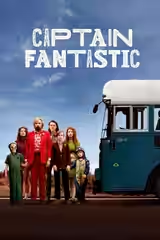
How does The Ballad of Jack and Rose compare to Captain Fantastic?
The Ballad of Jack and Rose and Captain Fantastic both follow a father who raised his children outside the world and meets its wall, and Captain Fantastic is the better evening. Both films trust their lead actor more than anyone else on screen, but Matt Ross keeps the family warm and funny for longer, where Miller turns her island into a lecture. Choose Day-Lewis for the harder, stranger performance; choose Mortensen for the more enjoyable film.
What should I watch after The Ballad of Jack and Rose?
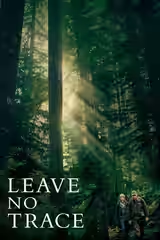
After The Ballad of Jack and Rose, try Captain Fantastic (2016, Fi1m 63): Viggo Mortensen raises six children in the woods and meets the same wall of the world. Then Leave No Trace (2018, Fi1m 88): A father and daughter in the forest, told with the restraint Miller’s film lacks.

Cast

If you liked this, try…

  1. Captain Fantastic (2016, Fi1m 63)Viggo Mortensen raises six children in the woods and meets the same wall of the world.

  2. Leave No Trace (2018, Fi1m 88)A father and daughter in the forest, told with the restraint Miller’s film lacks.

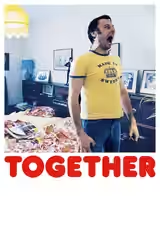
  3. Together (2000) · not reviewed yetLukas Moodysson’s Stockholm commune, 1975, warmer, funnier and just as unsparing.

  4. The Mosquito Coast (1986) · not reviewed yetHarrison Ford drags his family into paradise and refuses to notice it is not.

  5. Personal Velocity (2002) · not reviewed yetMiller’s earlier film, three women, small scale, and far better at leaving things unsaid.