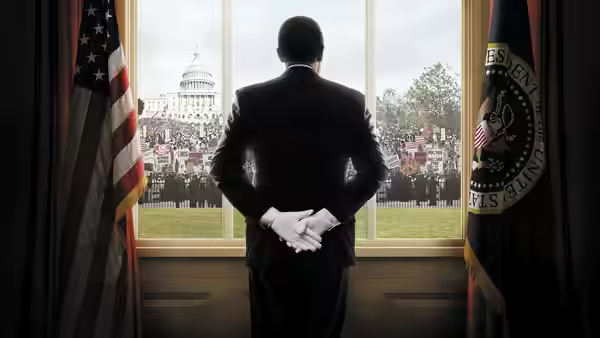
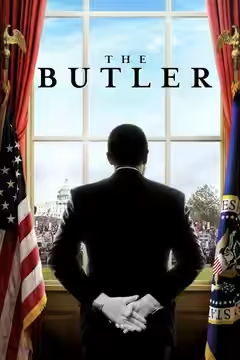
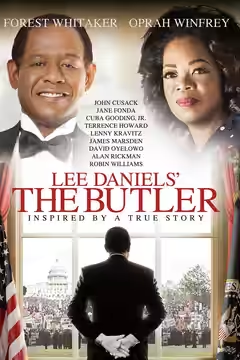
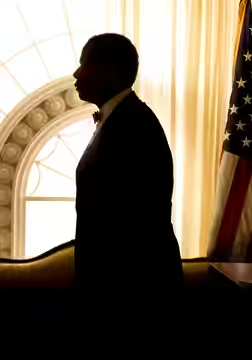
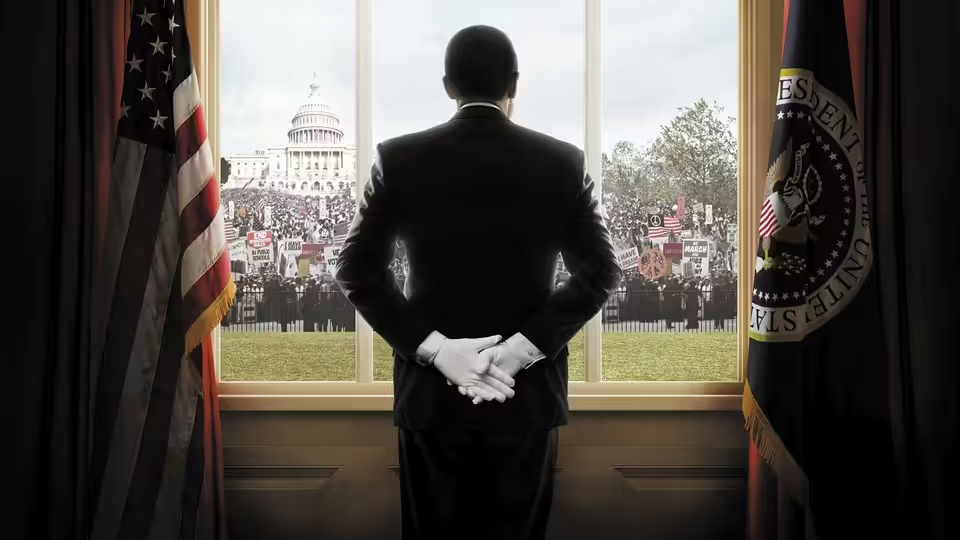
Cecil Gaines (Forest Whitaker) stands at a White House window overlooking a crowd and the Capitol
Film review

The Butler

2013 · Directed by Lee Daniels · 2h 12m

In a sentenceThe presidents keep interrupting a family drama we would rather be watching

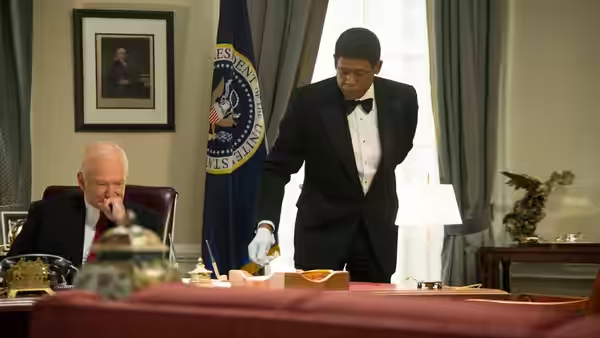
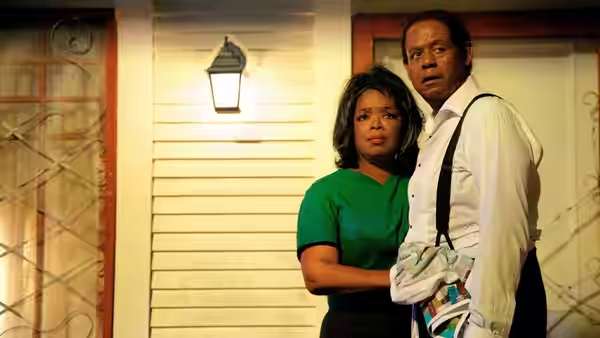
Cecil Gaines (Forest Whitaker) works as a butler in the White House, where his duties put him close to the people governing the country. Away from work are Gloria Gaines (Oprah Winfrey) and his son, Louis Gaines (David Oyelowo), whose civil-rights activism challenges Cecil’s belief in quiet, dignified service. Cecil wants to do his job properly, but the restraint it demands becomes a source of friction at home. Preparing a table for the powerful and arguing with Louis belong to the same daily life, as the family confronts competing ideas about how change can come.

Fi1m review

Forest Whitaker and Oprah Winfrey make The Butler affecting despite its crowded, insistent script. Lee Daniels’s historical drama is worth considering for the performances, with patience required for the famous faces and the repeated explanations.

Lee Daniels tries to tell a family’s story alongside a broad account of civil-rights history, and The Butler struggles to give both enough time. There is enough here to make it worth considering, chiefly in the performances, but Danny Strong’s screenplay keeps hurrying towards another public event. Cecil Gaines’s work in the White House gives the story a useful way to look at power. It also creates a temptation to make every encounter important.

Forest Whitaker makes Cecil’s restraint interesting because it looks like something he has learnt and continues to practise. The politeness takes effort; we can sense the judgement being held back. His performance allows Cecil pride in doing a job properly without pretending that the job puts him on equal terms with those he serves. When the writing becomes pushy, he remains measured, and the film depends heavily on that difference.

Oprah Winfrey gives Gloria Gaines the energy that Cecil keeps under control, and their shared scenes suggest people accustomed to one another. The family scenes give her room to be more than an audience for Cecil. David Oyelowo makes Louis Gaines’s activism feel like a serious choice, so the father-son disagreement has more substance than a dutiful argument between generations. We can understand why Louis is impatient without dismissing the experience behind Cecil’s caution.

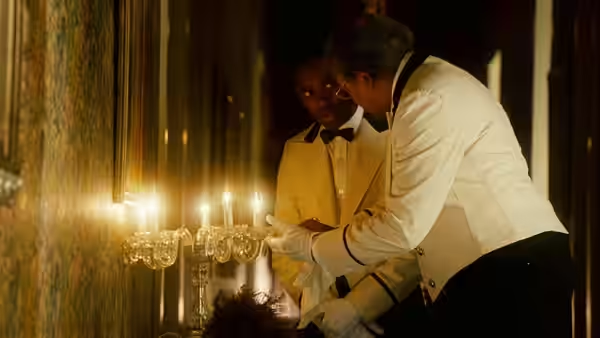
Joe Klotz’s editing finds a persuasive way to connect their experiences, moving between Cecil preparing a White House table and a civil-rights sit-in. We were moved by that sequence, because the ordinary business of being served makes the inequality painfully clear. The connection needs no accompanying lecture. It is also more thoughtful than the dialogue that repeatedly spells out the disagreement between Cecil and Louis.

Danny Strong’s script is less trusting. Too often a scene arrives with its lesson already prepared, leaving the actors to make an argument sound like a conversation. At 132 minutes, the film still feels hurried when it moves through public history, because so much has to be acknowledged. A historical family drama needs time for an argument to affect ordinary life; this one too often needs to get to the next event.

Andrew Dunn’s cinematography gives the White House scenes a formal polish that suits Cecil’s professional manner. Tim Galvin’s production design makes the setting convincing as a workplace, particularly when a table needs preparing. That polish can also make the film feel too comfortable when it ought to be troubling us. Rodrigo Leão’s music adds to the pressure to feel, sometimes where the actors have already done enough.

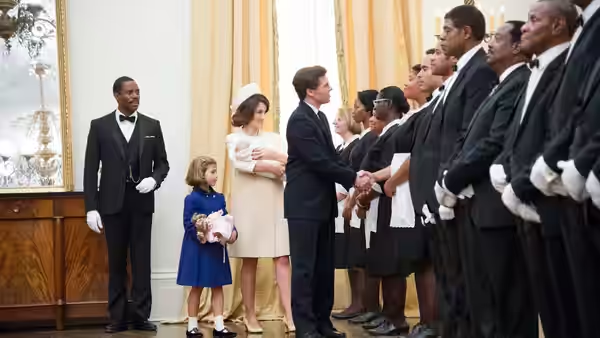
The casting of the political figures brings a separate distraction. John Cusack as Richard Nixon and Jane Fonda as Nancy Reagan invite recognition before there is much chance to consider the people being portrayed. These appearances make the passage through history feel more like a succession of appointments. Beside the patient work of Forest Whitaker, they are liable to seem like interruptions.

Those drawn to the conflict between Cecil and Louis will find enough here to justify the uneven stretches. We would be more cautious with anyone hoping for a patient account of political change. Watch it for the family, and allow for some blunt explanations along the way.

Critical consensus AI synthesised

63
Positive
9
Mixed
11
Negative
3
Slant Magazine
11 August 2013 · ★★★½/4 · Chris Cabin
88

Cabin finds the film familiar in its broad story but formally radical and emotionally urgent. He especially praises Lee Daniels’s visceral staging of the civil-rights violence and Oprah Winfrey’s electrifying performance.

Read the full review →
IndieWire
9 August 2013 · B · Eric Kohn
77

Kohn finds the film a thoughtful, emotionally grounded period drama despite its sentimentality and occasional camp. He praises the contrast between Cecil’s quiet White House service and his son’s activism, along with Forest Whitaker’s understated performance.

Read the full review →
The New Yorker
23 August 2013 · Richard Brody
75*

Brody finds the film stirring and politically resonant, though one filmmaking choice jolted him. He praises its attention to the dignity of ordinary work and highlights the power of its visual details.

Read the full review →
Evening Standard
15 November 2013 · The Standard
70*

The review finds the film sentimental and uneven but ultimately compelling, with its myths about American freedom sharply challenged. It especially praises Forest Whitaker’s restrained, affecting performance as Cecil Gaines.

Read the full review →
The AV Club
15 August 2013 · B- · Ben Kenigsberg
70

Kenigsberg finds the film sentimental and reductive, yet ultimately satisfying. He praises the powerful interlude crosscutting a sit-in with the butler setting the White House table.

Read the full review →
The Hollywood Reporter
9 August 2013 · Todd McCarthy
70*

McCarthy finds the film emotionally effective and often engaging despite its schematic storytelling and middle-of-the-road approach. He especially praises Forest Whitaker’s finely tuned, ultimately stirring performance.

Read the full review →

Straight answers AI written, from our review

Is The Butler worth watching?
The Butler is worth considering for its performances, especially if family drama interests you more than a patient account of political change; we scored it 66. Forest Whitaker and Oprah Winfrey make the home life affecting, but the crowded script, repeated explanations and distracting presidential casting require patience.
How long is The Butler, and what is it rated?
The Butler runs 2h 12m. It is a drama film.
Where can I watch The Butler in the UAE?
The Butler is not on any streaming or rental service in the UAE at the moment. It is available in 23 other countries; change your country at the top of the page to see where. Availability is checked daily.
How violent or frightening is The Butler, and is it suitable for children?
The Butler carries a UK 12A certificate, so children under 12 need an accompanying adult at the cinema, and suitability calls for parental judgement. Its civil-rights themes and serious father-son conflict make it a more natural choice for interested teenagers than younger children; the certificate alone cannot tell us how frightening individual scenes may feel.
How does The Butler compare to The Official Story?
The Butler is broader and more insistent than The Official Story, which we recommend as the more patient, affecting treatment of political history pressing into family life. Whitaker and Winfrey give The Butler its strongest reason to watch, while Norma Aleandro carries The Official Story through a plainly told drama with less room for comforting explanations.
What should I watch after The Butler?
After The Butler, try The Official Story (1985, Fi1m 81): Political history presses into family life, with less room for comforting explanations. Then Small Axe (2020, Fi1m 88): For more patient attention to Black lives under pressure from British institutions.

Cast

If you liked this, try…

  1. A Raisin in the Sun (1961) · not on Fi1m yetAnother family argues over dignity, money and what progress should mean.

  2. The Official Story (1985, Fi1m 81)Political history presses into family life, with less room for comforting explanations.

  3. A Dry White Season (1989) · not on Fi1m yetFor the anger at institutional racism, with fewer reassuring pauses.

  4. Small Axe (2020, Fi1m 88)For more patient attention to Black lives under pressure from British institutions.

  5. Still Walking (2008) · not on Fi1m yetStay with the family tensions, while leaving the presidential appearances behind.