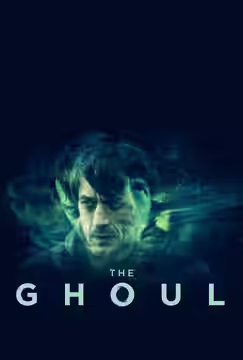
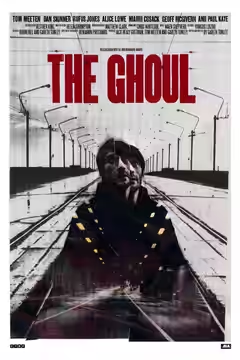
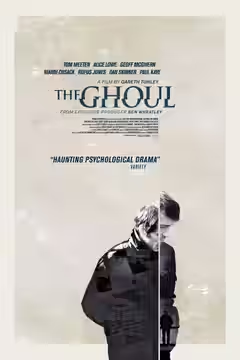
Gareth Tunley’s first film sends a detective into therapy to crack a case and keeps us guessing which of the two is the cover story. Tom Meeten and Paul Kaye are reasons to see it; the last twenty minutes are the reason to hesitate.
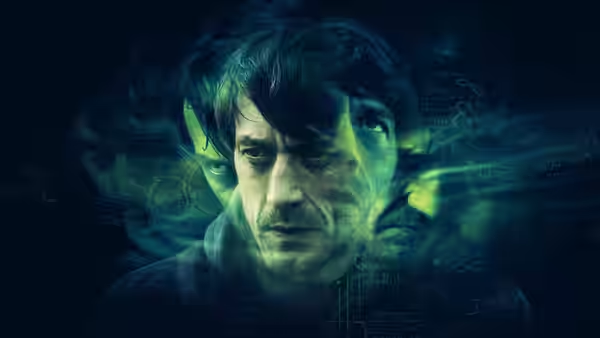
Gareth Tunley’s first film as writer and director opens on a double murder in a London house and is not, in the end, much interested in who did it. Chris (Tom Meeten), the detective brought in by his friend Jim (Daniel Renton Skinner), decides the way to the suspect is through the suspect’s therapist, and books himself in as a patient. From the first session the film starts asking its real question: is this a detective pretending to be depressed, or a depressed man pretending to be a detective? The Ghoul is small, grey and well acted, and for an hour it holds that question open with real skill. Then it has to decide how much to tell us, and it does not quite decide.
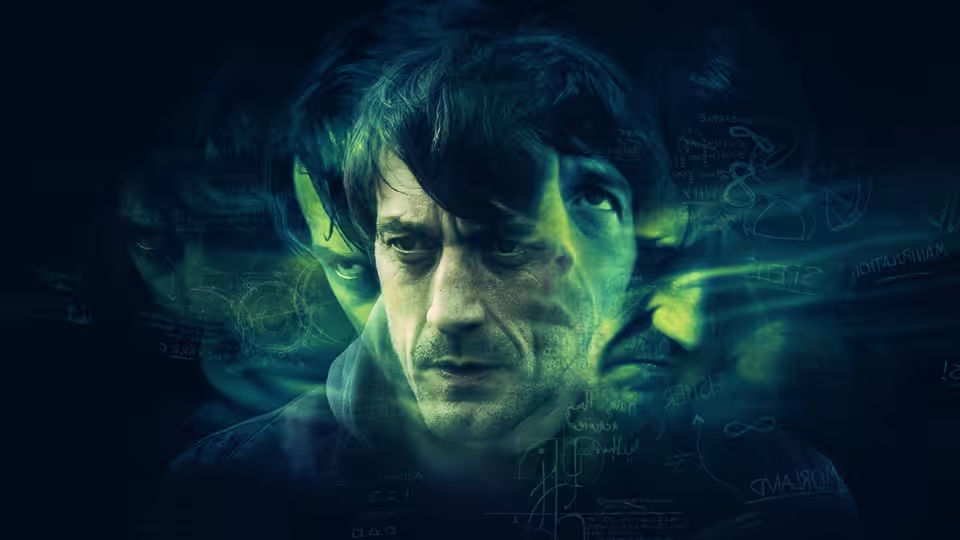
Meeten carries nearly every scene and does it by taking things away. He plays Chris with his shoulders up and his eyes down, a man who answers questions a beat late, and he never signals which version of Chris we are watching. In the police scenes he is a tired, competent professional. In Fisher’s chair he is a man who cannot account for his week. The acting does not change between the two, and that is the trick. It is a performance that would go unnoticed in a bigger film and is the whole point of this one.
Benjamin Pritchard shoots London as a city of back streets, stairwells and bedsits, with almost nothing in frame a visitor would recognise. Much of it is at night, lit by whatever streetlamp or kitchen bulb was already there, and the daylight scenes are overcast to the point of having no colour at all. Matthew Clark’s production design keeps the rooms bare and slightly wrong: Chris’s flat has a mattress and not much else, and Morland’s home is a mess of books, charts and symbols drawn on paper and pinned to the walls. Waen Shepherd, who also appears as Gav, writes a score of low electronic hums that sits under the scenes rather than on top of them, and the film is calmer for it.
The best stretch belongs to Paul Kaye. His Tommy Parnell is another of Fisher’s patients, and in a long night-time scene he talks Chris through a theory of loops and one-sided strips, of things that look like progress and are really a return, and he does it without once raising his voice. We did not move for the length of it. Kaye plays it so quietly that you lean towards the screen, and the speech tells you how the film is built while pretending to be the rambling of a man who has been awake too long. Niamh Cusack’s Fisher is just as good in the opposite key, patient and kind and watching Chris closely enough to be frightening. Alice Lowe gives Kathleen a warmth nobody else in the film has, and her few scenes with Meeten are the only ones in which Chris looks like someone who was once happy.
What does not work is the last act. Once the film has established that both versions of Chris are available to it, the procedural side thins out: the murder house, Jim and the case itself drift away, and the film does not miss them, though we did. Morland’s turn towards the occult tips things towards horror without ever arriving there. By the final twenty minutes we were frustrated, and not in the way the film wanted. We had stopped wondering what was real and started wondering whether Tunley had made up his mind. The last scene we will not describe. It answers the question the film asks; it does not satisfy it.
Critics have been split on it, roughly down the middle, and the split is almost entirely about that ending. We can see both sides. A first film that trusts its audience this much is rare, and British thrillers this spare are rarer still. It belongs with Kill List (2011) in the short run of British films that begin as crime and end somewhere harder to name. The difference is that Kill List kept its plot moving while it changed shape, and The Ghoul stops its plot to think.
See it for Meeten, for Kaye’s monologue, and for a London that films do not usually bother with, and see it with the lights down and the phone put away. It runs 81 minutes and carries a 15. The argument afterwards about which Chris was the real one will not be settled by watching it a second time. We tried.