George Amponsah’s documentary about two friends of Mark Duggan is patient, humane and openly on their side. It leaves the police case almost entirely off screen, which is a fault, but the portrait of two men getting on with it is worth an evening.
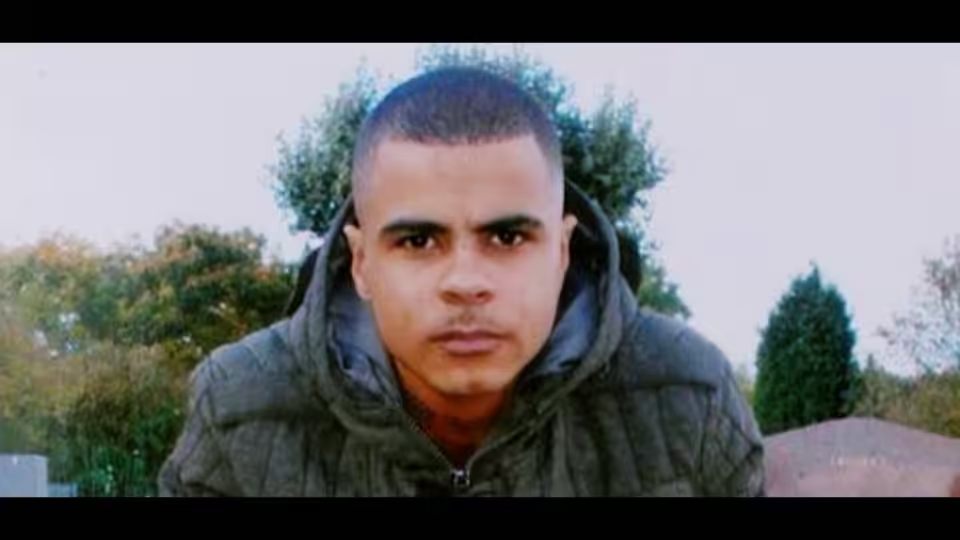
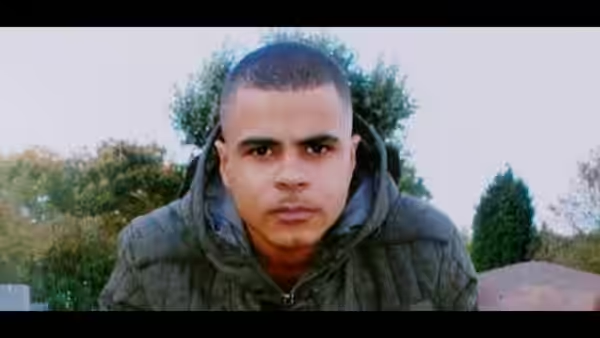
Mark Duggan was shot dead by police in Tottenham on 4 August 2011, and the riots that began outside the local police station two days later spread across England. George Amponsah’s documentary is not an investigation of the shooting. It is about two of Duggan’s friends, Marcus Knox Hooke and Kurtis Henville, and what their lives look like in the years after. The title is police jargon for forcing a moving car to halt, which is what happened to the minicab Duggan was in. The film takes the men’s side from the first frame and does not pretend otherwise. We think it is worth your evening, with that understood.
Marcus is awaiting sentence for his part in the night the riots began. Kurtis has children to feed and no job, and much of his screen time is spent looking for one. Both grew up on Broadwater Farm, and both knew Duggan from childhood. Amponsah’s method is to follow them, in cars, kitchens and corridors, and let them talk, and the writing he and Dionne Walker have done is mostly a matter of knowing when not to interrupt.
Matthias Pilz and Colin Elves shoot the estate mostly at night and mostly from the men’s height, so the blocks loom and the walkways run off into orange light. In daylight they keep the camera close and still, and let Kurtis fill the frame while he waits for a phone to ring. Michael Aaglund and James Delvin cut the present against the archive: the burning cars of 1985, when Broadwater Farm last went up and a police officer died, and the burning cars of 2011, placed side by side so the eye has to work to tell the decades apart. It is the film’s one piece of showing-off and it earns its place. Roger Goula Sarda’s score is sparse and low, strings under the talking, and it knows when to stop.
Here is what got at us. Not the archive, which we had seen, and not the footage of the night, which anyone in Britain had seen. It was Kurtis on the phone to employers, polite and well spoken and getting nowhere, and then putting the phone down and being cheerful for the camera. We found that harder to watch than anything with a siren in it, and we were a little ashamed that it took a man being pleasant to a switchboard to make us feel what the headlines had not.
The film’s flaw is the one it has chosen. The police are present only as archive and as the inquest; nobody from the Metropolitan Police speaks, and Amponsah does not set out the account of why officers stopped that car in the first place, or weigh it. Most critics have forgiven this. One has not, and we are with the one on this point, though not on the verdict. A film that wants us to doubt a shooting should put the official story on screen and take it apart, and this one mostly declines to. We also noticed how few women speak, in a film about an estate full of them.
What it does instead is rarer. Most documentaries about a death like this argue a case. This one sits with two men for 86 minutes and lets them be funny, evasive, tired and kind, when a caption or a mugshot would have done for most news desks. Marcus talks about the night he went to the police station with the care of someone who knows he will be quoted. Kurtis talks about Duggan as a friend who was good with his kids. Neither is asked to be a symbol, and neither volunteers.
It carries a 15 certificate and it ends at the inquest in January 2014. What the jury decided is a matter of record and we will not repeat it here; what Marcus and Kurtis do with the news is the film’s last and best stretch. Watch it at home, where the silences between the two men are easier to sit inside and the archive looks less like news.