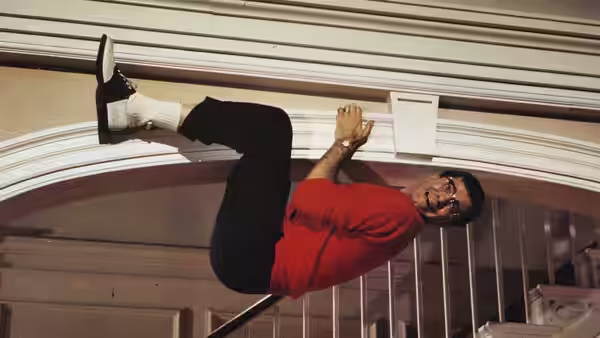
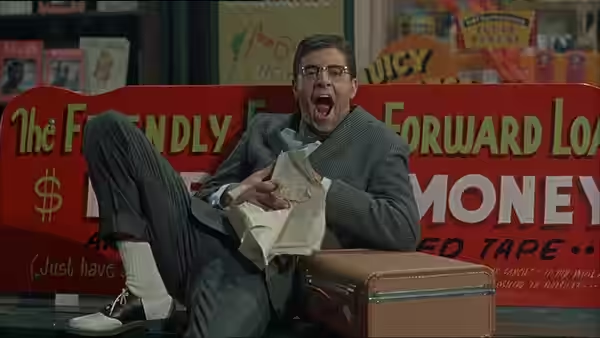
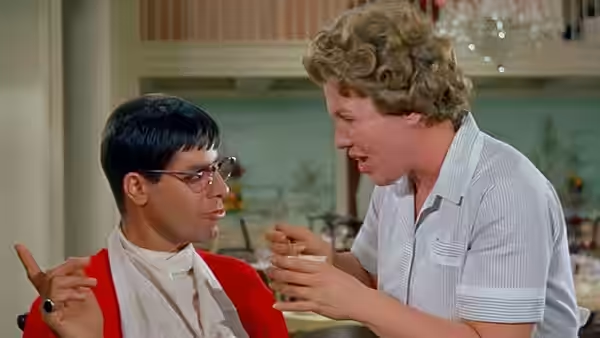
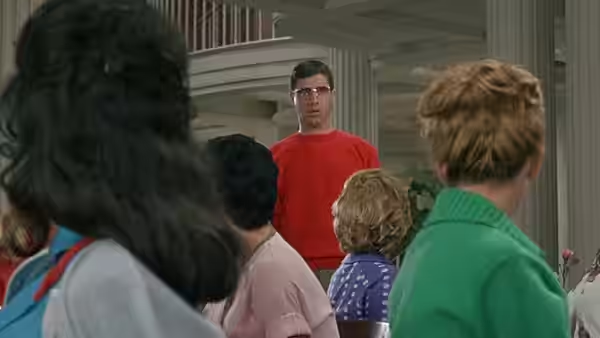
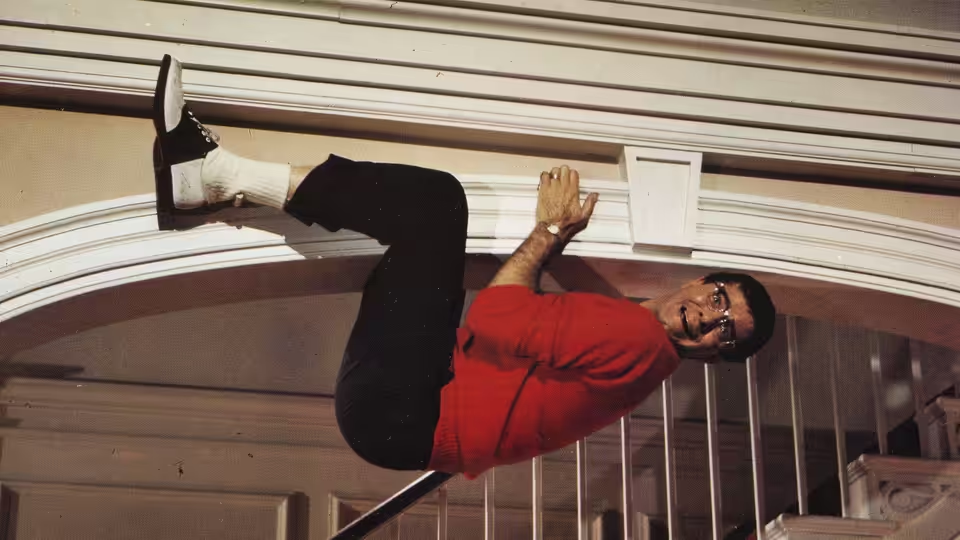
Herbert H. Heebert (Jerry Lewis) clings sideways to a wall in a red shirt
Film review

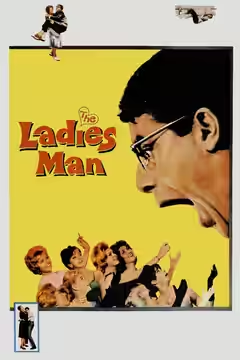
The Ladies Man

1961 · Directed by Jerry Lewis · 1h 35m

In a sentenceJerry Lewis builds the biggest dolls’ house in Hollywood and then cannot decide what to do in half its rooms

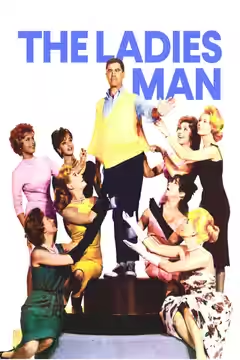
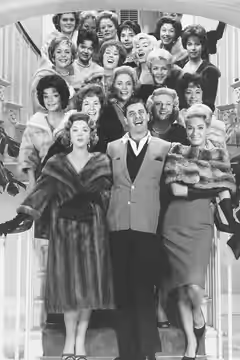
Hollywood. Herbert H. Heebert (Jerry Lewis), son of Mama Heebert (also Lewis), lands in an enormous split-level boarding house belonging to Miss Helen N. Wellenmellon (Helen Traubel). Katie (Kathleen Freeman) and Fay (Pat Stanley) are part of the household, and so is a resident billed only as Miss Anxious (Hope Holiday). Herbert is a young man whose trouble is women, and the house is full of them. Through its doors come George Raft and Jack LaLanne as themselves, Harry James with his trumpet, Buddy Lester as Willard C. Gainsborough, and Westbrook Van Voorhis as a television man from Person to Person. Nearly all of the film’s 95 minutes are spent inside the house.

Plays from YouTube when you press play; nothing loads from them until then.

Fi1m review

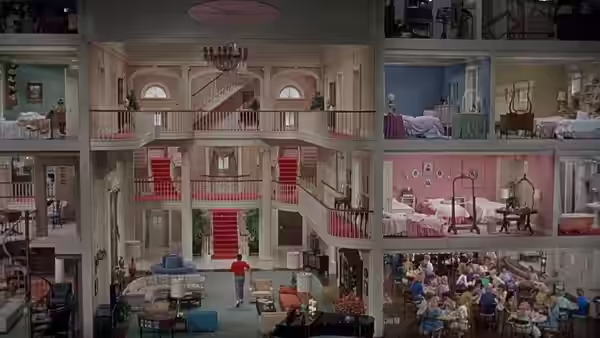
Jerry Lewis’s second film as director hangs a string of sketches on a boarding house built without its front wall, and the house is the star. At its best there is nothing else like it in American comedy; at its worst it is a man falling over.

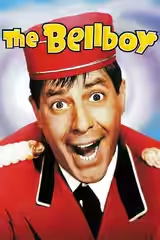
Jerry Lewis’s first film as director, The Bellboy in 1960, had no plot at all, and he seems to have taken the complaints to heart. The Ladies Man has one, or the outline of one. Herbert H. Heebert, jilted on the day he graduates, gives up women and takes a job as houseboy in a Hollywood house that turns out to be lodgings for several dozen of them. Lewis and his co-writer Bill Richmond (the credits also list Mel Brooks) use that as a peg to hang sketches on. About half the sketches work. The house works all the way through, and the house is why you should see it.

It is a boarding house built on a soundstage with its front wall left off, so that the camera can pull back and look into every room at once, the way a child looks into a dolls’ house. W. Wallace Kelley lights it flat and bright, in the pinks and creams of a sweet shop, with no shadows for anyone to hide in. Early on there is a morning sequence in which every door opens together and the residents go about their routines to Walter Scharf’s music, while the camera drifts up and across the storeys taking it all in. We sat forward and grinned, and we do not grin easily at slapstick from 1961. Nothing else in American comedy of the period looks like it, and Lewis knew it.

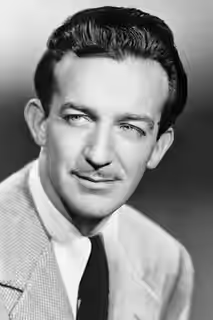
The best material comes from the house too. George Raft turns up as himself and Herbert refuses to believe it, so Raft has to prove it, and the proof is a dance the two men do together that we are still not sure how to describe. Buddy Lester plays Willard C. Gainsborough, a hard man whose hat Herbert ruins in stages, and Lester’s slow burn is the funniest sustained thing in the film. And there is a room nobody is allowed into, entirely white, in which a woman in black is waiting and Harry James and his band appear from nowhere; Edith Head dresses the sequence so that the only dark thing in it is the one thing Herbert should not touch. It is the closest the film gets to a musical number without anyone singing.

The rest is patchier. Lewis the performer does not trust Lewis the director, and whenever a scene is not built around the set he falls back on the face, the whine and the walk into the wall, and these were tired by 1961. Each sketch stops dead before the next begins, and Stanley E. Johnson’s editing cannot smooth the joins because Lewis has not written any. A television crew arrives to broadcast from the house, with Westbrook Van Voorhis fronting it, and the sequence runs on well past its last joke. Jack LaLanne leads an exercise class that is one idea repeated. At 95 minutes the film is not long, and we were still looking at the clock around the seventy-minute mark.

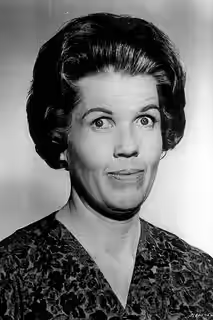
The women in the house are furniture, which is a problem in a film about women. Helen Traubel, as Miss Helen N. Wellenmellon, is a good sport and gets to sing, and Kathleen Freeman, as the housekeeper Katie, is dry and exact in the way she always was. Pat Stanley’s Fay is meant to be the one who reaches Herbert, and the script gives her about four lines to do it with. Hope Holiday is billed as Miss Anxious, which tells you how much characterisation the rest received.

Set against Lewis’s own work, it is more ambitious than The Bellboy and less finished than The Nutty Professor, which came two years later and had a story that could carry its ideas. Most critics rate it around where we do. A few place it near the top of his films, and we understand why, because when the camera is moving through that house it is easy to forgive everything. The trouble is that the camera keeps stopping so that Herbert can knock something over.

Watch it for the house, and when a sketch dies on you, which it will, look past Herbert at the rooms behind him. There is always something going on in one of them.

Critical consensus AI synthesised

74
Positive
4
Mixed
1
Negative
1

Most critics like The Ladies Man, and the praise clusters in one place: the set. Nearly every review notices the enormous split-level boarding-house interior Lewis built in Hollywood and treats it as the film’s real subject. Slant reads the space as an extension of Herbert’s psychological entrapment; The New Yorker sees Lewis’s choreography of the house as a comic picture of desire looking for a place in society. Time Out ranks it among Lewis’s best.

The reservations are about the comedy rather than the design. Variety, reviewing on release, finds the slapstick uneven, with more misses than laughs, while still admiring the set. The AV Club offers a milder version of the same thought, noting that the setpieces here are fitted into a plot. The spread is wide, from celebration to a shrug, and one review cannot be read closely enough to place. The consensus is that the building is the star; the argument is over whether Lewis is funny inside it.

Slant Magazine
13 October 2004 · ★★★★/4 · Eric Henderson
100

Henderson calls the film wild and exuberant, and sees it as Lewis’s definitive portrait of thwarted sexuality. He praises the enormous artificial boarding-house set for making its space an extension of Herbert’s psychological entrapment.

Read the full review →
Time Out
· DT
90*

Time Out regards the film as one of Jerry Lewis’s greatest. It singles out the striking split-level Hollywood interior, which nearly overwhelms Lewis as star.

Read the full review →
The New Yorker
26 October 2010 · Richard Brody
80*

Brody presents the film as a comic vision of desire seeking a place in society. He praises Lewis’s choreography of the boarding house as a whimsical, socially resonant spectacle.

Read the full review →
The AV Club
25 October 2004 · Keith Phipps
70*

Phipps praises Lewis’s early films as energetic, inventive comedies that support the auteurist case for his talent. He singles out the carefully choreographed comic setpieces, while noting that The Ladies Man applies the same formula within a plot.

Read the full review →
The New York Times
13 October 2000
64*

The review’s verdict cannot be determined from the accessible page. Its praise or criticism cannot be verified because the article text is unavailable.

Read the full review →
Variety
31 December 1960 · Variety Staff
40*

The review finds the film’s slapstick uneven, with more misses than laughs. It praises the elaborate, visually striking set as something to behold.

Read the full review →

Straight answers AI written, from our review

Is The Ladies Man worth watching?
The Ladies Man is worth watching for the house alone, a boarding house built without its front wall so the camera can look into every room at once, and we scored it 72. About half of Jerry Lewis's sketches work and the rest are a man falling over, so it suits anyone curious about what a 1961 comedy could look like more than anyone wanting laughs every minute.
How long is The Ladies Man, and what is it rated?
The Ladies Man runs 1h 35m. It is a comedy film.
Where can I watch The Ladies Man in Ukraine?
The Ladies Man is not on any streaming or rental service in Ukraine at the moment. It is available in 10 other countries; change your country at the top of the page to see where. Availability is checked daily.
How does The Ladies Man compare to Artists and Models?
The Ladies Man is the stranger and more ambitious film, and Artists and Models the noisier and more conventional one. Frank Tashlin gives Lewis and Dean Martin comic-strip colour and Shirley MacLaine but too much room for weak routines; here Lewis directs himself, and the set is more inventive than anything in the earlier film, though his own performance is the tired part. Choose the earlier film for a double act, this one for the building.
What should I watch after The Ladies Man?
After The Ladies Man, try Playtime (1967, Fi1m 88): Tati builds a whole city for one joke about glass and gets away with it. Then Artists and Models (1955, Fi1m 72): Lewis with Dean Martin, in Frank Tashlin’s colours, before he was allowed a crane; and Rear Window (1954, Fi1m 94): The other great film about looking into a building with the wall taken off.

Cast

If you liked this, try…

  1. The Bellboy (1960) · not on Fi1m yetLewis’s first film as director: no plot, no dialogue from him, and better for it.

  2. Playtime (1967, Fi1m 88)Tati builds a whole city for one joke about glass and gets away with it.

  3. Artists and Models (1955, Fi1m 72)Lewis with Dean Martin, in Frank Tashlin’s colours, before he was allowed a crane.

  4. The Party (1968) · not on Fi1m yetAnother house, another man who should not be in it, and Blake Edwards timing the collapse.

  5. Rear Window (1954, Fi1m 94)The other great film about looking into a building with the wall taken off.